SVA Guidelines for pets

“Dear Vaidya Mishra,
It is endlessly wonderful to read your knowledge and apply the SVA lifestyle! I am so grateful! I have a question on your vision of SVA Pets. I have purchased the SVA drops for dogs and make home-cooked food for my dog. Do you offer guidance for diet for pets? Would I be following the same SVA guidelines? Also – I find great comfort and experience incomparable love from my dog. Would you say that hugging our pets provide us with healing Soma as does hugging a tree? I would love to know your thoughts!

With love and gratitude, Maria J.”

1382

Vaidya replies:
“Dear Maria:
Vegetarian and non-vegetarian pets should be always fed homemade food. It is best not to feed them canned or pre-packaged food. However, if you do want to keep your pet on the SVA diet, make note that ghee is not good for dogs. It is too heavy for their digestive tract to handle. But you can instead cook their meals with some little olive oil or grape-seed oil. I recommend that your pet’s food be mainly boiled or steamed, not fried or sautéed with spices, etc.
For example: a well cooked meal of rice with lentils; or for breakfast organic milk with some overcooked oatmeal. Remember to always cook fresh food for them, particularly with non-vegetarian pets, because any processed proteins will, in the long run, result in the production of auto-immune toxins. Processed protein is a source of “amavisha” – highly acidic toxins.

1381
My Kookie, a mixed Pomeranian dog, used to love squashes, and paneer, with rice. She refused to eat anything pre-packaged and canned. She refused to eat dog food even when it was offered to her. Your pets will develop good habits, just like humans do, with time.
In addition to diet, you can give your pets some Transdermal TLC! For example, you can apply Ashoka on their paws. This helps keep their emotions in balance.
I had formulated the multi-mineral Herbal-Memory drop for my Kookie, and used to add a drop in her drinking water to support her overall health. This nectar drop contains “shilajeet” (Asphaltum punjabianum), a very good mineral for pets. To support bone health, I have formulated the pet’s Healthy Bones formula that enhances the absorKONICA MINOLTA DIGITAL CAMERAption of calcium from their food. It supports their joints. In addition to the drops and Transdermal creams, when it comes to bathing your dog or other furry pet, you can use Kookie’s Shampoo and Conditioner – safe and free from chemicals and synthetic additives, and with nourishing ayurvedic herbs.
You ask about hugging and petting our beloved furry companions as a source of Soma. I can tell you hugging your pet is the best thing you can do for healing vibrations – pets are god’s gift of unconditional love – always giving.


Indigestion due to eating mutually contradictory food items

This week Vaidya responds to Divya Alter’s question below:
“Dear Vaidya-ji,
Thank you for your tireless service of education, research, writing and product formulating. You are divinely empowered!
I would be very grateful if you dedicate a newsletter to the SVA perspective of proper food combining and mutually contradictory foods. What are the basic principles? Why is it important to follow them?
I’ve read explanations based on mainstream Ayurveda, but I know that the SVA tradition goes much deeper.
For example, I was surprised to read that it is not recommended to mix cucumber with lemon. Why is that? Could we mix lime and cucumber in a salad, for example?
Another example: not good to mix nightshades with dairy products? In this case, the Italian cuisine goes out the window! I personally avoid eating nightshades, following your advice, but I am curious why not.
It is not recommended to mix radishes with raisins. So, if I use daikon radish in a soup and raisins in a chutney as part of a meal — is that OK?
[…]
Thank you so much for considering my question.
I hope you are well.
Respectfully,
Divya Alter

Bhagavat Life: www.bvtlife.com”

VAIDYA RESPONDS

“Dear Divya,
thank you for your question. Let me respond point by point.
Cucumber with Lemon
First your question about consuming lemon and cucumber (as in a salad). Yes, you are right, it is not a good idea to consume these two food items together. The Charak Samhita Sutrasthan Chapter 26, verse 81, talks about “deha dhatu pratyanik” or “antagonistic (food items) for deha or the body, dhatu or tissue.” Meaning: some foods can be inimical, or hostile, to the stomach environment and overall bodily tissues. What does this mean?
As you know, in Ayurveda, edible items are categorized not only according to their nutritional content (carbohydrate, fat, protein, mineral, etc), but each edible item carries at least the following discernible properties, the bad combination of which can result in indigestion:
rasa or taste: 6 different kinds of taste – sweet, sour, salty, bitter, pungent, astringent
guna: 20 different properties on the digestive level
virya: 3 distinct effects and properties on the liver level
vipak: 3 distinct effects and properties on the colon
prabhava: more than a 100  subtle vibrational effects on targeted organs or systems

All these properties, in addition to the nutritional content, come into play in the ayurvedic perspective. When food items carrying properties that are hostile to each other  are consumed at the same time, they create imbalance in the stomach, as well as liver or colon areas. For example, in the question about cucumber and lemon, cucumber is somagenic and cooling and acts primarily in the rasa dhatu; while lemon is agneya and heating and also acts in the rasa dhatu. When consumed together, they create a fight in the rasa dhatu, as one is trying to cool things off, while the other wants to heat things up. So it is best not to consume them together. However, if you enjoy the flavor of cucumber with some lemon, you can try to use lime instead. In general, I always recommend replacing lime with lemon, as lime has an alkalizing effect on the body, while lemon is acidic, and will reduce your body’s pH. Lime has enough agni to help with digesting the cucumber, without creating a fight. Add a pinch of Soma Salt. Salt, in general, is agneya and helps with digestion, but Soma Salt, as you know, is cooling, hence its name soma salt. So it is very balanced and balancing when added to your meals.

Milk products and Nightshades
Your second question concerning consuming nightshades with milk products. Yes, unfortunately, it is not recommended that these be consumed together at all, regardless of the fact that one should steer clear of all nightshade vegetables or minimize their intake (tomato, potato, eggplant, bell peppers of any color) as I always teach, and as you mention. In the Charak Samhita, dairy products are no. 1 on the list of mutually contradictory foods to be careful about, particularly milk and yoghurt. The primary reason of course, is that milk is considered a very rich and therefore heavy food in Ayurveda. Milk carries a very sensitive chemical make-up that can get imbalanced readily if combined with improper food items. Because milk is so rich, Ayurveda always recommends it be consumed alone, and then, along with spices to help support its breakdown and absorption. Cheese, made from cow’s milk, carries the same heavy and rich properties. Cheese, like milk, is considered “abhishyandi” or “channel-clogging.” You know, in my SVA lineage, we put a lot of focus on the macro and micro circulatory channels that carry food as well as subtle vibrational energies. The “prabhava” of milk, and therefore of cheese, is “abhishyandi,” clogging, and if you combine this with any vegetable from the nightshade family, you are adding to the heavy property. So, for example, Eggplant Parmigiana, or Pasta Alfredo,  carry the prabhava of “maha-abhishyandi.”
The ultimate purpose of nutrition or food intake is to provide our bodies with the energy needed to survive and grow, For this, the food we intake needs to support our metabolic system to function, so that our body can use the nutrients to build and repair tissues, regulate our daily bodily processes, and convert the food into energy so we can be active.
When a food item is “abhishyandi” it means it needs some help to be digested optimally. In the case of milk, for example, Ayurveda always recommends we consume it with some green cardamom pods, some fresh ginger, or cinnamon stick. These spices help break down the sugar and protein molecules that make milk the rich clogging food item that it is.
When an “abhishandhi” food item is consumed without the support of spices, it slows down or may totally shut down the digestive process, based on an individual case, and we all know, that partial or badly digested food results in the build-up of ama, toxins.
When consuming nightshades with milk products, though, it is not only ama or toxins, but amavisha that can result, because they are “virudh virya” – they carry contradictory potencies, which result in “amavisha” – virulent highly acidic toxins. Consuming spices in this case may help some, but not in the long run.

Daikon radish (mulli) and raisins
With regards to daikon and raisins, in the ayurvedic shastras daikon carries a lot of caution, and is not to be combined with many food items. It is not advisable to consume daikon and raisins in the same meal, even if you have prepared them separately, as you mention, because daikon and raisin carry “rasa virudh” – their properties are opposite on the taste or rasa level: one is sweet, while the other is pungent, plus one is hot while the other is cold. They are, in addition, “virya virudh” – their potency in terms of cold, hot, and neutral, (not temperature-wise as with chilies for example) confuses the digestive system.

However, when you are consuming “rasa virudh” and “virya virudh” food items, you should consider the following categories:
1) pratyanik
2) virudh ahar
“Pratyanik” food items are those that should not be consumed together as they carry opposing properties; however, consuming them will not result in immediate side-effects! Your example of daikon radishes and raisins falls under this category. When you consume them together, you may not feel like it bothers you at all, but if you keep eating them together, in the long run, you may develop auto-immune digestive problems. On the other hand, if you have a milk product along with lemon, you may experience nausea, fatigue, a head-ache, right away – as in milk pudding and a refreshing glass of lemonade!

Food items that we understand to be mutually contradictory but that have been culturally consumed for a long time cause confusion. You raise the question of italian cuisine. One way to understand this would be through the ayurvedic concept of “homeostasis” or “prakriti sthapan” – I’ve written a detailed article about this. What this means basically is that our bodies are coded to do their best not only to survive but to evolve and thrive. They carry an intelligence that allows them to adjust and adapt in the face of a situation to keep things running optimally.

There are many traditional recipes in different cultures of the world that call for mutually contradictory food items. In this case, you want to add spices, so they can act as a bridge between ingredients. For example if you are cooking pasta with tomato sauce (!), you can add fresh ginger, chilies, Mum’s masala or any other balanced masala, to combat the guru or heavy properties of the pasta and the tomato and to enhance your digestive fire. Still, it is recommended not to consume such items on a regular basis.

When you consume “pratyanik” foods that are imbalancing to the stomach environment but not in an immediate way, the body finds ways for itself to accept that diet. However, it does come at a price. You may not observe or experience anything right away, but down the line, depending on your body’s tendencies to imbalance, it will result as a deep tissue imbalance.

When people adopt Ayurveda in their lives, they are usually open and prone to making a lot of changes in their routine and diet to help improve their lives. Herbs and spices consumed ayurvedically go a long way in re-awakening th intelligence of the tissues and organs. Even small doses bring about great awakening on many levels. The more the body awakens, the less it will tolerate diets or routines that go counter to the body’s intuitive intelligence and the natural cycles and rhythms of the sun.  Old habits may die hard, but they do die with perserverance…

To wrap things up, here are some additional general pointers.

1) Slow poisoning of and in the tissues: this is called “deha dhatu prathinik bhutani” – this results from mutually contradictory foods items that will slowly create toxins in all 7 tissues, – your example of cucumber and lemon, or growing up on processed food items or processed cheese, or mixing fruits with yoghurt. If you were introduced to such food items early in childhood and you grew up eating them, you may have developed a situation called “oak saatmiya” – slowly developing resistance to an otherwise undesirable food item.
2) Acute and immediate poisoning of the tissues as when you mix milk products with citrus fruits. This is identified as “deha dhatu virodh.” Such combinations should be avoided by all means.
3) Gun virudh: eating hot and cold together – like drinking coffee and having ice cream. This confuses the stomach and puts out the agni, increasing pitta. High pitta low agni is a very undesirable condition where an individual will keep craving food items, have a large appetite, but not be able to satisfy it, unless they correct the imbalance of high agni and low pitta.
4) Samyog virudh: imbalance by combination, for example,  – fish and milk
5) Samskar virudh: imbalance through cooking items that should not be cooked together: for example, milk and salt – as it is traditionally used in the famous french white sauce also called béchamel sauce.
6) Desh virudh: or imbalances relating to geographical location, or having to do with high or low altitude, too hot or too cold/freezing climate. The Charak Samhita describes 3 kinds of “desh virudh” explaining that certain recipes are good to eat in some parts of the world. The  Samhita explains that “desh virudh” – is when imbalancing foods are regularly consumed by the population of a country without any apparent signs of discomfort, due to their climate and other environmental factors. This is how imbalancing cuisines of the world gain prominence. But it does not mean that peoples from other cultures who have never been exposed to those foods will be able to handle them.

Hope this helps.”


Winter Itch!

Does the onset of seasonal cold weather bring you dry itchy skin? Do you feel overall dryness and flakiness? Or experience a burning itch and rash? Have you tried to keep your skin moisturized in the colder months of the year, but to no avail?

Based on our body’s natural tendency towards imbalance or dosha (vata, pitta, or kapha), you may experience dry itchy skin for different reasons and in different ways. Vaidya MishraWI-img1

responds to a couple of questions on dry itchy skin, and he elaborates further to give us a full understanding so we can self-manage symptoms as they arise, through SV Ayurveda, before they turn into chronic conditions that can be more challenging to address and correct.

“Dear Vaidya: I am an ayurvedic practitioner – I am 62 years old – who has studied ayurveda in India as well as the US. Last year a friend forwarded me your  newsletter and since then I have been so happy to discover that I can understand already familiar ayurvedic concepts I had already studied in a deeper as well as more practical light. I truly appreciate your SV take on Ayurveda and I am particularly fond of your firm stand on always taking into consideration the whole picture, “satya sampurn gyan” and not just getting side-tracked by one facet or detail, where one gets lost in treating symptoms. In general, I follow Ayurvedic guidelines and I am very good at keeping a good diet and routine. However, last week, I ate some ChineseWI-img2 food and that same night I developed a rash on both my legs, and it was terribly itchy. I had your Aswhagandha with Magnesium Oil at hand, so I applied it thinking it would help, unfortunately it did not help. I am writing because I would like to know why I had the itch, and why the Aswhagandha with Magnesium oil did not help. And what I should/could have done for help in this kind of situation. Thank you for reading my question, Catherine S.”

Dear Catherine: I am very happy that you like the perspective of “satya sampurn gyan” or the idea that “knowledge cannot be truthful when it is incomplete.” In response to your question, I would like to give you the whole picture, a teaching based on SV Ayurveda. Did you know that the ayurvedic study of skin conditions, in modern terms dermatology, is the most extensive in Ayurveda? More so than in any other tradition in the world? Itch in ayurveda is known as “kandu.” In the SV Ayurveda perspective, we opt for the “tri-sutra” approach. Mainstream modern day Ayurveda derives from “tri-sutra” Ayurveda, albeit forgetting it.

In short, a “tri-sutra” approach means you stop to consider the etiological factor or the origin, the cause of what has caused the symptom, instead of addressing the symptom. This can be very crucial because identical symptoms can have completely different root causes that call for completely opposing lines of treatments. Unless we identify the “hetu” or the cause, we will misdiagnose and mistreat, causing more aggravation and imbalance.

Tri-sutra ayurveda is contained, in a nutshell, in the verses: “hetu ling aushadh gyanam,” and “swasthatur parayanam.” The first step is to isolate the etiological factor for that specific person and specific symptom, and then draw the line of treatment.

So let us discuss your situation. Since you yourself mention that your rash appeared the same evening you had Chinese food for dinner, means you are somewhat awere that there may be a connection between the food you consumed and theWI-img3 rash that ensued. In this sense, the “hetu,” or etiological factor of your itch could have been any of the following:

  • Industrial unnatural salt
  • MSG
  • Synthetic vinegar
  • Unhealthy processed oil
  • Other food colorings or flavorings that are known to be allergic

Either way, your food contained ingredients that aggravated your “pachak” and “ranjak pitta” – the pitta in your stomach and in your liver. Which, eventually, aggravated your “bhrajak pitta” or the pitta in your skin, and that resulted in the rash. This means that you had a pitta predominant skin rash or itch. In other terms, a pitta predominant “kandu.”

Pitta kandu

Let me explain the pathogenesis or “samprapti” further. Aggravated “bhrajak pitta” or the pitta in your skin burned off the “shleshak kapha” of your skin, so that the “vyana vata” of the skin lost its balancing factor, “shleshak kapha” and your ras and itch emerged.

WI-img4But at the origin was “bhrajak pitta.” A common feature of pitta predominant rash is: it burns when you itch it. The SVA Aswhagandha oil is not recommended for pitta aggravations, that’s why although it’s an oil and it has magnesium in it, it contains Aswhagandha which can be pitta aggravating. That is why it would not soothe your rash. It would have been ideal to apply the SVA Pitta oil with Magnesium which would have pacified your itch.

 Aushadhi Gyanam

Now, to address your rash, what can you do? First thing I would recommend is to apply the Lalita’s Prebiotic CreamClay on affected areas before shower. Why? Because an aggravated “bhrajak pitta” can kill the friendly bacteria of your skin, so I recommend you apply the Prebiotic body clay on the affected areas, leave it one for 10-12 minutes, then wash it off in the shower, and then apply Lalita’s Probiotic cream for the body.WI-img5 Using the creamclay and the probiotic cream, you are not only addressing your “bhrajak pitta” but you are also doing more: pulling out the toxins with the clay, exfoliating the toxins, then with the prebiotic cream you are establishing a good environment for the skin where friendly bacteria can grow, and then you are nourishing and feeding your skin by applying the probiotic cream the replenishes the friendly bacteria. This is a full and complete protocol.

I would like to also mention more possible hetu-s or etiological factors for pitta predominant “kandu” that you can steer clear of:

  • synthetic lime juice
  • excessive use of sour tamarind
  • skipping or delaying meals
  • consuming hard liquor or alcohol
  • eating pungent foods and specially red chilies
  • consuming hing or asafetida
  • foods with synthetic additives – colors and preservatives
  • decomposed left-over food
  • coffee

In general, you should steer clear of pitta provoking foods and behavior. Laugh often. Take things lightly, remember that nothing and nobody is perfect, and perfection is an on-going process of growth, not an accomplished state. Follow a pitta pacifying diet using SVA Pitta Masala or spices, use SVA Pitta Tea twice a day, etc. Surround yourself with the aroma-s of rose and jasmine – soothing, cooling, and uplifting.

This was a pitta dosha related kandu or rash situation. What about Vata and Kapha? I would like, for your our readers, to explain vata and kapha related skin rashes

Vata Kandu

In Vata predominant rashes, the etiological factor is related to dryness: additional dryness in the environment due to the season’s cold windy weather (usually Autumn); or dryness related to diet; lack of good fat in the diet; late night sleep patterns; high altitude, etc. When one gets a “vata kandu,” the rash will itch creating desire to itch further but without the sensation of heat and burning.

WI-img6Samprapti” or the circle of pathogenesis ­ cause and effect that keep augmenting each other: vata aggravating environmental, dietary, or lifestyle factors aggravate “vyana vata” or the vata factor that circulates nutrition and lubrication. The skin is the first to get affected by an aggravation of “vyana vata” because it is a barrier between the environment and the body. In addition, in the presence of cold weather, the microcirculatory channels shrink, so the skin receives less nourishment internally from within the body due to shrunk channels. This results in a lessening of the balancing factor of the skin, or “shleshak kapha,” resulting in more “vyana vata” imbalance, because “shleshak kapha” grounds “vyana vata.” This is when the rash or the itch kicks in.

Aushadhi gyanam or therapeutics: apply Vata Massage Oil with Magnesium and Vit D. This will help pacify Vata right away as it contains vata pacifying herbs. Vata will also be pacified as it gets nourished transdermally and externally through touch and the application of the oil that contains Vit D and Magnesium. In addition, add vata pacifying foods to your diet that are primarily nurturing and lubricating: such as ghee, olive oil. Avoid drying foods such as chips, pop corn, cold foods, salads, etc. Go to bed on time, and sleep in a soothing quiet environment free from EMF devices, with good circulation of air, yet warm. Stay rehydrated – make the rehydration drink (lime, water, a pinch of toasted cumin seeds, a pinch of Soma Salt, sugar to taste, 2-3 leaves of fresh mint). Always keep your extremities (hands and feet) warm, by covering them. Enhance blood flow for added thermogenesis by improving your circulatory channel by using SuperSport roll-on or transdermal cream morning and evening. Keep yourself as well as your home and car, as nothing aggravates vata like cold weather!

Another thing that is important to do is to nourish the environment of the skin, using prebiotic and probiotic bacteria, to help reverse the aging of the skin. Using products that re-establish the friendly bacteria in your skin will not only pacify vata externally but internally as well. apply the Prebiotic body clay on the affected areas, leave it one for 10-12 minutes, then wash it off in the shower, and then apply Lalita’s Probiotic cream for the body. The cream will nourish the starved friendly bacteria for your skin, and keep the skin environment healthy, reducing the occurrence of dryness and rashes.

Kapha kandu

For kapha predominant individuals, eating kaphaaggravating foods that are heavy and clogging such as yogurt, avocadoes; or eating too much of the sweet taste (rice, sugar, milk, etc), or using bad fat or too much fat; or napping during the day or sleeping after sunrise; or leading a sedentary life with no or not enough exercise; all these are factors that will imbalance the kapha body type and may result in skin imbalances.

Samprapti or the “how it happens:” kapha aggravating diet and lifestyle will aggravate the shleshak kapha of the skin which will disturb the timely and effective evacuation and release of toxins – as weWI-img7 know, our skin is the largest detox organ.

Kapha kandu symptoms of rash and itch will manifest as a deep desire to itch, without necessarily and external visible markers such as dryness, or redness, heat, or the sensation of burning.

Aushad gyanam or addressing your skin imbalance: use the SVA Detox Oil, warm it and apply a small amount on the affected area, massage in gently, leave on for 10-15 minutes. Then apply the Prebiotic body CreamClay. This will pull out the toxins that are stuck there pacifying “shleshak kapha,.” Leave the creamclay on for 20 minutes, then rinse it off, and apply the SVA Mahasurya Shanti cream. In addition to this local application, maintain a kapha pacifying diet and routine, and don’t forget to exercise to help keep toxins moving out. Incorporate SVA Shroto Shudhi Masala and Shroto Shudhi Tea into your diet.

Keep in mind

That regardless of your body type or condition of your skin imbalance, eating proper protein is necessary – light and easy to digest protein, such as fresh paneer if your lacto-vegetarian, or free-range organic chicken and fish, cooked with spices. Timely and sufficient intake of protein helps keep all doshas and types in balance, and supplies nourishment to help re-instate balance faster and more easily.

Herbal Memory Nectar Drops

WI-img8The Herbal Memory Nectar Drops will supply deep tissue intelligence to reset your body’s own defense and balance systems to take of your rash effectively when you maintain the guidelines for each body type. You do not need to wait to develop a rash or an itch, you can incorporate the guidelines and the drops, based on your body’s doshic inclination, to keep things running smoothly during the colder weather months.

Use the following formula, add 2 drops of each in 1 liter of water:

  • Turmeric drop
  • Allergy Formula 2 drops
  • Daru Haridra 2 drops
  • Yasad – Zinc – 2 drops

Caution: if your skin condition is related to a medical condition such as diabetes, kidney disease, or any other auto-immune medical condition (eczema, psoriasis, rosacea, etc), check with your medical physician before using any herbs or incorporating any alternative ayurvedic or SVA protocol.

“Dear Vaidya Mishra: I am a 42 year old Caucasian female. I’ve recently gained a lot of weight (20lbs in 3 months). Because of stress I kept a bad diet over the past 6 months that resulted in excessive sudden weight gain. I’ve been trying to lose the weight by eating more spices in my food and reducing ghee. But now that the weather has turned cold, I’ve noticed that I have excessive dryness in my skin, for example my fingertips feel almost cracked and they have a very rough feeling. But in addition, last week, I came home from work, very stressed out, and my entire legs, ankles, knees, thighs were almost on fire, with a deep itch. I know this must have something to do with my reducing the ghee and increasing the spices, but what can I do to help me lose weight without getting more dry skin and itching and skin rashes?”

In gratitude, Marlena Z.

Looks like you have kapha predominant body and kapha predominant itch. First, try to stop all kapha aggravating food and behavior and (re)introduce good healthy fat like ghee and olive oil into your diet. Increase the amount of turmeric toasted in ghee, and add to your meals. Do regular daily exercise. Add drumsticks, fenugreek leaves, karela, and white daikon radish with green chili and ginger. Avoid white sugar and pastries. Stress definitely plays a major role. Make the following tea:

  • 1 tablespoon dry toasted coriander
  • 1 tablespoon raw coriander
  • Add ¼ tsp black fresh ground peppercorns
  • 2 green cardamom pods

Bring this mixture to a boil, filter, then add 6 fresh leaves peppermint. You can drink this 2-3 times a day.

Then, you have to unclog your channels eliminate the toxins that are coming out through your skin and causing the rash. The tea will help you with that, but you may also add Shroto Shudhi Masala and Shroto Shudhi Tea to your daily routine, rotating with MedAgni Masala. Also, incorproate Garcinia Cambogia Chutney into your diet – ¼ to ½ tsp with your meals. Meditate twice a day to reduce stress. Give yourself a 10-15 minute break in-between tasks.

Another thing that will help you is dry massage. Rub your limbs (arms and legs) with raw silk gloves, particularly on the areas where fat is deposited. This will help with circulation. On the itchy areas, below the waist, apply the SVA Detox oil, leave it on for 10 minutes, then apply the Lalita’s Prebiotic CreamClay for the skin, leave it on for 20 minutes, rinse it off, then apply the Surya Shanti cream and leave it on.

SVA Vit D with or without the Sun?

SVDWOWTS-img1“I love Dr. Mishras formulations! […] One more question concerning the Vitamin D Cream Plus. Is it necessary to go out into the Sun for it to work? Cloudy days can be a problem! … and one more question – Will Dr. Mishra be offering telephone consultations for Fall Cleansing protocol? Many thanks for your time and care. Namaste, MJ”

Dear MJ: no, it is not necessary to go out in the sun when you are using the Vit D Cream or roll-on. But on the days where it is sunny, it is a good idea to go out to have 10-15 minutes exposure as that will enhance absorption and assimilation.

For the Fall cleanse protocol, I am unfortunately so busy with finishing up several writing and educational projects that I will not be offering a seasonal cleanse conference call. You are, however, always welcome to call the Prana center, at 1.888.9SHAKTI, to set up a phone consult to go over details for seasonal protocols.

Studying Shakha Vansiya Ayurveda

“I am currently a student of Ayurveda and am so inspired by your school and thoughts in the field. I am wondering if it is at all possible to learn or study with either you directly or one of your qualified students.

Vanita A.”

Dear Vanita: we are working on putting together a very comprehensive on-line course, which will be using my sutra to science format that creates a dialogue between the ancient texts and the latest scientific findings. It will also bring in a very practical dimension by incorporating teaching from my clinical experience, as well as those of my SVA practitioners. Participants in the course who wish to take things further will have the opportunity to intern with some leading SVA experts in their clinics.

SSVA-img1We will be announcing details and schedules of this new course in the new year, so stay tuned. In the meantime, you may learn much by listening to my audio and video recordings. You can find these either on my website, www.vaidyamishra.com, or watch them on my SVA Health Channel on YouTube. Another great source of knowledge are my weekly newsletters and blog posts, I invite you to subscribe if you have not already done so.

Garlic sprigs?

“Thank you for the post on garlic.

Question…I have heard that garlic is much better to eat if the yellowish/greenish sprig is removed before eating/cooking.

Is there any substance to this notion?

Thank you.

Jeff Cohen”

GS-img1Dear Jeff: This yellowish greenish sprig has concentrated sulfur content, which has been exposed to the air, and thus becomes even more heating for the physiology, as well as lethal for the friendly bacteria!So yes, it will reduce the undesirable effect somewhat when you remove the sprigs before consuming the garlic. However, sulfur is still present. And again, as I have explained in the past, the beneficial or not consumption of garlic for an individual will depends on how much sulfur that indivdual’s colon can handle; how much garlic that individual consumes with what types of food, which vegetables. For example, if an individual consumes garlic with cooling vegetables, such as loki or summer squash (zucchini), and if they are not a high pitta type, maybe their colon can handle the garlic and sulfur content, and their friendly bacteria will not be harmed.

Chuna?

“Namaste Mishra ji,
I am a 36 year old woman and have two kids. My mom from India told me to give kids sulfur chloride (chuna). She said it’s good for me too. That it helps for bones and calcium. Please let me know the right way to use this or if not than reason behind it. Thank you very much. Om shanty, Ripal D.”

Dear Ripal: this is a popular but crude way of supporting the body’sC-img1 calcium. I do not recommend it, because it can be heating. Heating for the circulatory micro and macro channels. With long term use, it can also be irritating for the liver. For calcium support, I rather recommend good quality coral calcium in addition to dietary intake of calcium. You may want to use my SVA Soma Cal Herbal-Memory Nectar drops; or the SVA Soma Cal capsules. You can add ¼ capsule of Soma Cal to a glass of milk or a meal. Or add 3 drops of Soma Cal to 16 oz of water and calcium rich food such as: cooked baby spinach, toasted and ground sesame seeds, good (organic non-homogenized) milk, home-made yogurt, etc.

6 Year Old Grinding Teeth

“Hello
My child is 6 years old son. Grinding teeth at night. Can u plz tell me cure and cause for this problem.”

Hello: this is a typical vata aggravation. It is an indication that he may need richer nourishment – you are probably feeding him well but he needs more. Keep him away from anything not made in your kitchen, and give him only unctuous vata pacifying meals. Before bed, apply my transdermal cream called Mastishk Shamana. Also, give him full body massage preferably 2-3 times a week – blend 20% SVA Vata oil with Magnesium and Vit D and 80% almond oil. Massage his whole body going length wise on his limbs, and clockwise circular on his joints. Let 6YO-imghim relax for 10-15 minutes in a warm room after massage, and then shower the oil off. Otherwise, make sure you feed him, on time, 4-5 times a day. Do not use a microwave to warm or cook his food. Avoid using a microwave at home completely, as it is not good for any one of you. And keep him away from electromagnetic devices, minimize or avoid his use of computers and computer games. Get a copy of my EMF booklet and try to follow the tips that I lay out in there. Electromagnetic radiation and overload of frequency can impact a child’s physiology dramatically, throwing off Vata dosha completely. Don’t keep any electromagnetic machines such as cell phone chargers, TV, computers, etc, near his bed. Try these things and and let us know how he improves.

Verse for Bananas

Dear Vaidya: can you give textual reference to “abhishandhi” effect of bananas please. Thank you, Martin G.”

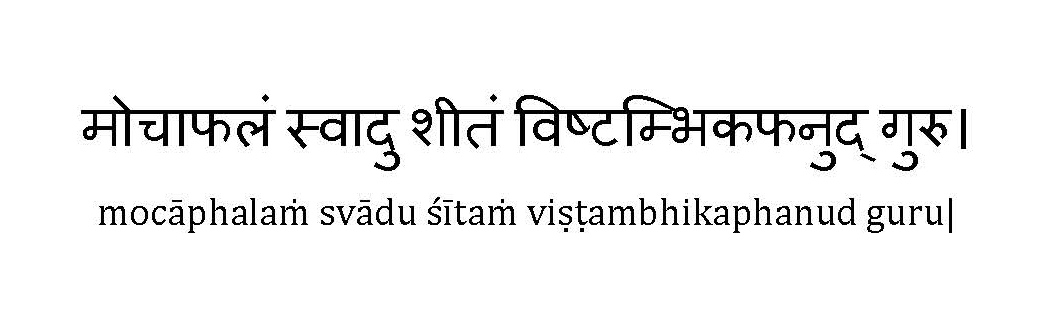
As previously discussed in my blog (and newsletter dated October 17, #42 Volume 3), the small and aromatic bananas are great to consume, because they do not carry channel-blocking property. However, in general, small aromatic bananas, particularly in the United States, are very rarely available. Larger bananas are readily found across the world and that is what people tend to consume. As far as the reference is concerned, here is a verse from Bhav Mishra’s Bhav Prakash Nighantu, – which is considered to be the best “nighantu,” the best commentary for Ayurveda’s materia medica:VFB-img1
As you can read in the verse above, large bananas are “bisthambi:” very heavy to digest and channel blocking through the creation of ama; they also increase kapha dosha on a cellular level, and are heavy (guru). Carrying these 3 properties,: bhishtambi prabhava, increasing kapha dosha, and having guru (heavy) and sheet or cold guna (property), they slow down or dampen agni or the metabolic fire in the stomach. This is the root cause of disease, as a reduced digestive fire will result in toxins or ama, and there can be no disease without ama. Specifically: anything cool or cold in property shrinks the circulatory channels. A banana is bhishtambhi in more ways than one as you can see. Due to its cold and heavy properties, that shrinks channels and creates ama on the cellular level. Large bananas increase shleshak kapha which restricts movement. This is why my ancestors capped it as an abhishandi fruit. Favor small bananas anytime, whenever available.

Why not Winter Squash?

“Hi.
I wonder why you don’t recommend Winter Squash? I’ve seen on other places that Winter squash is actually recommended in Ayurveda. So how come you say it’s not healthy?
Olle W.”

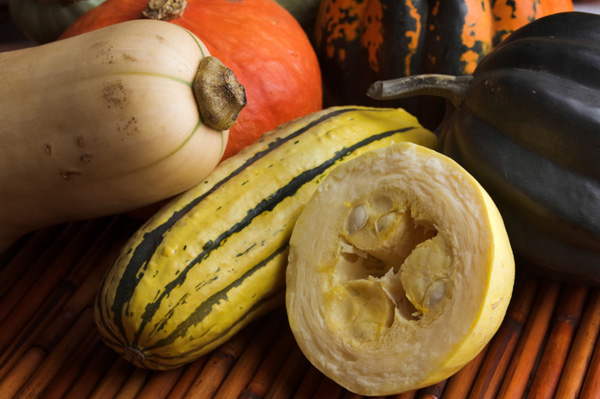
WNWS-img1Dear Olle: this opinion comes from my familial lineage. My ancestors observed, centuries ago, that the winter squash is channel clogging. In my SVA lineage, we put a lot of attention on channels – physical and vibrational – much more so than any other aspect of the physiology. This is why you will also see that we recommend not to consume larger beans (kidney, lima, garbanzo, etc); no winter squashes; to avoid big bananas; etc. All these things were found to be channel clogging and having an adverse effect on health. True, they may be very nourishing and very high in nutrient content, but their channel clogging “prabhava” or post-digestive and post-absorption effect disturbs the flow of these same nutrients in the large physical or macro as well as the small and subtle micro channels. They also block the macro and micro detox pathways. In our SVA practice, I, alongside my practitioners, have noticed concrete visible differences when clients stop consuming these channel-clogging foods.