The latest scientific findings indicate that there is a great chemical and physical necessity for sleep, above and beyond the psychological need. The consensus is that the brain needs sleep to wash off toxins created during the day’s activity.1
How is this washing off done? Pioneering research has found that brain cells – glial cells – shrink during sleep  to open up the interstitial gaps between neurons to allow fluid to flush out neurotoxins in the brain through a network of plumbing pipes – glymphatic system.
If the brain is not allowed to detox through proper sleep, toxic proteins may be formed and/or left behind. Toxic proteins play a major role in chronic brain disorders – Alzheimers, Parkinsons, dementia.
Sleep is now confirmed to not only be necessary downtime for housekeeping to flush out neurotoxins, but to contribute to its nightly restoration.
Shodhana and Rasayana
This is not news to Ayurveda. The detoxing and rejuvenative functions of sleep (“shodhana” and “rasayana”) have long been known, and the Carak Samhita Sutrasthana says that sleep (“svapn”), along with a healthy diet (“ahar”) and ethical balanced behavior (”Brahmacharya”) is one of the 3 sub-pillars of life, or “traya upastambah:” The sutra continues to explain that with proper regular sleep the body gains “bala” or physical and mental strength; its immunity is enhanced; complexion improves; digestive and post-digestive activities are optimal; the mind gets more balance and nourishment from the physiology ; there is overall improvement in the assimilation and transformation activities on the cellular and vibrational levels.
 But Ayurveda has also known, since its inception, that sleep is essential for deep multi-dimensional detox.
Daily Detox through Sleep
Our bodies are deeply attuned to the environment we live in. In modern terms, we speak of the circadian rhythm: a 24 hour biological cycle that keeps organs and organ systems running in our bodies, in relation to the environment, and particularly the the day-night cycle of 24hours. Our cellular metabolic processes respond to and are regulated by this cycle. In Ayurveda, the daily biological rhythm of the body is discussed in relation to dinacharya and ratricharya: day-time and night-time protocols respectively. The understanding of daily metabolic cycles in Ayurveda also relates to light, but goes beyond as well.
In Ayureda, different portions of the day are said to carry distinct properties that affect our physiological activities in different ways. The day is structured in portions that carry more or less of the 3 cosmic energies that make up everything under the sun. In Vaidya Mishra’s lineage these 3 cosmic energies are emphasized as key players for understanding and managing health. They are: Soma, Agni, and Marut.
- Soma: the creational principle of support and sustenance best symbolized by the Moon or lunar energy
- Agni: the principle of transformation best exemplified by solar energy
- Marut: best exemplified by space and air, this is the principle of movement
SV Ayurveda structures the day in sequential portions that carry more or less properties of Soma, Agni, or Marut. This is translated as the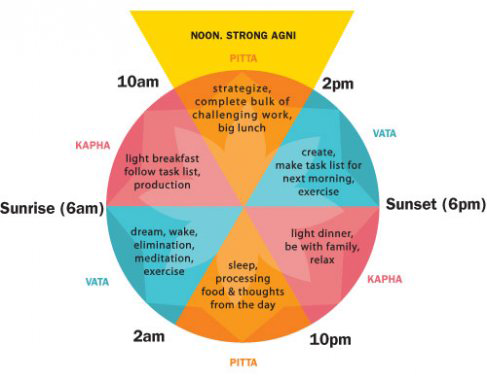 tendency to have or accumulate more or less imbalances of Kapha, Pitta, or Vata during a given day. This is how an ayurvedic day looks like:
- early morning, from 6am to 10am is more soma, it is kapha time
- from 10am to 2pm is agni predominant when the sun’s effect is highest on our physiology,and that is pitta time
- from 2pm to 6pm is more marut predominant, and that is vata time
The 24 hour day cycle is divided into mirror parts, but they oscillate between rest and activity. 12 hours of activity vs 12 hours of rest – this includes a couple of hours prepping up for and then coming off of high activity or deep rest. An ideal day is balanced between the 2 strokes of rest and activity.
While the early morning soma time from 6-10am is necessary to rev up the body to accomplish the day’s activities, the evening soma time extending from 6-10pm is to be used to calm it back down, unwind it, and ground it, prepping it for deep rejuvenative sleep.
When the evening time is properly used to calm down the nervous system, giving rest to the organs and organ systems, then the ensuing Agni predominant portion from 10pm to 2am, will be successful in performing its task of detox and transformation.
Ideally, our days are meant to be structured to alternate between rest and activity. During the day, when the sun has risen, our minds get engaged in our senses, our bodies become busy carrying out activities, our brains are fully aligned with our dynamic senses.
When the day wanes, if our awareness is attuned to Nature’s rhythm, our fatigued physical body and brain will understand that it is time to shift gears and ready the body for sleep. The sutra says: When “manas” or the mind gets “klante,” fatigued, from activity or“karma,” enjoying the objects or “visyayebho” of the senses, then it wants to release itself (“nivartante”) of those objects by going into sleep or “svapiti.” This is the definition of sleep according to Ayurveda.
Sleep through the Night
But sometimes sleep can be the most elusive thing. No matter how tired we feel and want to sleep, we are not able to wind down, fall asleep, nor stay asleep. There are different ways to correct sleep imbalances, based on external and internal factors.
 Sleeplessness occurs when the brain is unable to disconnect from the activities of the senses. When the brain remains engaged in the objects of the senses – something that happened during the day – either extremely exciting or stressful; a task that was unfinished; an emotional charge that remains unprocessed; a stressful thought that won’t leave you. Your mind keeps running the episode over and over again. Due to different hetu-s or original causes, people are not able to disconnect or detach their minds from their senses, and then sleep eludes us. There is not one way to correct a sleep imbalance, because there is not one reason that may cause insomnia. In SVA, Vaidya mishra insists on following the “hetu ling aushadi gyanam” principle: first investigate and isolate the actual cause of the sleeplessness to be able to correct it fully and effectively.
In this sense, based on one’s physiology, there can be 3 distinct ways of approaching problems in sleep, each is based on one of the 3 cosmic energies, Soma, Agni, Marut, that get reduced to imbalances in our physiologies as Kapha, Pitta, and Vata, based on our body’s preference to receive more or less of each energy.
In general, it is good to turn down the lights, reduce the use of TV and computer, and do gentle yogic exercise or meditation to ease the body into the rest period of the day. But here are specific guidelines for those who need a little more pacification.
Vata
Sleeplessness that is caused by too much Vata, or air and space accumulation, can result from:
- the overuse of EMF devices such as computers, cellphones, etc.
- from eating or drinking too much dry or drying foods or drinks (snacks, caffeinated drinks);
- from skipping meals or not eating enough, or eating on the go;
- eating too much pungent and spicy meals;
- over-engaging in physical or mental labor without taking proper breaks;
- travelling for long hours (flying, driving too much) without a break to recover and reset the body
In this case, the mind gets overwhelmed, it needs a nourishing nurturing break to relax and recover, so that it can detach itself from the senses in order to be able to fall asleep.
Sometimes, even if one falls asleep, they wake up fatigued and foggy – sleep is scattered and not grounded enough. In this case, one should adopt one or more of the following steps:
- proper vata pacifying foods that are more unctuous and grounding in nature;
 may drink a milk date shake before sleep (boil milk with a couple cardamompods, a stick of cinnamon; take off the heat, pour into a blender and add 1-2 pitted medjool dates and blend. Drink warm before bed).
- do self-massage with SVA Vata oil with Vit D and Magnesium;
- Drink Soma Nidra Tea half an hour before sleep;
- Use the Soma Nidra Oral spray
- Shower with Soma Nidra Soap;
- Take a bath with Soma Nidra Sleep Pouches
- Apply Soma Nidra Aroma oil blend on your wrists and behind your ear lobes, or put a couple of drops in an aroma diffuser to release the aroma in your room during your sleep
- Apply Mastishk Shamana transdermal cream on your lower spine.

PITTA
All of the above Vata pacifying recommendations can be done to help with sleep by an individual of any constitution, but sometimes things need to be addressed specifically for Pitta problems. Pitta imbalance prone individuals may experience lack of sleep primarily due to food related imbalances. If they do not eat a proper meal that has high protein content, their fiery high metabolism will not settle down enough to allow soma to ground them in deep rejuvenative sleep. They will wake up during high pitta time, between 12am and 2am, restless, emotionally strung, and unless they pacify their pachak or digestive pitta with a sweet juicy pear, they will not be able to fall back asleep. Not addressing pachak pitta or digestion and trying to fall back asleep through transdermal, transmucosal, aromatherapeutic, or yogic means will fail to work for a high pitta individual!
High Pitta individual must also make every effort to go to bed no later than 10pm, as they will receive second wave when pitta time kicks in, making them prone to engage in creative activities instead of allowing the physiology to rest and detox. As the night ages, it will become harder for them to fall asleep, accumulating more pitta, and resulting in pitta related imbalances – mood swings, excess heat in mind and body that can result in imbalances in different ways.
Pitta organs become more active during pitta time: liver, spleen and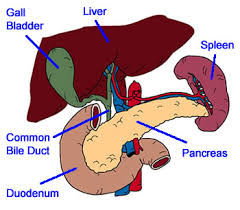 pancreas. During the night shift of Pitta, these organs’ activity amounts to detox and transformation of the whole body, including the brain.
If the person is in a sleeping state between 10pm to 2am, then transformation based detox and rejuvenation is not impaired, waste products go into proper detox pathways and the outcome is the body’s nourishing nurturing substance known as Ojas. The shastras or ayurvedic texts highlight that proper sleep produces Ojas as well as toxin-free cellular system.
If pitta types consume alcohol or meals that are high in spices as well as pungent, their physical brain will need an extra-boost of Soma to reset itself. Soma is the raw material for neurotransmitters. When there is not enough soma, the brain starves and it becomes difficult for it to get disconnected from the horses or the senses, resulting in poor sleeping patterns. What to do?
- Eat protein rich light meals before sleep
- Consume some Rose petal preserve with dinner
- Have more squashes during the day or for dinner
- Drink the milk/date shake
- Make a cup of Soma nidra tea.
- Apply DGL transdermal cream on your liver and stomach area, gently massaging
- Take a shower with Soma Nidra soap
- Give yourself a gentle calming massage with Pitta oil with Magnesium
- Laugh every day!
KAPHA
Lack of sleep related to kapha imbalance can result from eating heavy clogging meals; not having enough exercise; consuming yogurt at night; sleeping during the day. In all these instances, the physical channels between mind and body get clogged, and the mind cannot communicate properly with the senses, making it difficult to disconnect the senses and mind.
If you are prone to kapha imbalance – your body tends to have a slower metabolism and accumulate more Soma – you can balance things by:
- Incorporate daily exercise into your life
- Eat spice rich food for lunch and dinner – you may also add fresh ginger and thai green chilies if your pitta is not off
- Apply SuperSport roll-on or cream on arms legs as well as your lower spine morning and evening
- Use Soma Nidra oral spray – 2-3 squirts before bed
- Drink a cup of Soma Nidra Tea or use any of the other Soma Nidra products to help induce sound sleep, however, all these will work best when you incorporate exercise and balanced meals into your routine
- most important is to make sure you do not sleep beyond 6am as that will accumulate more Soma in your physiology resulting in more clogged channels
Sometimes, you may need to pacify both pitta and vata, or pitta and kapha. You will learn to understand the signal that your physiology is giving you as ayurvedic knowledge unfolds in your awareness once you invite it to be part of your routine.
Wishing you blissful sweet nights…
1 Go to www.bbc.com and search for “Sleep cleans the brain of toxins.


 If you missed it, it’s all here. All the talks, the practical demonstrations, and workshops. All the knowledge that has been helping countless people, delivered by Vaidya’s growing family of SVA experts. You may purchase the full set or individual talks. Go to YouTube to Vaidya’s SVA Health Channel to watch clips from all the talks and practicums.


