Nadi-s: Healing Pathways of Your Cosmic Self

Unlike mainstream Ayurveda, Vaidya Mishra’s SVA tradition puts extra attention on the role that the body’s vibrational channels play in your health. These are known as “nadi” in Sanskrit. These channels are so important that even if you are able to maintain 100% of any healthy daily regimen, when your vibrational channels are not “perfect” in their functioning, you may still feel off. It is important to distinguish these non-physical vibrational channels from the micro and macro physical channels in your body to understand how things work.

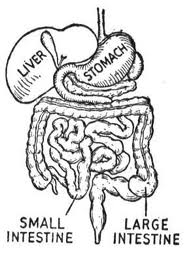
Think of it this way: imagine your body is a metropolis or a big busy city, (perhaps New York City), with non-stop high regular traffic going in allNHPOYCS-img1NHPYCS-img2 directions. This means cars, buses, subways, and people going up and down and left and right and in and out and along the main traffic arteries. Just like the city if made of major road and highways, as well as smaller side roads and pedestrian walk-ways, our bodies are made of macro and micro physical channels. The macro channels are called “Sthoola Shrotas” and the micro channels are called “Shukshm Shrotas.” We can see the macro channels with our naked eye, but the micro channels can only be seen under a microscope. If there were a blockage anywhere on any of the pathways, it wouldNHPYCS-img3.png affect the rest of the traffic through a domino effect. In a similar way, our bodies have pathways, some large some small, they are physical channels that carry actual physical material and particles that can be viewed under the microscope. Some of our physical channels are: the intestines; the blood vessels (arteries, veins, etc); the bronchial tube; the bronchial channels; etc. When food is ingested, it gets broken down in the stomach, then transformed into blood in the liver, absorbed as nutrients in the intestines, and the unused material gets evacuated through the feces. But along with the visible, there is always an invisible aspect! Think of all the non-visible traffic that accompanies all the physical activity in the city, the stuff you cannot see with your eyes, such as all the electronic information and data that is being transmitted every second to keep the subways running on time; or the movement of heat and energy that gets released and generated by the traveling engines and walking people; or think of all the sound that is also being generated by each mobile entity and traveling all over the place; and then you can even think of more and more subtle things as well, such as the thoughts of each individual, the feelings they are carrying. All these non-visible things also occupy space and get transmitted, even if on a much more subtle level that we still cannot fully measure with machines and our technology. This kind of non-physical material needs special non-physical channels to get transmitted with. In our bodies, this is somewhat similar to the vibrational channels discussed in the Vedic tradition, called the nadi-s.

The knowledge of the nadi-s is not specific to Ayurveda. In fact, you can read most about it in a text called the “Shiva Samhita.” The Shiva Samhita (śivasaṁhitā also Siva Samhitā) is a Sanskrit text on yoga, whose author is unknown. It is a conversation between Shiva and his consort Parvati. It is a central classical treatise of Hatha yoga. The second chapter of this treatise focuses entirely on the nadi-s,NHPYCS-img4.png listing them, naming them, describing their location and direction. For example, some of the most important nadi-s or vibrational channels are: Ida and Pingala (Ida through the left nostril and Pingala through the right nostril); the Sushumna nadi, or the main vibrational nadi that is aligned along the spinal chord; the gandhari nadi in the left eye, hastijihva in the right eye, etc. In total there are, according to the Shiva Samhita, seventy two thousand nadi-s spread throughout the body. They originate like sprouts from the navel area.

Just like the macro and micro physical channels carry physical material, the vibrational channels or nadi-s carry non-physical vibrational material which isNHPYCS-img5.png primarily pranic in nature. Vaidya Mishra’s SVA lineage uses the knowledge of prana and the nadi-s very concretely. Prana is the primary vibrational energy that our bodies are made-up of, and the Shiva Samhita maps out the different channels and pathways through which this prana travels in our bodies after entering it through the Adipathi Marma point and the nadi-s. The SVA lineage uses the knowledge of prana, the life-giving, healing and nurturing energy made of Soma Agni and Marut, and Marma points, the transformative pranic delivery juncture points in the body to correct imbalances that can result in physical dis-ease.

The nadi-s are the connecting and communicating factor between cosmic energy and the physical body. Nadi-s receive prana from the environment and distribute it in the body through the sandhi-s after enteringthrough the marma points. Sandhi-s are the gaps or synapses, the junction between two nerve cells. A synapse consists of a minute gap across which impulses pass by diffusion of a neurotransmitter chemical. We have learnt through SVA that Prana is made up of Soma or lunar energy, Agni or fiery energy, and Marut or spatial energy. In our bodies, Soma predominant pranic energy travels on the left side; Agni predominant pranic energy travels on the right side of the body; finally, Marut predominant pranic energy travels in the spinal chord, being received and delivered to the whole body through the spinal chord.

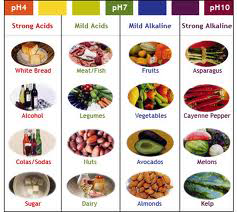
While the nadi-s have a major impact on the health of the physical channels, the physical channels do get disrupted through physical materials as well. If we eat channel-clogging foods such as: large beans; or vegetables from the night-shadeNHPYCS-img6.png family (bell-pepper, eggplant, potato, tomato); or if we consume too much bread, or soy products. If we consume too many sour and/or acidic foods, or bad vegetable oils, then they become inflamed. It is somewhat easy to document and follow the deterioration of the physical channels. But how do the vibrational channels become imbalanced? Since they are so tiny and subtle and beyond the material realm, should they not be forever healthy?
We may tend to forget that we live in a world that is carried by very powerful non-physical energies. Particularly in this day and age, our bodies are exposed to very high quantities of vibrational pollution. What is vibrational pollution? EMF, EMR, and any/all frequencies emitted by electricalNHPYCS-img7.png and/or magnetic devices. Cellphones, computers, pads, etc.! The polluting electrically charged vibrational energy from these devices enters our physiology and gets mixed up with our pranic energy. EMF being of a fiery agneya nature, it burns up the Soma in our bodies and creates imbalances. Many symptoms emerge when you are over-exposed to high quantities of agneya energy. Some people become more short-tempered and snappy; others feel fatigued very easily; yet others develop skin rashes or other more serious chronic conditions. The nadi-s or vibrational channels not only receive pranafrom the universe but they also filter unwanted vibrational energies that the body may be exposed to. When theNHPYCS-img8.png body is exposed to too much EMF on an ongoing basis, then the nadi-s become overwhelmed, and this, in its turn, affects the marma points and the sandhi-s or gaps in our cells. But it is not just vibrational pollution that affects these nadi-s. A good diet can nourish and maintain these nadi-s in good health.


Did you know that, as per the SVA perspective, the ultimate benefit from our food or herbs goes to nourish these very same nadi-s? The ultimate nourishment that you get from any physical material is called “prabhav.” Prabhava constitutes the specific vibrational make-up of any ingredient. It is vibrational inNHPYCS-img9.png that it cannot be examined under the microscope, but the vedic texts list a prabhava for every ingredient under the sun. For those who have pure physiologies, the prabhavas can be experienced or felt exactly as the texts describe them. For others who may have clogged channels, the prabhava may not be felt at all.

The prabhava of any ingredient operates only on the vibrational level and nourishes the vibrational pathways or nadi-s. Most of the time, when people are ingesting herbal supplements and not getting any benefit out of this, it is because either poor digestion, or weak assimilation, or an overloaded liver, or the lack of yogini-s (friendly bacteria in the colon), are disrupting the flow and energy and delivery of the prabhava of the herbs.

The health of the physical body matters, what you eat physically matters, but you have to also consider the vibrational health of your body through the nadi-s. Taking care of the nadi-s will automatically take care of the sandhi-s and the marma points. Vaidya relates that his father used to say: “nadi-s are the single vibrational channels, sandhi-s are when one channel branches out into many, and marma points are where all three nadi-s of all three pranic energies (Soma, Agni, Marut) are flowing unhindered, connected at each point to the individual light of the soul. So when you take care of the marma, you are taking care of the nadi-s because of pranic flow, and taking care of the sandhi-s, of everything!”

Besides food, there is also another highly effective way of supporting your nadi-s, and that is transdermally. You see, the “lom randra”-s, or every hair follicle of your body is connected to a nadi. So when you apply any topical or transdermal product which has the prabhava of the herb captured in a good living natural base, it will penetrate the body through the nadi, and reach the gap or sandhi-s and marma-s. You can also guide, based on your need, how and what to apply where in order to supply specific herbal prabhavas for specific organs or organ systems. Vaidya Mishra’s SVA Transdermal Marma System™ teaches this method, so you can apply specific creams on specific marma pints to target specific organs or sandhi-s connected to that marma point.

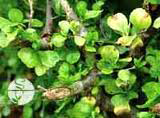
In this sense, the very first transdermal product Vaidya made in order to support, toNHPYCS-img10.png open, clean, and nourish the nadi-s was about 10 years ago. He called it SuperSport. It contains Prasarini as its main ingredient, a very important ayurvedic herb that is commonly used in the SVA tradition to enhance the reception of prana to the nadi-s, sandhi-s, and marma points. In addition to Prasarini, Vaidya’s formula also contains:
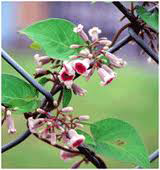
  • Parijat: a specific herb that supplies prana directly to the nerves;
  • Vitex nigundo, or nirgundi, dilates the gaps for the proper reception of pranic energy;
  • Camphor: clears the physical channels to receive prana more readily;
  • Tea-tree: unblocks the physical channels from ama to receive prana;NHPYCS-img11.png
  • Guggul: unblocks and cleans the fat channels to receive prana;
  • Mimosa pudica: enhances the reception of prana to the nerve endings;
  • Ashwagandha: supplies more pranic energy to the physical nerve;

NHPYCS-img12When you apply Vaidya Mishra’s SuperSport herbal synergy either as a cream or a roll-on on your marma points, you are taking care of the marma point itself, but also addressing the sandhi, and the nadi-s that connect to that marma point. When you enhance coordination between these three vibrational aspects(marma, nadi, sandhi), you are then supporting your physical channels and nurturing your physical organs and systems from the inside out!

What happens when your physical channels, organs, and systems are able to receiveNHPYCS-img13.png prana in an unhinder edmanner? It supports them by re-establishing Nature’s intelligence in them, so each cell in your body can run optimally by itself as it has been programmed to, for detox, and self- maintenance. When pranic flow to all the physical aspects of the body is unhindered, then any physical approach a physician takes to heal physical organs will work even better.
The SuperSport Herbal Synergy, either in the cream format, or the lipid and water soluble roll-on formats also helps if you have to work in a highly electronically charged environment, if you are highly exposed to EMF at work or at home. The SuperSport group of products also help calm the mind and enhance the coordination between mind and body, by allowing for the free unhindered flow of prana all over the physiology.

TURMERIC TUBERS

“Do you sell turmeric pieces (like shown in your YouTube video “How to use turmeric?” In the video it was explained that turmeric “powder” oxidation occurred very rapidly, and for that reason it was better to buy the pieces of turmeric that are peeled and cooled dried in your plant. Thank you, Monica R”

ANSWER: yes, that is the case, that is why we grind the turmeric roots in our facility with a hammer grinder, and only on demand, and then we vacuum pack them and recommend that people consume and not store them for long periods of time. We also recommend that you keep the ground powder in your kitchen in an air- tight container. It is not necessary to refrigerate it though. However, the turmeric tubers are also available for sale if you so desire. You will need a highly efficient grinder though, as they are tough to pulverize, and that is why we make the powder available as well.

For more information for our clients, you can watch the Turmeric Youtube video on this link: http://youtu.be/cafoiHQiwPw


GREEN PROTEIN RECIPE

“Hello,
Would you kindly send me the Green protein recipe as presented in this Youtube

video: http://www.youtube.com/watch?v=Fw99ChA_uXI
My wife and I would also be very grateful if you would kindly let us know the ‘brand/model’ of the blender you have used in preparing this recipe.
Thank you so much for posting this information online.
Thank you,
Sincerely,
Gaurav N.”

Dear Gaurav: the recipe is below. And the brand of the blender is Cuisinart. But nowadays, we have discovered a small very handy blender/chopped that goes by the name of Ninja and is sold for only $20 at the Target stores. It is very powerful, can blend quit a bit of quantity (enough for 6-8 people) and is quite powerful as it has 4 blades instead of 1 or 2 plus it is small and easy to clean… Hope this helps.

Green-Protein

It’s delicious, it’s quick, it’s nourishing, and kids will love it – young and old! It’s Vaidya’s magical SVA recipe, a powerhouse of protein and iron. You can use any leafy greens: baby spinach leaves, collard greens, Swiss chard, dinosaur or purple kale. Steer away from mustard greens as they tend to be a little heating and pitta aggravating. Recipe:
80% weight by weight leafy greens
20% weight by weight fresh cheese (paneer) 1/4 cup spring water
1/2 tsp Mum’s Masala
1/2 tsp Mum’s Ghee
1/4 tsp Soma Salt
Fresh Thai Chilli (optional)
Fresh ginger 2 slices (optional)
1/4 tsp Olive oil Add the ghee to your pan, along with the Mum’s Masala (and chili and ginger if you are using these). Add the paneer chunks and sauté for a couple of minutes. Remove stems (may keep some) from your greens. You can mix Swiss chard, collard greens, purple or dinosaur kale. Add also a few sprigs of flat Italian parsley (curly will also do if you can’t find the flat). Chop everything roughly. Add to your paneer pan and add some water. Cover the top and cook for only as long as it takes (depending on how much greens you put) to allow the greens to turn bright green in color). Remove from the stove and put everything into your blender. Add a little water and blend to a perfect smooth texture (you may add more water as needed). Hot water is recommended, but room temperature will also do. When you are ready to serve, squirt some fresh lime on top and mix it in. Enjoy your protein!

DEVI INCENSE

“[Do] I get the same benefits from putting the Devi Incense in one of those [electrical] aroma pots? I did htat last night and it did put a wonderful aroma in the air. I put in a little of the incense with a little water. Carol Brown”

Yes, this is a great idea. This is a good way of still getting the benefits of the Boswellia and the incense ingredients without the smoke. The heat will activate and release the properties into the air.

WHOLE WHEAT OR WHITE FLOUR?

“I’ve been hearing for many years that white wheat flour is not good for health. It’s claimed that white flour is quickly transformed into fat and increases the sugar level in the blood, while whole flour takes longer to digest and for this reason won’t create much fat and it’s better for the digestive system. I tried hard to convince my wife and kids to move to whole wheat flour. Now, [I also just heard] that whole wheat flour is not used in India and it is considered as food for animals. You know, people have the tendency of assuming that if it comes from India it’s based on Vedic knowledge. But I would like to hear from a reliable Ayurveda expert.
Do you know what is true, regarding this subject? Do you know what Vaidya Mishra thinks about it?
I’ll really appreciate if you can get the answer for this issue.
Cheers,
Marcelo”

Dear Marcello: In Vedic India or traditional not contemporary India, we always favored and used whole wheat flour. Stone-ground whole wheat flour. Whole wheat flour not only physically contains all the nutrients and micro-molecules of the bran, but it is also pranically very rich. That’s why, the complexity of the carbohydrate makes it slow on metabolism and digestion, but at the same time making it more nourishing and sustaining as well. Energetically speaking, it won’t spike your blood- sugar and then give it a dive. This is because of the slow sustaining release of the carbs. During the refining process or when it is bleached and the bran is totally removed, wheat loses its total nutritional value, the one it was endowed with by Mother Nature. In this sense, it also loses Prana. Often, bleached refined flour is favored for its cosmetic appeal, etc. but whole wheat is always preferable to use. The only time someone should avoid whole wheat flour is if the individual is gluten intolerant. In that case, I recommend incorporating quinoa into the diet.

One last but important point to remember in this context is that according to Ayurveda, refined wheat flour also tends to create constipation because it does not contain enough fibre.

CASEIN IN MILK?

“Can you please answer a question for me. I been told by some authorities that casein in milk does not get absorbed at all, and that in fact consumption of milk is one of the biggest causes of osteoporosis. I agree that regular milk from stores, homogenized and pasteurized, full of hormones, shouldn’t be consumed, but organic milk isn’t that different then? Thank you.
Alexa”

Casein (pron.: /ˈkeɪs.ɪn/ or /ˈkeɪˌsiːn/, from Latin caseus, “cheese”) is the name for a family of related phospho-proteins. These proteins are commonly found in mammalian milk, making up 80% of the proteins in cow milk and between 20% and 45% of the proteins in human milk. Casein has a wide variety of uses, from being a major component of cheese, to use as a food additive, to a binder for safety matches! As a food source, casein supplies amino acids; carbohydrates; and two inorganic elements, calcium, and phosphorus.

It is true that casein in found in milk, but if milk is organic, and consumed according to the vedic tradition, that is when it is boiled with some spices, such as clove, green cardamom, turmeric, cinnamon, and only then used or consumed, then all the casein- related heaviness goes away. The only time casein becomes problematic for digestion and absorption is if someone is really born with milk intolerance or allergies. But when the consumed milk is good, organic as you mention, not carrying additives, and preferably neither homogenized nor pasteurize, or raw as it is called, then there should be no problems. And there should be no problems at all according to the Vedic tradition, if milk is not not consumed cold, or it is not highly processed. The vedic tradition gives specific samyog (combination) and sanskar (preparation) methods to help avoid any side-effects from consuming even good milk, and in particular cow’s milk. This is because cow’s milk, rich and nourishing, is considered the most auspicious milk after mother’s milk.

Here is an SVA recipe to help you with processing all the molecules from milk.

50% organic milk
50% water
or 4oz milk to 4 oz water
add ¼ tsp Vaidya SVA Madhur Masala (a specific blend of spices to be consumed with milk and sweet available from www.chandika.com)
Boil. Bring down the room temperature and enjoy!

OR make your own blend with:
cinnamon 1 stick
cardamom 1 part
fennel 10 parts
nutmeg 1 part

Mix all of the above in a spice grinder and pulversize to a fine powder

Then add ½ tsp of this mixture to your milk and water mixture
Boil and cool down a little and sip slowly before bedtime.

Contra­indications: if you are lactose or casein intolerant, or have any disease and your medical doctor has recommended that you do not use milk, do not use this recipe. Or if you are a high kapha type individual, it is best to avoid milk altogether.

SVA ROSE PRESERVE: WHY IS IT SOUR AND THICK?

“I love the rose petal jam!! Wow, it is so intense!! Celestial ambrosia! Were I asked to tweak the recipe at all, I would decrease the as corbic acid as it gives it a little more lemony flavor than I prefer. Perhaps you need it in there for the canning process? The texture is quite thick for jam, but I like the stiffness of it since I don’t use it as jam, I eat it out of the jar for a candy treat. Mine had almost a nougat texture. It was interesting comparing it to [a competitor’s] jam, […] which I ordered last month before knowing you were making it.In case you haven’t had theirs, [it] is a darker, sweeter jam, more jam like in texture, and less pronounced in rose flavor. Theirs is also considerably less expensive than yours, I guess because you are using the rose absolute and you use more roses. FYI I mentioned your rose jam to a friend, who said she saw yours on the Chandika website but bought [the competitors’ instead] because it was so much less expensive. So you might need to do a little more of a sales job to point out the uniqueness of yours, if you are going to keep it at a price point that is more than twice that of [the competitors’]. It’s hard to know the difference online if you haven’t tried both. Thanks. Gail H.”

Dear Gail, thank you for your feedback. Ayurveda says it is always best to try to incorporate all six tastes. The common rose petal jam available on the market is not sour, rather totally sweet taste predominant. Because of its high sweet content, it can aggravate the kapha dosha. The shastra-s say: “ati yoga” or too much of any taste in long term or even short term usage is not good for health. In this case, too much sweet can result in weight gain, uneven sugar metabolism, stiffness, fatigue, etc. that’s why our rose petal Preserve has been formulated to first taste sweet, then sour, then also you will notice the astringent taste coming from the petals, and finally a little bit of the bitter after taste, and last you may also notice the very subtle salty taste… I tried to keep it balanced and delicious by incorporating all the tastes (minus the pungent).

Our preserve is thick because we have added more organic rose buds. Usually, manufacturers tend to use more sugar syrup, some rose powder, or some synthetic rose fragrance. Their preserve may smell rosy soft, look good, but you the total therapeutic value of rose will not be present. I have seen many formulators using only sugar syrup, synthetic rose color, and synthetic rose fragrance while we use organic rose buds and Rose Absolute essence – so you can understand why the SVA Rose Petal Preserve costs twice as much! We will be offering free samples to people know what we mean before having to buy it to experience it. Thank you for your feedback, we hold your words to heart.

OIL PULLING AND HIGH PITTA TYPE

“I am a hight pitta person, I learnt about sesame oil gargle from the Vaidyas in India 15 years ago. I started to gargle with sesame oil but it gave me blisters in the mouth. In your last newsletter I saw that Carak recommends the same thing, so how come it did not work for me? I have very sensitive gums and the only toothpaste that works for me, after so many trials, is your SVA HighCalcium toothpaste. I would love to resume doing Oil pulling, so which oil should I use? Amanda L.”

Yes, you are right. For high pitta people or those with high-pitta aggravation, sesame oil is not good nor recommended to use. Coconut oil is your best option. Melted coconut oil. And the SVA HighCalcium toothpaste is good for high pitta body type people or pitta aggravated people because it is rich in coral calcium and fennel. And it also takes care of common de-mineralization problems occurring in pitta predominant individuals. To find out more about high pitta type, you can watch: http://youtu.be/e8YIt0_TEH4

Pumpkin your Pie!

Ingredients:

Filling:
Carrots – 6 oz. (cooked/boiled in water)
Sweet yam – 8 oz. (cooked/boiled in water)
Soma salt – 1/2 tsp.
Raw sugar – 1  1/2 cup
Arrow root – 1 Tbsp.
Kid’s Masala no.2 – 2 tsp (may replace with a pinch of vanilla powser or omit if unavailable)
Nutmeg powder – 1/4 tsp.
Ginger powder – 1 tsp.
Baking powder – 1/2 tsp.
Shredded Almond – 4 oz.

Topping:
Heavy whipping cream – 4 oz.
Fresh paneer – 4 oz.

Pie crust:
(Please use your traditional pie crust recipe).

Method: 

3y6a0n9iCombine all ingredients, except for the pie crust and topping, in a food processor or blender until smooth.  Pour into pie crust.  Bake for 10 minutes.

Step 2:  Whisk heavy whipping cream and freshly made paneer (do not completely strain the whey out so it is softer).  Spread it on top of the baked pie.  Garnish with sliced almonds.

Method:

Can I Nourish All Seven Layers of the Skin At Once?

Lalita’s Age-Defying Cream, our most popular face cream, was designed specifically to nourish all seven layers of the skin.  It is a water-based cream which the skin readily absorbs, and is great for daytime use.  Before you expose your face to the cold winter wind, apply Lalita’s Age-Defying Cream.  You will immediately feel it’s rejuvenating effect as your skin absorbs the essence of the many divine herbs that it contains.  Don’t be surprised if people comment on your lustrous, healthy looking skin.

Which Is Better, Lalita’s Facial Oil or Facelift Cream?

In this gift basket we give you a choice between Lalita’s Facial Oil and Lalita’s Facelift Cream.  Both provide deep oleation, which is important to get to the root of dryness in the skin.  Healthy skin needs both water and lipid to maintain proper moisture.  Lipid is especially important because it protects the water in the skin from evaporation.

For everyday dryness, use Lalita’s Facial Oil.  Its contains very fine, micro-molecules of lipid which penetrate into the skin to nourish the lipid layers.  For deeper wrinkles, or deeper dryness, use Lalita’s Facelift Cream.  This lipid-based cream goes even deeper than Lalita’s Facial Oil and provides more lubrication to the skin.  It also takes longer to penetrate the skin and should only be used at night so that it has many hours to be absorbed.

Lalita’s Facial Oil is very light and fine for oleating the face without clogging.  It can be used during the day without giving an oily appearance to the skin.  For deeper nourishment or deep wrinkles, Lalita’s Facelift Cream is best to use before bed.  Daytime use would make the face look oily.

Does Your Health Take A Nosedive When You Travel?

All your muscles ache, and you don’t care if you ever eat again.  The thermometer reads 101 as you lie on the bed feeling sorry for yourself.

You traveled 3,000 miles to be here with everyone, and now you can’t even attend the party.  What will you do for the holiday meal, look over from the couch and watch the others eat?

There’s nothing worse than being sick when you travel.

It’s easy to avoid sickness when you travel by following these tips:

Keep Your Channels Open

Prana is corrupted when you travel, especially when you are flying.  The body tries to restrict the corrupted prana from entering the body by closing the nadis (vibrational channels).

This puts pressure on the nadis and slows the flow of prana in the body. The digestive system, bowel movements and ojas are all adversely affected.  Immunity goes low, making you susceptible to viral infections.

If you want to stay healthy when you travel, you have to keep the channels open:

  1. Use a Nadi opening spray  (e.g.: Flex’nFlow Body Mist) on your palms and inhale during the flight.
  2. Use a good nasya oil (for example Ida Pingala Oil) to your nostrils during the flight.
  3.  Practice gentle deep breathing at regular intervals to keep the nasal passages open.
  4. Avoid ice cold drinks, sodas, cold foods, and raw foods, all of which block the channels.

Prepare Yourself For Travel

Sometimes you don’t have much choice, but wherever possible get extra rest before you travel.  Plan ahead for all the last minute things that must be done before you go.

Don’t stay up late the night before.  If you can get to bed early for a few nights before you travel, your nadis (vibrational channels) will naturally be open and your immunity will be strong.

Try to avoid red-eye flights and late night arrivals whenever possible

Airports and airplanes are full of the highest EMF/EMR.

Prepare your nadis for this by getting a spinal treatment (with Flex’n Flow Transdermal Cream) before you leave.  (You can get a professional treatment session with one of Vaidya Mishra’s Shaka Vansya Ayurveda practitioners or you can have a friend swipe your spine several times from top to bottom with the cream).

Also, use Flex’n Flow cream or Mist on your feet before wearing socks.  This opens the channels in the feet (the slowest area of circulation in the body) and keeps prana flowing in the extremities.

Finally, apply Maha Marma Oil, Ida Pingala Oil, Karna Oil and Guda Oil before travel. These are all designed to open the nadis of the body and to prevent the build-up of corrupted prana in the nadis.

Food Is Your Friend (Or Can Be Your Enemy!)

Pay attention to your digestion when you travel.  Don’t overeat.  Digestion becomes weak when the channels shrink during travel.  If you eat more than you can digest, you further block the channels, decreasing the flow of prana, and increasing your risk of getting sick.

Take small portions and eat slowly.  Keep mealtimes consistent whenever possible.  Minimize dining after dark when you are traveling.  When the sun is up, there is more agni in the environment to keep your digestive fire high.

Favor sweet juicy fruits like pears, apples, and pomegranate when traveling.  Include channel opening spices that enhance circulation, such as black pepper, cardamom, cumin, mint, turmeric, nutmeg, rose, coriander, fennel and ginger.

Rehydrate yourself by drinking natural spring water with good pH balance frequently.  Don’t confuse the dehydration and fatigue that accompany jet lag with hunger.

Take Care Of Yourself Immediately After Your Trip

Whether you have full scale jet lag, or are arriving after a short flight or a modest drive, you can start feeling great in no time:

SVA Facial Marma Massage

Wash your face with natural herbal soap.  Apply Facial Clay and leave on for 10 minutes.  Rinse with warm water.

Do facial marma self-treatment with Lalita’s Age Defying Cream, Deep Moisturizing Lotion, or Lalita’s Facial Oil. You will immediately feel more relaxed and will find yourself breathing more deeply.

If you don’t have any of the products above, just do a dry massage. You will still feel the benefits of flowing prana to your head and neck area through the opened marma points. The herbs in the creams will help re-balance the vata on a deeper layer, but just re-activating the marma points with touch will also help.

Eye Care

Make a thick paste with Vaidya Mishra’s Skin Clay, place a tsp of clay on each side of a cheese cloth corresponding to the location of the eyes, lie down, close your eyes, and place the cheesecloth strip on the eyelids.  Leave on for 10 minutes.  Rinse with cool water.  This helps remove puffiness and is very refreshing and cooling to the eyes.

For The Mind And The Whole Body

Use Vaidya Mishra’s Samadhi Set creams, give yourself a nadi treatment, or do the Self Massage for Vibrational Balance.

Remember, this holiday season when you take care of yourself you will have much more to give to your loved ones!

What is the relationship between Prana, Sandhi-s, Srota-s, and Marma-s?

WITRBPSS-img1It is a wonderful thing to know that the full power and significance of marma points in our bodies are even greater than we can imagine! Not only do these points give us immediate access to the life force keeping us alive, but as described in the vedic shastras, they are in direct connection to our individual soul, our “jeevatma.” This means  that we can take care of not only our physical, emotional, and mental health through our body’s marma points, but we can even connect with the subtle light of our own souls… What can this mean?
As taught exclusively in Vaidya Mishra’s SVA lineage, Prana is made up of the three cosmic elements by now familiar to us: Soma, Agni, and Marut. Each marma point is connected to different organs and sections in our body on one hand, and on the other hand they all run a direct connection to the individual soul – jeevatma. Because they are in direct connection to the soul, they operate Satwa, Rajas, and Tamas, the three distinct qualities or properties of the mind. Marma points thus have two very important qualities. They are directly connected to the silent part of consciousness, the witnessing Jeevatma, but at the same time they help to operate the dynamic activity of the organs and organ systems in the body. They are the juncture points where nadis (vibrational channels) meet, and that serve as a gateway for Soma, Agni, and Marut.
The Marma Chikitsa (classical textbook of Marma) explains that it is important to avoid incision or punctures on marma points during operation, as these may result in incurable imbalances. This is why Ayurveda does not fully endorse using needles as in acupuncture, especially on marma points. Direct injury of a marma point can results in either different treatable symptoms or irreversible permanent harm. The ancient marma textbook details all known and possible harm and gives remedies.
Since marma points are so delicate and yet such important powerful points in our physiology, it is very important to take the best care of them, not just in protecting them from physical and vibrational harm, but also by maintaining the proper circulation of prana throught good diet and gentle marma massage.

Vaidya’s ancestors always paid the most attention to the marma points and, over time, developed many wonderful approaches to healing through these marma points. Vaidya acknowledges he has been fortunate enough to receive the gift of this knowledge and, in addition to his personal experiences as a healer over the last almost 40 years,  to have put together an easy and practical system that gives immediate results. It is the Transdermal Marma System™. The Transdermal Marma System™ or TMS™ combines the ancient wisdom of marmas (their location, function, relation to different organs etc), it includes the knowledge of which herb will be optimal for which marma point, and in addition, it also gives the specific sound vibration therapy (or mantra) for each specific marma point. In addition, there is a specific way s of touching each specific marma point. Not all marma points can be re-awakened or balanced with the same quality of touch or amount of pressure. The TMS™ supplies appropriate herbs through the skin (transdermally), appropriate touch, appropriate vibrational healing that addresses the deeper levels of imbalances, and appropriate aromatherapy (the aroma molecules serve as carriers for delivering the herbs to their targeted destinations). When Vaidya first developed the TMS™, Dr Douglas Beech and he were working together trying to help several clients with severe fybriomialgia. After incorporating TMS™ into their healing protocol, they got 98% results. Then other doctors, including Dr Marianne Teitelbaum started to use TMS™ for other chronic conditions with great success, including, different chronic pain situations, autism, allergies, and much more.
So how does it all work? As taught in the SVA lineage, the srotas (physical channels) are structured by sandhi-s (gaps). At the meeting point of these Srota-s and Sandhi-s, Marma-s are found. Marma-s, in turn, are connected to consciousness.
When the essential oils and herbs found in a jar of Transdermal Marma System cream are applied onto a marma point, the specific vibrational energy of the creams penetrates and unclogs the channels, awakening the intelligence of the gaps (sandhi). When Sandhi-s and Nadi-s are active and awakened, then they affect the physical channels (Srota-s) and the Prana starts to flow into the different physical organs and organ systems and eventually through the whole body. The physical channels also need Prana. Marma organizes all this activity of the flow of Prana in our bodies on all the levels.
Now we know a little more about how wonderful and powerful these divine marma points are. They are connected to our souls, the root of our silence, and the seed of our dynamism. The three primary Nadi-s: Ida, Pingala, and Sushumna, are the most important Nadi-s which support all other Nadi-s in our body. All marma points are connected to Ida, Pingala, and Sushumna, because Ida is Soma predominant, Pingala is Agni predominant, and Sushumna is Marut predominant. Keeping these three primary Nadi-s free from toxic build-up and vibrational pollution, Vaidya  has created many different methods of delivering cleansing and protective herbal formulations. For example: the Ida/Pingala oil for the nostrils can be used morning and evening. On the spine, DGL Transdermal cream can be applied every night, as well as SupertSport Transdermal cream. The Samadhi Set™ is good to use always, as it addresses the heart, mind and senses through the marma points, and hundreds of people have reported how much they love using it twice daily. In addition, for those of you who need to use something more to help them throughout the day Vaidya has now made SuperSport and Flex’nFlo available in a new format. Click here to hear Vaidya talk all about it. ..

Are you Spice-Deficient?

In the ocean of Ayurveda, there are a lot of gems! Among those gems, the knowledge of Agni (digestive and metabolic fires), Ama (semi- or undigested food materials left behind in the tissues and organs), and Ojas (the finest by-product of good metabolism that nourishes the neuro-transmitters and hormones and gives glow to the face). Agni, Ama, and Ojas share a close relationship to herbs and spices.  The chemical make-up of spices can enhance or slow down our metabolic activities, help or hinder it. In other words, the balance of Agni, the circulation of Ama, the production of Ojas can be affected by the use or lack of spices and herbs. According to Ayurveda, and particularly in the SVA tradition, spices and herbs do not just contribute flavor to our palate they are a necessary part of our daily diet. They maintain optimal metabolic rate and avert sickness which results from the production of toxic waste. They balance our emotions and clear mental fog through the balance of hormones and other finer chemicals that nourish our cells. We can look a little more closely at how spices and herbs in our food help us in different ways.

The first thing is proper combination or Samyog. Which spices do we combine with other ones and in what proportions. The second most important thing is proper processing or Sanskar,  how to cook and in what medium. Ayurveda supplies us the detailed knowledge of what will work best for whom, how, and why. When proper Samyog and Sanskar are used, spices and herbs can help balance almost all kinds of digestion ailments, correcting metabolic and assimilation problems.

Not only eating spices and herbs, but smelling them is also therapeutic! Through their aromatherapeutic value they connect the mind and the digestive system via subtle  pathways, travelling in the micro- and macro- physical channels (Srota-s) as well as the vibrational channels (Nadi-s).
AYSD-img1Raw spices and herbs help even through their aroma, but cooking the spices and herbs is recommended in Ayurveda. Cooking – that is exposing to heat – activates the inherent chemical properties of the spices and herbs, creating a molecular interaction between the spices and the oil medium used (ghee or olive oil). Cooking makes the spices and herbs more easily available to the digestive organs and systems in our body. In addition, cooking with spices also sanitizes toxic unwanted materials that might be present in the vegetables, lentils, or grains. But spices and herbs have an additional even greater property.

Almost all spices and herbs are primarily known to be Yogvahi, that is: they act as vehicles for the micronutrients found in the food you eat. Spices help to break down carbohydrate, protein, fat, as and when needed. As Yogvahi-s, they are as essential to our diet as all the food groups found on the food pyramid, but somehow we have forget to use them, and we only include them in our recipes for added flavor!

The SVA tradition explains that spices and herbs are little packets of intelligence, equipped with the blue-prints for healing! The minute they enter our body they start to clean-up the channels paving their way to their destination, carrying along nutrients they that came with and taking them to where they are meant to go for further processing, In addition, they make sure that unwanted bi-products are evacuated through the proper pathways and discarded from the body in a timely manner.

However, there is more! Spices and herbs are so intelligent that they can perform their functions not only when we eat them, but also when we apply them on our skin. If they are pranically preserved and placed in a lively medium (a good oil base or shea butter) they enter the skin and travel through its different layers and then travel through the blood stream, bypassing all the digestive organs and systems, and they reach the mind, the heart, and all the  extremities of the body.

AYSD-img2The topical use of spices and herbs is very important in the SVA tradition, because often, due to different factors, the body is unable to ingest large quantities or spices that are necessary for it to restore balance. Topical transdermal use is safe, highly effective, and even faster than oral ingestion and digestion. It takes seconds for transdermal topical absorption to reach its targeted area, while it takes approximately 20-30 minutes for food, after it is ingested, to be broken down, processed, and eventually distributed. Spices and herbs when used topically, also help the skin locally, on the spot. They nourish and awaken it, and then rejuvenate its different layers, before being transdermally absorbed all over the body.

So how can you tell if you are spice-deficient? SVA recommends that we  ideally consume at least some turmeric, cumin, coriander, and fennel with every meal. These four spices are basic in their balancing properties and targeted benefits. Otherwise, if you tend to feel tired after completing a meal, or if you tend to overeat because you do not feel satiated, or crave sweets excessively after completing a meal, these are all signals that there is some imbalance in your digestive system, and adding the proper mixture of spices (masala) can help correct it. A good digestion is key to healthy emotions and clear mind! Click here to watch Vaidya talk about spice deficiency and much more!

What happens when you eat or The Mechanics of Ayurvedic Digestion

Proper digestion of food is the foundation of our health. But what does proper digestion mean in ayurvedic terms and what does it entail? Vaidya Mishra offers a very specific and clear answer. Click here to hear Vaidya Mishra explain the details of the ayurvedic digestive process. But do we every stop to think about what triggers digestion? How does our body “know” when to start the process of digestion?
The SVA tradition reminds us that the process of human digestion is initiated even before you put something into your mouth! When you see and smell the food, your body already prepares itself by sending signals to your different brain centers. The brain then triggers the release of specialized chemicals that will help in the break-down, digestion, and absorption of your food. We have all experienced this. Remember what happens when you look at pickles? Your mouth automatically produces more saliva to coat the spice, salt and sour that is coming in with the pickle! Or the feeling of content in your heart when you see or smell a freshly baked hot-from the-oven cake?

This is your brain sending signals to your digestive system based on what the senses are gathering. Science confirms the fact that digestion begins with the sight and smell of food and calls this stage of digestion “cephalic phase” (cephalic means that which has to do with the head). This phase occurs before food enters the stomach and is very important because it readies the body for eating and digestion. The sight and thought of the food stimulate our cerebral cortex. Then the taste and smell of our food are sent to yet other specialized parts of our brain, the hypothalamus (this is a small chamber in our brain that connects the nervous system to the endocrine system) and the medulla (this part of the brain deals with the cardiac, respiratory, vomiting, and involuntary functions, such as breathing, heart-rate, blood pressure). When the cerebral cortext, the medula and the hypothalamus receive all this information they adjust their functions and ready the physiology in all its aspects to enhance the secretion of gastric juices and enzymes.
Ayurveda also explains this complex system of digestion in detail.Vaidya Mishra’s lineage, Shaka Vansiya Ayurveda, likens the digestive system to a burner and uses the analogy to its fullest to explain its different components. This is how Vaidya Kameshwar Mishra explained the digestive process to his interning son, Vaidya Ramakant Mishra, when his college teacher was unable to explain and elucidate the difference between Pachak Pitta and Pachak Agni….

SV Ayurveda likens the stomach to aWHWYE-img1 ‘burner’ – imagine a burner as the one in your kitchen stove on which you cook everyday. In order to function and cook food placed on top of it, your burner needs fuel. Our stomach supplies such fuel (gastric acid, pepsin, digestive enzymes). In ayurveda, the fuel of this burner is called “pachak pitta.” How do you ignite this fuel? When your brain receives the signal that food is coming, it starts releasing pachak pitta in the stomach cavity which amounts to lowering the stomach pH so that the “cooking of the ingested food” can be initiated. This produces a flame/fire called “pachak agni” or “jathar agni” which is responsible for transforming the food that was ingested. This phase is called the gastric phase (or the stomach phase) that takes approximately 3-4 hours to complete! At this point in the stomach we have food, we have gastric and digestive juices (pachak pitta), a lowered pH (1-3), and automatic reflexes that churn the food breaking it down into smaller molecules and particles and this constitutes the pachak agni, the actual cooking activity.

SVA highlights that in order to support this highly sophisticated activity of eating and digesting food, of maintaining the proper balanced activity of Pachak Agni and Pachak Pitta in the burner, the gap, it is necessary to chew well, and helpful to eat in silence because chewing helps to break down the food by mixing it in with the digestive fluids found in the saliva, because unlike some other species, for humans, digestion begins in the oral cavity or the mouth. We secrete large amounts of saliva every day (1-1.5 litres/day). This saliva helps moisten the food and it contains digestive enzymes which aid in the chemical breakdown of complex molecules. The tongue helps form the food into a ball and pushes it to the back of the mouth and then down the esophagus where it is ready to be broken down by the stomach. Keeping silence helps to focus on the food. It gives the brain the opportunity to put undivided attention to govern all the activities in the mouth, the esophagus, the burner, or the digestive gaps. When the brain’s attention is not divided by other activities, then it can better determine how much flame needs to be given during the process of digestion. The brain then knows best what to do if there are problems arising due to either the food that was ingested (if it needs more breaking down if it is too rich in fat or protein) or if the digestion is slow because the individual is tired(not sleeping enough and working too much) or undergoing emotional stress etc. If digestion is slow due to heavy foods, it may also be due to the lack of proper spicing and cooking or the quality of the food or the quantity of the food, or the temperature of the food. This is where the concept of Ama comes in. The vedic shastras (ancient classical texts) say that no physical disease can happen without Ama hence one of the synonyms of disease is “amaya” (full of ama).

What are some ayurvedic digestive imbalances?
There can be 3 kinds of imbalances that the flame can have due to problems in the fuel or the burner. Click here to listen to Vaidya explain these.
For example,  if the fuel is less in quantity or the burner is clogged (different parts of the stomach are not functioning optimally) or both then the flame, the Agni (overall cooking process) will be low. This state is called Mandagni – or low Agni. In this case, when the food reaches the stomach without proper spicing that would correct that condition, then whatever portion of the food is not cooked properly will result in Ama. Proper spicing can help this situation very easily as different spices can help with different parts of the digestive process – some enhance the Pachak Pitta, others correct the Pachak Agni, others yet just clean the gaps on the burner to let the Pachak Pitta and Pachak Agni interact and do their job better in a cleaner environment! Modern nutraceutical science promotes high nutrient content diets across the board for all individuals. For example, brown rice. Brown rice contains more nutrients than white rice but then what happen when somebody has low Agni? When they eat heavier food that their stomach cannot fully properly digest, it will remain semi-digested, that is they will produce ama (semi-digested toxins) out of the nutrients in brown rice. In the case of Mandagni or the slow flame, SV Ayurveda gives specific recommendations for spices based on specific body types, age, climate, or season, and even ethnic background. Taking care of Mandagni or low agni situation through recommending spices is easier than other conditions Common helpful spices for Mandagni are: fresh ginger, sunthi(pitta-pacifying ginger), black pepper corns, long pepper (pippali), green thai chilies, ajwain seeds, cumin seeds.  But recommending these spices to all low Agni or Mandagni people would be dangerous in the situation where the person is either high Pitta by Prakriti (natal constitution), or if the Pitta is aggravated and accumulated in the stomach or the Sandhi (gap) or the burner is clogged, due to vibrational toxins (resulting from emotional or other non-material stress).  Unlike mainstream Ayurveda, SV Ayurveda identifies this condition called “High Pitta Low Agni” and has remedies to help balance it preventing further digestive and emotional aggravation. If an individual has high Pitta low Agni when the fuel is hot and the flame is low, then all the above spices will heat up the Pitta even more and create aggravation (desire to eat more but ability to digest less and less resulting in heaviness, fatigue, acidity, heartburn, emotional upset). In this situation, SVA recommends spices such as fennel, coriander to cook with. Clove is also very good for high Pitta and low Agni situations. but in very moderate doses. As far as turmeric, the king of spices goes, it has to be used in high Pitta low Agni with lots of coriander and fennel.
Connecting the mind and the stomach, that is keeping your attention on the eating process and not on TV or a conversation or reading a book is also recommended in Ayurveda. In ayurvedic terms, the mobility factor in the our bodies is call the Vata Dosha. The Vata Dosha helps to move things where they are meant to go. It supplies the air principle to our physiology. It has many subcategories. During digestion, it is important to keep Prana Vata (that runs the brain activity) and Samana vata (that keeps activity in the stomach going) balanced and coordinated, since the brain always commands the conversion and flow of the flame as modern science also recognizes. Hear more about the sub-doshas with Vaidya Mishra, click here

Tips for connecting Samana and Prana Vata :
when you eat, keep your spine straight to allow for the optimal flow of Prana Vata to the stomach area and also to give better room for Samana Vata to do its job. If you are having trouble with your circulatory vibrational channels, you can use Vaidya Mishra’s Supersport Transdermal cream on the spine or Supersport spray on the stomach (apply in clockwise motion) before food. 

Modern Science Confirms the Sutra-s

There are thousands of studies on turmeric and its health benefits including its preventative action for a wide range of fatal and chronic modern diseases, including: cancer, arthritis, diabetes,MSCTS-img1cardiovascular diseases, osteporosis, Alzheimer. Research shows that turmeric helps the body release cancer causing toxins, blocks estrogen receptors and enzymes that promote cancer and prevent the growth of new blood vessels.
 Turmeric is now recognized as one of the most powerful chemopreventive and anticancer agents. Anticancer drugs weaken the immune system, but curcumin actually enhances it! even acting as an immune restorer. Research at UCLA has concluded that turmeric is effective for the treatment and prevention of Alzheimer’s disease. Researchers have found that turmeric helps maintain healthy brain cellular metabolism, helps the the cells repair themselves and maintains the cell connection to each other. A wealth of data shows the anti-inflammatory, antioxidant, chemopreventive and anti-neoplastic (fighting cancer), antibacterial, antifungal, antiviral properties and capabilities of turmeric. The countless benefits of turmeric are so diverse that they affect virtually every organ.

Some pertinent research references:

  •          Churchill M. Chadburn A, Bilinski RT, Bertagnolli MM. Inhibition of intestinal tumors by curcumin is associated with changes in the intestinal immune cell profile. J Surg Res. 2000 Apr;89(2):169-75.
  •          Pal S, Bhattacharyya S, Choudhuri T, et al. Amelioration of immune cell number depletion and potentiation of depressed detoxification system of tumor-bearing mice by curcumin. Cancer Detect Prev. 2005;29(5):470-8.
  •          Perkins S, Verschoyle RD, Hill K, et al. Chemopreventive efficacy and pharmacokinetics of curcumin in the min/+ mouse, a model of familial adenomatous polyposis. Cancer Epidemiol Biomarkers Prev. 2002 Jun;11(6): 535-40.
  •         South EH, Exon JH, Hendrix K. Dietary curcumin enhances antibody responses in rats. Immunopharmacol Immunotoxicol. 1997 Feb;19(1):105-19
  •         Kim GY, Kim KH, Lee SH, et al. Curcumin inhibits immunostimulatory function of dendritic cells, MAPKs and translocation of NF-kappa B as potential targets. J Immunol. 2005 Jun 15;174(12):8116-24
  •          Bhattacharyya S, Mandal D, Saha B, et al. Curcumin prevents tumor-induced T cell apoptosis through Stat-5a-mediated Bcl-2 induction. J Biol Chem. 2007 Jun1;282(22):159-64.
  •          Thangapazham RL, Sharma A, Maheshwari RK. Multiple molecular targets in cancer chemoprevention by curcumin. AAPS J.
  •          Jagetia GC, Aggarwal BB. “Spicing up” of the immune system by curcumin. J Clin Immunol. 2007 Jan;27(1):19-35.
  •          Yang F, Lim GP, Begum AN, et al. Curcumin inhibits formation of amyloidbeta oligomers and fibrils, binds plaques, and reduces amyloid in vivo. J Biol Chem.2005;280:5892-901.
  •          Lim GP, Chu T, Yang F, Beech W, Frautschy SA, Cole GM. The curry spicecurcumin reduces oxidative damage andamyloid pathology in an Alzheimertransgenic mouse. J Neurosci. 2001;21:8370-7.
  •          Cole GM, Morihara T, Lim GP, Yang F, Begum A, Frautschy SA. NSAID and Antioxidant Prevention of Alzheimer’s Disease: Lessons from In Vitro and Animal Models. Ann N Y Acad Sci.2004;1035:68-84