Drinking Turmeric in Water, as a Tea?”

“I have a question in regards to turmeric. I know Turmeric should be cooked or sautéed in ghee and added to your meal with lunch and dinner but can anyone drink it? In the You Tube video Vaidya says it is ok to drink milk with Turmeric but for example can one boil it in water or even tea, or should it be toasted, than you may boil it in water or tea? Or should one instead use Turmeric HMG, if they want to drink turmeric? Also what is the best tridoshic product one can use to help remove marks from the sun? Maybe the SVA Purifying Cream? I don’t know, please advise, thank you, Michael A.”
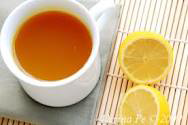
DTIWAAT-img1Dear Michael: in the SVA tradition, we do not recommend drinking turmeric to be consumed alone in a liquid/water base. Why? We always recommend people to boil turmeric in milk, because milk contains both lipid and protein molecules in addition to a liquid base. Protein and lipid molecules bind themselves to the turmeric molecules and travel together balancing each other. In addition, when you add cinnamon and cardamom to the mixture, you facilitate the breakdown of the sugar and the protein in the milk, making it even easier for absorption. Altogether, after all this “samskar” or process of boiling, we are binding turmeric with other molecules, and this gives it a more steady sustained delivery to the cellular system, making sure that the liver is not getting overwhelmed. A quick note that it is also ok to drink turmeric with goat milk, or home made almond milk – for the same reasons.

Otherwise, if you would still like to drink Turmeric in a water base, yes it is ok to use the Turmeric Herbal Memory Nectar drops – add 2 drops in 32oz of good high pH Spring water and sip slowly throughout the day.

With regards to your other question, my SVA Aloe sandalwood lotion is the best for helping with sun marks, but remember to also apply DGL transdermal cream on the liver, a sun marks are a product of a “hot and cranky” liver, also add Nectar drops of Turmeric and Bhumi Amla: 2 drops each in 32 oz of water.

Shishu and Bal Marma – additional details

SABMAD-img1“Namaste, Vaidya Mishra, Thank you for your latest blog posting about marma therapy and massage for babies. I found it very interesting and useful, as I perform daily abhyanga on my baby daughter. I do not know much about the marma points, however, and the illustrations did not seem to match up with the descriptions of which marma points to use. Could you please provide clearer illustrations or perhaps a video on your YouTube channel to help your readers/viewers/customers better understand how to do the marma therapy on babies?
In gratitude for your knowledge,
Lisa”

Dear Lisa: thank you for your email. Here is a clearer numbered sequence of the names of the marma points and the corresponding images. And thank you for your suggestion, we will be posting a YouTube video for SVA Shishu and Bal Marma soon – stay tuned for more!
Shishu Marma Steps:

SABMAD-img2Step 1: All 4 Talahridiya points. Talahridiya means “extensions of the heart:” the energetic heart literally vibrates at these points in the palms and the soles. Massaging these points brings pranic support to the whole physiology at the outset and facilitates the massage of the remaining points for the overall flow of prana.
Step 2: now you move on to the knees or Jhanu. We have 2 points in the  frontand 2 points in the back. Both pairs are found in dips on either side of the knee bone, and in the back, on SABMAD-img3either side of the soft tissue.
Step 3: now you move on to the elbows. Just like the knees, we have 2 pairs of points on the inside and the outside of the elbows, on either side of the elbow bone where there is a dip, and on the inside on either side of the soft tissue.
Step 4: this is the most tender yet most powerful marma point, the Adipathi, that connects directly to the cosmos. Follow the directions and do not touch this marma, just cup your hand and hold on top for a minute or so. Final step: you are now ready to swipe down the spine. Hold your “shishu” on your forearm and gently glide down his/her spine several times, 7 times is a good number. You have now completed your SVA Shishu Marma Massage and you may proceed to do a general massage, now that pranic flow has been enhanced and optimized, your baby will enjoy the massage more and get even more benefit out of it.

For your toddler Marma Steps, repeat steps 1, 2 and 3 of Shishu Marma
SABMAD-img4massage. Then:
Step 4: Ans or middle of the shoulders, where we also, as adults, get all the tightness and stress accumulated!
Step 5: Ans Phalak or the midpoint of the shoulder blades as shown in the image, another point of stress accumulation as we grow older….

SABMAD-img5Step 6: is the fontanel, or the soft spot on the top of the head. Follow the same recommendations and cup your toddler’s fontanel.
Step 7: Finish off your marma massage with the spinal swipe – always top to bottom, go down as many as 7 times or more as desire, s/he will love it, it will calm them down by helping release the used pranic energy

Fresh Turmeric Root, and Tea?

“Dear Vaidya,I am seeing fresh turmeric root at the store. Is this something we can or should be using? If so, how do we prepare it?
Many Thanks
Gail H.’

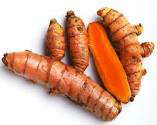
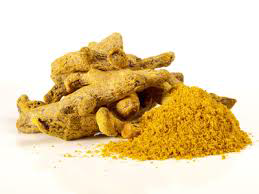
FTRAT=img1Dear Gail: fresh turmeric root contains all of its oils and properties in raw crude form, and as anything in its raw or crude form, can be too harsh on the physiology to handle. However, regardless of this, traditionally, in ayurvedic India, raw turmeric was and still never is used before being processed because it is very heating for the liver – it over-activates it. It should always be processed then powdered to abate its heat. There are many methods of processing, some simple and others complex. Here is a simple  method you can do at home: boil the roots once – bring them to a boil in water and then turn off. Throw out the water. Spread out your roots on a pan and dry them. After they are thoroughly dried pulverize them for use.
Please do not follow the recent trend of so many health guru-s and hip health recipe advocates and websites that are recommending making turmeric tea with freshly grated turmeric root, adding lemon and ginger and honey as a sweetener! When it comes to ancient herbs, we should always consider the tradition that comes along with it. Just because science is confirming the benefits of turmeric for so many imbalances that plague our contemporary culture, we should not lose track of our common sense, and always use caution when incorporating spices and herbs into our diet in novel ways. It is always best to consult with an expert and a time-tested tradition. Thank you for your lovely question.

How Much Turmeric Daily?

“Since I found Mr Vaidya Mishra with all of his teachings and knowledge, I began following his recommendations and buying some products. For instance, I just  bought ghee and turmeric, but I need a little more information regarding turmeric. Since I live in the west coast, the only way to clarify my questions regarding the products Mr. Mishra sells, is through the internet.

  1. If a person in “not” sick, how much turmeric is recommended daily when cooking (how many tsp a day?)
  2. If one feels sick, (fibromialgia, arthritis), how many tsp(s) a day?

With gratitude,
Moni R.”

Dear Moni: please go to my SVA Health Channel on YouTube and watch the video onHMTD-img1How to use turmeric.” In general, for a healthy person, I recommend ¼ to ½ tsp turmeric powder cooked or sautéed in ghee in added to your meal with lunch and dinner.
Remember: NEVER consume raw turmeric, as it can heat up the liver too much too quickly. And never consume large amounts of turmeric alone. Always cook it in ghee or with your vegetables and protein. My YouTube video will give you additional details.
If someone has a medical condition as you mention, they should always check with their medical physician concerning whether they should consume any turmeric at all.

Toxic Turmeric?

“Hello Vaidya, […] I have a patient who became quite perplexed after reading your response to the question on herb/drug and herb/spice interaction in issue #35 (August 29, 2013)… He is on several medications and has now stopped eating all spices in fear. My question is: how can we learn to navigate the use of spices in tandem with diseases? Thanks, Dr. Lisa Raskin”1

Here is an excerpt of the article that Dr Lisa Raskin is referring to (issue #35, vol. 3, August 29, 2013): “So how should an ayurvedic practitioner deal with medical conditions, even as and when they work hand in hand with a medical physician? As you can see, it is not a good idea to avoid food or spices when they create a synergistic interaction. On the contrary, that synergistic power should be used toTT-img1 the benefit of the patient ,to help gradually minimize the doses of medication, because in this case food materials will not have unwanted side-effects as they are managed wisely. In this situation, we are attempting to get the desired results from food materials and spices rather than medicine. But just as synergistic interaction is beneficial and can be tailored safely while working with an MD and getting testing regularly by a lab, antagonistic reactions should be avoided. This means: measures should be taken so that a diet should not create roadblocks for the medicine. Food or spices that can potentially reduce or block the effect of any drug should not be used and consumed. So, in conclusion, dear Nancy, this is a big topic and a very pertinent question, here I tried to answer it as succinctly as possible. I hope to elaborate on this further in the future. In the meantime, I hope this helps.”

Dear Dr Raskin: there are several things to consider in the use of spices when a client is on heavy doses of medicine. That response I had given was focusing on individuals who are consuming large quantities of spices in supposedly therapeutic, because modern science has confirmed their medicinal properties. As I explain and re-iterate all the time, it is very important to have the proper samyog and samskar,TT-img3 or in other terms, the combination and the preparation. What are you combining your spices and herbs with? Do you have the proper carrier to ensure safe delivery? And second, how are you preparing them? There are means and methods to prepare herbs and spices for safe and effective delivery and consumption. I can never stress these two points enough. In theory, in Ayurveda, almost every ingredient can

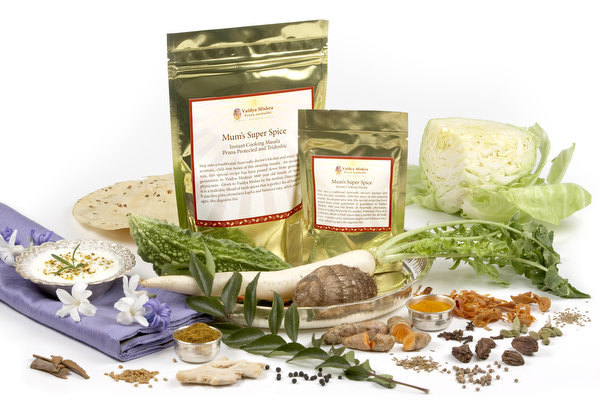
be consumed safely and effecting by adopting this theory of proper samyog and samskar. For example, you must be familiar with the spice mix I generally recommend to individuals who are just getting started with Ayurveda with baby steps, it’s my: 1/1/6/6, or 1 part turmeric, 1 part cumin, 6 parts coriander and 6 parts fennel mix. Now while turmeric has now known and confirmed medicinal properties that can be detrimental to an individual who is already on high doses of multiple medicines, if that same amount of turmeric is consumed with cumin to enhance absorption, with coriander and fennel to pacify the heat of the turmeric, and also help flush out through the urinary tract the toxins that the turmeric is going to mobilize, then turmeric becomes that indivdiual’s best friend. In his sense, recipes like Mum’s Masala are safe for almost everybody to consume – unless one is experiencing liver disease or any other kind of severe medical condition then it is always necessary to check with one’s medical doctor first. So how come Mum’s Masala that contains 18 different ingredients is safe? How does it work? Each ingredient in Mum’s masala is toasted at a different temperature, because the toasting time of each spice is different. This is part of the samskar of this formula. Toasting makes all the properties of the spices more readily available and cuts down on cooking time both on the stove and in the stomach! Then TT-img2ingredients like cumin can even more easily enhance absorption; fennel and coriander better cool off; fenugreek pulls out toxins from the fat tissue faster; curry leaf supports the liver so it can better handle turmeric; green cardamom supports protein metabolism more effectively; clove unblocks the channels faster; likewise, turmeric will be more effective at its job of supporting the liver in its complex detox process. In this sense, Mum’s Masala, because of the way it is put together and processed, it’s safe for almost everybody.
The point is: no one should be consuming turmeric capsules or to take turmeric alone as a tea (with hot water and lemon etc). So SVA masala mixes or the personal 1/1/6/6 spice mix based on body type imbalance and age etc are safe to use. These are time-tested formula-s that have the shatras and deep ayurvedic knowledge as back-up. They are not a hype! Like the capsules and the turmeric tea hype currently circulating on websites. And remember: these spice mixes are either to be cooked (or just sprinkled in the case of the Mum’s Masala) with your vegetable, lentils, with a fat and water, etc. During the inaugural SVA conference, Dr. Hari Sharma, a pioneer researcher on turmeric and cancer, explained to us that turmeric can help the body prevent and correct imbalances in 80% of diseases.
My point is: do not give up on turmeric, due to fear. But if the shadow of a doubt is still lurking on one’s mind, I have made the safe Herbal Memory nectar drops, and the Turmeric nectar drops are safer to consume as they only contain the nano-particles of turmeric and the “intelligence” of turmeric, which even bypasses the liver!


1 Dr Lisa Raskin has now a clinic in Florida: 2600 N. Military Trail, Suite 330, Boca Raton, Florida 33431. She can be reached at drlraskin@gmail.com

Shishu and Bal Marma

SABM-img1Ancient classical Ayurveda, categorized into 8 branches of specialized healing knowledge also known as “Asthang Ayurveda” (8 limbs of Ayurveda), devotes an entire branch to children from birth to early adulthood, including care for the mother. In the SVA lineage, this special pediatric field has been augmented and refined over several continuous generations to address contemporary needs, every time, all the time, through the simple yet powerful tool of Marma points.

Optimal daily care is even more necessary for infants and children in this day and age. Due to their smaller body weight and incomplete development, even a small amount of synthetic chemicals, preservatives, artificial colors, artificial scents can disturb and disrupt their growing bodies and brains. For an underdeveloped brain, as well as the organs and organ systems that are fully open to receiving and aligning with the intelligence of the environment, synthetic chemicals pollutants interfere firsthand with the growth, and intelligence of interaction between the brain and the body, between one organ and another organ, blurring the reception for the signals of Nature’s vibrational and physical communications. This is why, in the SVA tradition, in addition to classical ayurvedic remedies, SV ancestors developed specific marma protocols forSABM-img2 shishu and bal. Shishu is the early stage of infancy and up to the point when your baby is weaned off of breast-feeding. Bal is when your baby is weaned off and up to the point where he can walk fully and confidently.

We call these specific marma protocols, SVA Shishu and Bal Marma Protocols.

Everybody is born with all the marma-s, total 107 marma points plus 27 SVA spinal marma points (in addition to the 107). No classical texts discuss this aspect of knowledge, as it is exclusive to the SVA lineage.

Is marma massage on infants and children really that necessary though? When it comes to the care of infants and children, with SVA Marma, you can address the impact of environmental, dietary, vibrational and physical pollution more effectively. You can strengthen resistance to pollutants. Enhance the stamina of the digestive system. Protect the growing body from stressors. In the ayurvedic branch of pediatrics called: Kaumāra-bhṛtya1 or “treatment of children,”

we find many recommendations for diet, herbal supplementation, or advanced care. But with daily SVA marma care you can supply integral preventative care to strengthen and enhance immunity and health easily, safely, and effectively through transdermal delivery and “sparsh vigyan” or the science of touch.

Babies love touch – why is that? Babies receive a lot of soma from nature. This is partially why they need constant warmth or agni, to transform that soma. Touch is the manifested aspect SABM-img3 of marut or circulation, so it enhances the intelligence and circulation and supports in the transformation of soma. With regular marma and massage, the body receives more marut and is able to transform soma into its building blocks faster and better.

We have learnt that all the sandhi-s or intra-cellular gaps is where all transformation occurs; and all the nadi-s or vibrational channels, is the pathway through which prana is received, delivered, used, and released. EMF plays a major interrupting role in the reception, delivery, use, and release of used prana. So Shishu marma is designed to give more  intelligenceto marma-s, nadi-s, and sandhi-s, as Shishu Marma is primarily a pranic protocol. It’s a very gentle gentle gentle process. In Shishu Marma, you do not cover all the marma points, just a basic few.

Shishu Marma Protocol

SABM-img4As Shishu is the early stage of infancy and up to the point when your baby is weaned off of breast-feeding, this is the early developmental stage where everything in and about your baby is soft and tender, so you use no pressure, just a very gentle touch, and tender movements.

Step 1:
Take a small amount of your SVA baby care lotion, and put in the palm of your left hand. Using the ring finger of your right hand to take some and apply very gentlSABM-img5y on all 4 talahridya points – apply first on the right talahridiya point and gently circle a couple of times, then do the left palm, then the right foot, and finally left foot. Talahridiya – extensions of the heart are located in the center of the palms and the midpoint of the soles.

Step 2:
Get some more lotion and apply on all 4 jhanu marma-s very gently, going in circular clockwise motion. Jhanu is located in the front and the back of the knees. 2 in the front and 2 in the back.

SABM-img6 Step 3:
Apply on all 4 ani marmas. Ani are elbow marma-s. 2 in the front and 2 in the back on either side of the elbow joint.

Step 4:
Cup your right  palmand hold on top of the Adipathi marma (the fontanelle or the top soft part of the head), don’t apply anything, just cup the hand for about a 1 minute or so, then hold your baby on your left forearm so you can swipe his/her spine from the top to the bottom using very little lotion and a gentle soothing touch.

You can repeat the full 4 steps several times, 7 times. Do this in a quiet clean EMF-free environment. After completing this marma massage, it is recommended you give your baby very gentle massage with your SVA Blissful Baby Massage oil.

SVA Massage Protocol

Warm the oil in your sink or in a bottle warmer – it should beSABM-img7 slightly higher than room temperature, then pour some in the palm of your hand, rub them together, warm them up, start with the shoulders, going in outward strokes from the neck out, then come circular on the shoulder bones, then move down to the arms, circular on the elbows, then down onto the hands and swiping out from the fingers. On the back, top to bottom, circular on the hips, then downwards, circular on the back of the knee, then swipe down the legs. Same steps on the front. On the belly clockwise – only if and when the umbilical chord has fallen off and the navel is fully healed. Do not touch the upper trunk area – heart and lungs area.

Make eye contact during massage whenever possible. Touch is a very important element of comfort and communication with your baby, it will calm your baby, and ground it.

SABM-img8Bal Marma

When your baby is old enough to be weaned from breast-feeding, it is now a “bal” or a toddler. Your toddler has now reached a new physiological and vibrational maturity stage, and is able and ready to receive a more extensive SVA marma treatement involving more marma points and more quantities of herbalized cream for transdermal delivery. In shishu, you just gently touched the marma, but in bal, you can apply soft pressure. Bal covers your baby’s toddler stage and on into his 7-8th year.


4-PointsB

Full Steps for Bal Marma Massage

Start with all 4 talahridiya, all 4 ani marma, all 4 janu marma, plus ansa (midway between the neck and the shoulder) marma, ans phalak (midpoint of the shoulder blades) marma, as well as all spinal marma points. Go clockwise on every marma point. Finish off with adipathi marma. For the Adipathi marma, put some Bal Massage oil into the palm of your right hand, rub your hands, and then cup his/her adipathi. Then use your right palm that still has massage oil in it, to swip down his/her spine, from top to bottom, 7 times.

After completing the Marma massage on your baby, you can give him/her a full body massage. Warm the oil in your sink or in a bottle warmer – it should be slightly higher than room temperature, then pour some in the palm of your hand, rub them together, warm them up, start with the shoulders, going in outward strokes from the neck out, then come circular on the shoulder bones, then move down to the arms, circular on SABM-img9the elbows, then down onto the hands and swiping out from the fingers. On the back, top to bottom, circular on the hips, then downwards, circular on the back of the knee, then swipe down the legs. Same steps for the front of the body. On the belly clockwise – only if and when the umbilical chord has fallen off and the navel is fully healed. Do not touch the upper trunk area – heart and lungs area.

Vaidya Mishra received this training directly from his father, who used to teach mid-wives in their village. He had trained them well in shishu marma massage, and Vaidya initially trained with these mid-wives. They were very well versed in shishu and bal marma massage. Infants and toddlers who received regular marma massages used to thrive in their growth and development. These children would be radiant with intelligent smiles, and their immunity would easily ward off seasonal sicknesses.

Here are some of the benefits of regular SVA Shishu and Bal Marma Massage:

  • SABM-img10Enhanced immunity
  • Better relaxed and calm demeanor
  • Improved digestion and absorption
  • Deeper restful sleep
  • Increased joyfulness and confidence

Precautions:

  • Before you massage your infant, toddler, or young child, make sure there are no drafts in the room and it is comfortably warm
  • Your baby must be well fed and rested otherwise it will be cranky and restless and will not benefit from the massage
  • It is ideal to give the baby a massage after it has had a bowel movement
  • Do not massage if your baby has fever, or has received vaccination, or is experiencing any sickness, or any allergic rash
  • Best times to massage: mornings ½ hour after feeding.

Keep in touch with your baby from start to finish by havingSABM-img11 eye contact and talking to your baby throughout the session, or singing to it.

Vibrational Massage

For both shishu and bal you can do vibrational massage on the heart area. Vibrational massage means “not touching.” Going close to the skin into the vibrational field just before touching and gently going in clockwise motion. Do this only on the heart and ribcage area.

SV Ayurvedic care for infants and mothers addresses the biological needs for different ages; taking into account gender, ethnic/cultural make-up, in relation to the different seasons and seasonal transitions; plus individual distinctions such as types of colon; distict levels of tolerance, etc. The SVA Marma and Massage protocols have been designed to enhance the reception and flow of prana for a safe and effective nurturing and rejuvenating experience.


 1 Kumarya bhritya, also known, as bala chikitsa, discusses the treatment of all possible ailments relating to pregnancy, childbirth, and post-delivery, affecting both mother and child. Herbal and natural remedies for most frequent problems such as gastrointestinal ailments; teething disorders; rickets; etc. The importance of a proper balanced diet for mother and child, of mother’s milk, as well as general care of the infant from age 0 up till 16-years. Even natural remedies for infertility or a diet for the sexual preference of an unborn  child are discussed.

Nadi-s: Healing Pathways of Your Cosmic Self

Unlike mainstream Ayurveda, Vaidya Mishra’s SVA tradition puts extra attention on the role that the body’s vibrational channels play in your health. These are known as “nadi” in Sanskrit. These channels are so important that even if you are able to maintain 100% of any healthy daily regimen, when your vibrational channels are not “perfect” in their functioning, you may still feel off. It is important to distinguish these non-physical vibrational channels from the micro and macro physical channels in your body to understand how things work.

Think of it this way: imagine your body is a metropolis or a big busy city, (perhaps New York City), with non-stop high regular traffic going in allNHPOYCS-img1NHPYCS-img2 directions. This means cars, buses, subways, and people going up and down and left and right and in and out and along the main traffic arteries. Just like the city if made of major road and highways, as well as smaller side roads and pedestrian walk-ways, our bodies are made of macro and micro physical channels. The macro channels are called “Sthoola Shrotas” and the micro channels are called “Shukshm Shrotas.” We can see the macro channels with our naked eye, but the micro channels can only be seen under a microscope. If there were a blockage anywhere on any of the pathways, it wouldNHPYCS-img3.png affect the rest of the traffic through a domino effect. In a similar way, our bodies have pathways, some large some small, they are physical channels that carry actual physical material and particles that can be viewed under the microscope. Some of our physical channels are: the intestines; the blood vessels (arteries, veins, etc); the bronchial tube; the bronchial channels; etc. When food is ingested, it gets broken down in the stomach, then transformed into blood in the liver, absorbed as nutrients in the intestines, and the unused material gets evacuated through the feces. But along with the visible, there is always an invisible aspect! Think of all the non-visible traffic that accompanies all the physical activity in the city, the stuff you cannot see with your eyes, such as all the electronic information and data that is being transmitted every second to keep the subways running on time; or the movement of heat and energy that gets released and generated by the traveling engines and walking people; or think of all the sound that is also being generated by each mobile entity and traveling all over the place; and then you can even think of more and more subtle things as well, such as the thoughts of each individual, the feelings they are carrying. All these non-visible things also occupy space and get transmitted, even if on a much more subtle level that we still cannot fully measure with machines and our technology. This kind of non-physical material needs special non-physical channels to get transmitted with. In our bodies, this is somewhat similar to the vibrational channels discussed in the Vedic tradition, called the nadi-s.

The knowledge of the nadi-s is not specific to Ayurveda. In fact, you can read most about it in a text called the “Shiva Samhita.” The Shiva Samhita (śivasaṁhitā also Siva Samhitā) is a Sanskrit text on yoga, whose author is unknown. It is a conversation between Shiva and his consort Parvati. It is a central classical treatise of Hatha yoga. The second chapter of this treatise focuses entirely on the nadi-s,NHPYCS-img4.png listing them, naming them, describing their location and direction. For example, some of the most important nadi-s or vibrational channels are: Ida and Pingala (Ida through the left nostril and Pingala through the right nostril); the Sushumna nadi, or the main vibrational nadi that is aligned along the spinal chord; the gandhari nadi in the left eye, hastijihva in the right eye, etc. In total there are, according to the Shiva Samhita, seventy two thousand nadi-s spread throughout the body. They originate like sprouts from the navel area.
Just like the macro and micro physical channels carry physical material, the vibrational channels or nadi-s carry non-physical vibrational material which isNHPYCS-img5.png primarily pranic in nature. Vaidya Mishra’s SVA lineage uses the knowledge of prana and the nadi-s very concretely. Prana is the primary vibrational energy that our bodies are made-up of, and the Shiva Samhita maps out the different channels and pathways through which this prana travels in our bodies after entering it through the Adipathi Marma point and the nadi-s. The SVA lineage uses the knowledge of prana, the life-giving, healing and nurturing energy made of Soma Agni and Marut, and Marma points, the transformative pranic delivery juncture points in the body to correct imbalances that can result in physical dis-ease.
The nadi-s are the connecting and communicating factor between cosmic energy and the physical body. Nadi-s receive prana from the environment and distribute it in the body through the sandhi-s after enteringthrough the marma points. Sandhi-s are the gaps or synapses, the junction between two nerve cells. A synapse consists of a minute gap across which impulses pass by diffusion of a neurotransmitter chemical. We have learnt through SVA that Prana is made up of Soma or lunar energy, Agni or fiery energy, and Marut or spatial energy. In our bodies, Soma predominant pranic energy travels on the left side; Agni predominant pranic energy travels on the right side of the body; finally, Marut predominant pranic energy travels in the spinal chord, being received and delivered to the whole body through the spinal chord.

While the nadi-s have a major impact on the health of the physical channels, the physical channels do get disrupted through physical materials as well. If we eat channel-clogging foods such as: large beans; or vegetables from the night-shadeNHPYCS-img6.png family (bell-pepper, eggplant, potato, tomato); or if we consume too much bread, or soy products. If we consume too many sour and/or acidic foods, or bad vegetable oils, then they become inflamed. It is somewhat easy to document and follow the deterioration of the physical channels. But how do the vibrational channels become imbalanced? Since they are so tiny and subtle and beyond the material realm, should they not be forever healthy?

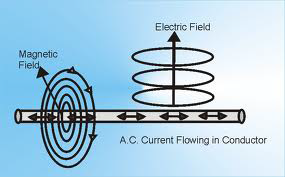
We may tend to forget that we live in a world that is carried by very powerful non-physical energies. Particularly in this day and age, our bodies are exposed to very high quantities of vibrational pollution. What is vibrational pollution? EMF, EMR, and any/all frequencies emitted by electricalNHPYCS-img7.png and/or magnetic devices. Cellphones, computers, pads, etc.! The polluting electrically charged vibrational energy from these devices enters our physiology and gets mixed up with our pranic energy. EMF being of a fiery agneya nature, it burns up the Soma in our bodies and creates imbalances. Many symptoms emerge when you are over-exposed to high quantities of agneya energy. Some people become more short-tempered and snappy; others feel fatigued very easily; yet others develop skin rashes or other more serious chronic conditions. The nadi-s or vibrational channels not only receive pranafrom the universe but they also filter unwanted vibrational energies that the body may be exposed to. When theNHPYCS-img8.png body is exposed to too much EMF on an ongoing basis, then the nadi-s become overwhelmed, and this, in its turn, affects the marma points and the sandhi-s or gaps in our cells. But it is not just vibrational pollution that affects these nadi-s. A good diet can nourish and maintain these nadi-s in good health.

Did you know that, as per the SVA perspective, the ultimate benefit from our food or herbs goes to nourish these very same nadi-s? The ultimate nourishment that you get from any physical material is called “prabhav.” Prabhava constitutes the specific vibrational make-up of any ingredient. It is vibrational inNHPYCS-img9.png that it cannot be examined under the microscope, but the vedic texts list a prabhava for every ingredient under the sun. For those who have pure physiologies, the prabhavas can be experienced or felt exactly as the texts describe them. For others who may have clogged channels, the prabhava may not be felt at all.

The prabhava of any ingredient operates only on the vibrational level and nourishes the vibrational pathways or nadi-s. Most of the time, when people are ingesting herbal supplements and not getting any benefit out of this, it is because either poor digestion, or weak assimilation, or an overloaded liver, or the lack of yogini-s (friendly bacteria in the colon), are disrupting the flow and energy and delivery of the prabhava of the herbs.

The health of the physical body matters, what you eat physically matters, but you have to also consider the vibrational health of your body through the nadi-s. Taking care of the nadi-s will automatically take care of the sandhi-s and the marma points. Vaidya relates that his father used to say: “nadi-s are the single vibrational channels, sandhi-s are when one channel branches out into many, and marma points are where all three nadi-s of all three pranic energies (Soma, Agni, Marut) are flowing unhindered, connected at each point to the individual light of the soul. So when you take care of the marma, you are taking care of the nadi-s because of pranic flow, and taking care of the sandhi-s, of everything!”

Besides food, there is also another highly effective way of supporting your nadi-s, and that is transdermally. You see, the “lom randra”-s, or every hair follicle of your body is connected to a nadi. So when you apply any topical or transdermal product which has the prabhava of the herb captured in a good living natural base, it will penetrate the body through the nadi, and reach the gap or sandhi-s and marma-s. You can also guide, based on your need, how and what to apply where in order to supply specific herbal prabhavas for specific organs or organ systems. Vaidya Mishra’s SVA Transdermal Marma System™ teaches this method, so you can apply specific creams on specific marma pints to target specific organs or sandhi-s connected to that marma point.

In this sense, the very first transdermal product Vaidya made in order to support, toNHPYCS-img10.png open, clean, and nourish the nadi-s was about 10 years ago. He called it SuperSport. It contains Prasarini as its main ingredient, a very important ayurvedic herb that is commonly used in the SVA tradition to enhance the reception of prana to the nadi-s, sandhi-s, and marma points. In addition to Prasarini, Vaidya’s formula also contains:

  • Parijat: a specific herb that supplies prana directly to the nerves;
  • Vitex nigundo, or nirgundi, dilates the gaps for the proper reception of pranic energy;
  • Camphor: clears the physical channels to receive prana more readily;
  • Tea-tree: unblocks the physical channels from ama to receive prana;NHPYCS-img11.png
  • Guggul: unblocks and cleans the fat channels to receive prana;
  • Mimosa pudica: enhances the reception of prana to the nerve endings;
  • Ashwagandha: supplies more pranic energy to the physical nerve;

NHPYCS-img12When you apply Vaidya Mishra’s SuperSport herbal synergy either as a cream or a roll-on on your marma points, you are taking care of the marma point itself, but also addressing the sandhi, and the nadi-s that connect to that marma point. When you enhance coordination between these three vibrational aspects(marma, nadi, sandhi), you are then supporting your physical channels and nurturing your physical organs and systems from the inside out!

What happens when your physical channels, organs, and systems are able to receiveNHPYCS-img13.png prana in an unhinder edmanner? It supports them by re-establishing Nature’s intelligence in them, so each cell in your body can run optimally by itself as it has been programmed to, for detox, and self- maintenance. When pranic flow to all the physical aspects of the body is unhindered, then any physical approach a physician takes to heal physical organs will work even better.

The SuperSport Herbal Synergy, either in the cream format, or the lipid and water soluble roll-on formats also helps if you have to work in a highly electronically charged environment, if you are highly exposed to EMF at work or at home. The SuperSport group of products also help calm the mind and enhance the coordination between mind and body, by allowing for the free unhindered flow of prana all over the physiology.

Are you Spice-Deficient?

In the ocean of Ayurveda, there are a lot of gems! Among those gems, the knowledge of Agni (digestive and metabolic fires), Ama (semi- or undigested food materials left behind in the tissues and organs), and Ojas (the finest by-product of good metabolism that nourishes the neuro-transmitters and hormones and gives glow to the face). Agni, Ama, and Ojas share a close relationship to herbs and spices.  The chemical make-up of spices can enhance or slow down our metabolic activities, help or hinder it. In other words, the balance of Agni, the circulation of Ama, the production of Ojas can be affected by the use or lack of spices and herbs. According to Ayurveda, and particularly in the SVA tradition, spices and herbs do not just contribute flavor to our palate they are a necessary part of our daily diet. They maintain optimal metabolic rate and avert sickness which results from the production of toxic waste. They balance our emotions and clear mental fog through the balance of hormones and other finer chemicals that nourish our cells. We can look a little more closely at how spices and herbs in our food help us in different ways.

The first thing is proper combination or Samyog. Which spices do we combine with other ones and in what proportions. The second most important thing is proper processing or Sanskar,  how to cook and in what medium. Ayurveda supplies us the detailed knowledge of what will work best for whom, how, and why. When proper Samyog and Sanskar are used, spices and herbs can help balance almost all kinds of digestion ailments, correcting metabolic and assimilation problems.

Not only eating spices and herbs, but smelling them is also therapeutic! Through their aromatherapeutic value they connect the mind and the digestive system via subtle  pathways, travelling in the micro- and macro- physical channels (Srota-s) as well as the vibrational channels (Nadi-s).
AYSD-img1Raw spices and herbs help even through their aroma, but cooking the spices and herbs is recommended in Ayurveda. Cooking – that is exposing to heat – activates the inherent chemical properties of the spices and herbs, creating a molecular interaction between the spices and the oil medium used (ghee or olive oil). Cooking makes the spices and herbs more easily available to the digestive organs and systems in our body. In addition, cooking with spices also sanitizes toxic unwanted materials that might be present in the vegetables, lentils, or grains. But spices and herbs have an additional even greater property.

Almost all spices and herbs are primarily known to be Yogvahi, that is: they act as vehicles for the micronutrients found in the food you eat. Spices help to break down carbohydrate, protein, fat, as and when needed. As Yogvahi-s, they are as essential to our diet as all the food groups found on the food pyramid, but somehow we have forget to use them, and we only include them in our recipes for added flavor!

The SVA tradition explains that spices and herbs are little packets of intelligence, equipped with the blue-prints for healing! The minute they enter our body they start to clean-up the channels paving their way to their destination, carrying along nutrients they that came with and taking them to where they are meant to go for further processing, In addition, they make sure that unwanted bi-products are evacuated through the proper pathways and discarded from the body in a timely manner.

However, there is more! Spices and herbs are so intelligent that they can perform their functions not only when we eat them, but also when we apply them on our skin. If they are pranically preserved and placed in a lively medium (a good oil base or shea butter) they enter the skin and travel through its different layers and then travel through the blood stream, bypassing all the digestive organs and systems, and they reach the mind, the heart, and all the  extremities of the body.

AYSD-img2The topical use of spices and herbs is very important in the SVA tradition, because often, due to different factors, the body is unable to ingest large quantities or spices that are necessary for it to restore balance. Topical transdermal use is safe, highly effective, and even faster than oral ingestion and digestion. It takes seconds for transdermal topical absorption to reach its targeted area, while it takes approximately 20-30 minutes for food, after it is ingested, to be broken down, processed, and eventually distributed. Spices and herbs when used topically, also help the skin locally, on the spot. They nourish and awaken it, and then rejuvenate its different layers, before being transdermally absorbed all over the body.

So how can you tell if you are spice-deficient? SVA recommends that we  ideally consume at least some turmeric, cumin, coriander, and fennel with every meal. These four spices are basic in their balancing properties and targeted benefits. Otherwise, if you tend to feel tired after completing a meal, or if you tend to overeat because you do not feel satiated, or crave sweets excessively after completing a meal, these are all signals that there is some imbalance in your digestive system, and adding the proper mixture of spices (masala) can help correct it. A good digestion is key to healthy emotions and clear mind! Click here to watch Vaidya talk about spice deficiency and much more!

What happens when you eat or The Mechanics of Ayurvedic Digestion

Proper digestion of food is the foundation of our health. But what does proper digestion mean in ayurvedic terms and what does it entail? Vaidya Mishra offers a very specific and clear answer. Click here to hear Vaidya Mishra explain the details of the ayurvedic digestive process. But do we every stop to think about what triggers digestion? How does our body “know” when to start the process of digestion?
The SVA tradition reminds us that the process of human digestion is initiated even before you put something into your mouth! When you see and smell the food, your body already prepares itself by sending signals to your different brain centers. The brain then triggers the release of specialized chemicals that will help in the break-down, digestion, and absorption of your food. We have all experienced this. Remember what happens when you look at pickles? Your mouth automatically produces more saliva to coat the spice, salt and sour that is coming in with the pickle! Or the feeling of content in your heart when you see or smell a freshly baked hot-from the-oven cake?

This is your brain sending signals to your digestive system based on what the senses are gathering. Science confirms the fact that digestion begins with the sight and smell of food and calls this stage of digestion “cephalic phase” (cephalic means that which has to do with the head). This phase occurs before food enters the stomach and is very important because it readies the body for eating and digestion. The sight and thought of the food stimulate our cerebral cortex. Then the taste and smell of our food are sent to yet other specialized parts of our brain, the hypothalamus (this is a small chamber in our brain that connects the nervous system to the endocrine system) and the medulla (this part of the brain deals with the cardiac, respiratory, vomiting, and involuntary functions, such as breathing, heart-rate, blood pressure). When the cerebral cortext, the medula and the hypothalamus receive all this information they adjust their functions and ready the physiology in all its aspects to enhance the secretion of gastric juices and enzymes.
Ayurveda also explains this complex system of digestion in detail.Vaidya Mishra’s lineage, Shaka Vansiya Ayurveda, likens the digestive system to a burner and uses the analogy to its fullest to explain its different components. This is how Vaidya Kameshwar Mishra explained the digestive process to his interning son, Vaidya Ramakant Mishra, when his college teacher was unable to explain and elucidate the difference between Pachak Pitta and Pachak Agni….

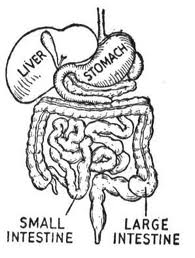
SV Ayurveda likens the stomach to aWHWYE-img1 ‘burner’ – imagine a burner as the one in your kitchen stove on which you cook everyday. In order to function and cook food placed on top of it, your burner needs fuel. Our stomach supplies such fuel (gastric acid, pepsin, digestive enzymes). In ayurveda, the fuel of this burner is called “pachak pitta.” How do you ignite this fuel? When your brain receives the signal that food is coming, it starts releasing pachak pitta in the stomach cavity which amounts to lowering the stomach pH so that the “cooking of the ingested food” can be initiated. This produces a flame/fire called “pachak agni” or “jathar agni” which is responsible for transforming the food that was ingested. This phase is called the gastric phase (or the stomach phase) that takes approximately 3-4 hours to complete! At this point in the stomach we have food, we have gastric and digestive juices (pachak pitta), a lowered pH (1-3), and automatic reflexes that churn the food breaking it down into smaller molecules and particles and this constitutes the pachak agni, the actual cooking activity.

SVA highlights that in order to support this highly sophisticated activity of eating and digesting food, of maintaining the proper balanced activity of Pachak Agni and Pachak Pitta in the burner, the gap, it is necessary to chew well, and helpful to eat in silence because chewing helps to break down the food by mixing it in with the digestive fluids found in the saliva, because unlike some other species, for humans, digestion begins in the oral cavity or the mouth. We secrete large amounts of saliva every day (1-1.5 litres/day). This saliva helps moisten the food and it contains digestive enzymes which aid in the chemical breakdown of complex molecules. The tongue helps form the food into a ball and pushes it to the back of the mouth and then down the esophagus where it is ready to be broken down by the stomach. Keeping silence helps to focus on the food. It gives the brain the opportunity to put undivided attention to govern all the activities in the mouth, the esophagus, the burner, or the digestive gaps. When the brain’s attention is not divided by other activities, then it can better determine how much flame needs to be given during the process of digestion. The brain then knows best what to do if there are problems arising due to either the food that was ingested (if it needs more breaking down if it is too rich in fat or protein) or if the digestion is slow because the individual is tired(not sleeping enough and working too much) or undergoing emotional stress etc. If digestion is slow due to heavy foods, it may also be due to the lack of proper spicing and cooking or the quality of the food or the quantity of the food, or the temperature of the food. This is where the concept of Ama comes in. The vedic shastras (ancient classical texts) say that no physical disease can happen without Ama hence one of the synonyms of disease is “amaya” (full of ama).

What are some ayurvedic digestive imbalances?
There can be 3 kinds of imbalances that the flame can have due to problems in the fuel or the burner. Click here to listen to Vaidya explain these.
For example,  if the fuel is less in quantity or the burner is clogged (different parts of the stomach are not functioning optimally) or both then the flame, the Agni (overall cooking process) will be low. This state is called Mandagni – or low Agni. In this case, when the food reaches the stomach without proper spicing that would correct that condition, then whatever portion of the food is not cooked properly will result in Ama. Proper spicing can help this situation very easily as different spices can help with different parts of the digestive process – some enhance the Pachak Pitta, others correct the Pachak Agni, others yet just clean the gaps on the burner to let the Pachak Pitta and Pachak Agni interact and do their job better in a cleaner environment! Modern nutraceutical science promotes high nutrient content diets across the board for all individuals. For example, brown rice. Brown rice contains more nutrients than white rice but then what happen when somebody has low Agni? When they eat heavier food that their stomach cannot fully properly digest, it will remain semi-digested, that is they will produce ama (semi-digested toxins) out of the nutrients in brown rice. In the case of Mandagni or the slow flame, SV Ayurveda gives specific recommendations for spices based on specific body types, age, climate, or season, and even ethnic background. Taking care of Mandagni or low agni situation through recommending spices is easier than other conditions Common helpful spices for Mandagni are: fresh ginger, sunthi(pitta-pacifying ginger), black pepper corns, long pepper (pippali), green thai chilies, ajwain seeds, cumin seeds.  But recommending these spices to all low Agni or Mandagni people would be dangerous in the situation where the person is either high Pitta by Prakriti (natal constitution), or if the Pitta is aggravated and accumulated in the stomach or the Sandhi (gap) or the burner is clogged, due to vibrational toxins (resulting from emotional or other non-material stress).  Unlike mainstream Ayurveda, SV Ayurveda identifies this condition called “High Pitta Low Agni” and has remedies to help balance it preventing further digestive and emotional aggravation. If an individual has high Pitta low Agni when the fuel is hot and the flame is low, then all the above spices will heat up the Pitta even more and create aggravation (desire to eat more but ability to digest less and less resulting in heaviness, fatigue, acidity, heartburn, emotional upset). In this situation, SVA recommends spices such as fennel, coriander to cook with. Clove is also very good for high Pitta and low Agni situations. but in very moderate doses. As far as turmeric, the king of spices goes, it has to be used in high Pitta low Agni with lots of coriander and fennel.
Connecting the mind and the stomach, that is keeping your attention on the eating process and not on TV or a conversation or reading a book is also recommended in Ayurveda. In ayurvedic terms, the mobility factor in the our bodies is call the Vata Dosha. The Vata Dosha helps to move things where they are meant to go. It supplies the air principle to our physiology. It has many subcategories. During digestion, it is important to keep Prana Vata (that runs the brain activity) and Samana vata (that keeps activity in the stomach going) balanced and coordinated, since the brain always commands the conversion and flow of the flame as modern science also recognizes. Hear more about the sub-doshas with Vaidya Mishra, click here

Tips for connecting Samana and Prana Vata :
when you eat, keep your spine straight to allow for the optimal flow of Prana Vata to the stomach area and also to give better room for Samana Vata to do its job. If you are having trouble with your circulatory vibrational channels, you can use Vaidya Mishra’s Supersport Transdermal cream on the spine or Supersport spray on the stomach (apply in clockwise motion) before food. 

Modern Science Confirms the Sutra-s

There are thousands of studies on turmeric and its health benefits including its preventative action for a wide range of fatal and chronic modern diseases, including: cancer, arthritis, diabetes,MSCTS-img1cardiovascular diseases, osteporosis, Alzheimer. Research shows that turmeric helps the body release cancer causing toxins, blocks estrogen receptors and enzymes that promote cancer and prevent the growth of new blood vessels.
 Turmeric is now recognized as one of the most powerful chemopreventive and anticancer agents. Anticancer drugs weaken the immune system, but curcumin actually enhances it! even acting as an immune restorer. Research at UCLA has concluded that turmeric is effective for the treatment and prevention of Alzheimer’s disease. Researchers have found that turmeric helps maintain healthy brain cellular metabolism, helps the the cells repair themselves and maintains the cell connection to each other. A wealth of data shows the anti-inflammatory, antioxidant, chemopreventive and anti-neoplastic (fighting cancer), antibacterial, antifungal, antiviral properties and capabilities of turmeric. The countless benefits of turmeric are so diverse that they affect virtually every organ.

Some pertinent research references:

  •          Churchill M. Chadburn A, Bilinski RT, Bertagnolli MM. Inhibition of intestinal tumors by curcumin is associated with changes in the intestinal immune cell profile. J Surg Res. 2000 Apr;89(2):169-75.
  •          Pal S, Bhattacharyya S, Choudhuri T, et al. Amelioration of immune cell number depletion and potentiation of depressed detoxification system of tumor-bearing mice by curcumin. Cancer Detect Prev. 2005;29(5):470-8.
  •          Perkins S, Verschoyle RD, Hill K, et al. Chemopreventive efficacy and pharmacokinetics of curcumin in the min/+ mouse, a model of familial adenomatous polyposis. Cancer Epidemiol Biomarkers Prev. 2002 Jun;11(6): 535-40.
  •         South EH, Exon JH, Hendrix K. Dietary curcumin enhances antibody responses in rats. Immunopharmacol Immunotoxicol. 1997 Feb;19(1):105-19
  •         Kim GY, Kim KH, Lee SH, et al. Curcumin inhibits immunostimulatory function of dendritic cells, MAPKs and translocation of NF-kappa B as potential targets. J Immunol. 2005 Jun 15;174(12):8116-24
  •          Bhattacharyya S, Mandal D, Saha B, et al. Curcumin prevents tumor-induced T cell apoptosis through Stat-5a-mediated Bcl-2 induction. J Biol Chem. 2007 Jun1;282(22):159-64.
  •          Thangapazham RL, Sharma A, Maheshwari RK. Multiple molecular targets in cancer chemoprevention by curcumin. AAPS J.
  •          Jagetia GC, Aggarwal BB. “Spicing up” of the immune system by curcumin. J Clin Immunol. 2007 Jan;27(1):19-35.
  •          Yang F, Lim GP, Begum AN, et al. Curcumin inhibits formation of amyloidbeta oligomers and fibrils, binds plaques, and reduces amyloid in vivo. J Biol Chem.2005;280:5892-901.
  •          Lim GP, Chu T, Yang F, Beech W, Frautschy SA, Cole GM. The curry spicecurcumin reduces oxidative damage andamyloid pathology in an Alzheimertransgenic mouse. J Neurosci. 2001;21:8370-7.
  •          Cole GM, Morihara T, Lim GP, Yang F, Begum A, Frautschy SA. NSAID and Antioxidant Prevention of Alzheimer’s Disease: Lessons from In Vitro and Animal Models. Ann N Y Acad Sci.2004;1035:68-84