For Him: Male Stamina

Male health as a medical specialty, or andrology (from the ancient Greek for andros or man, + logia or study), developed only in the late 1960-s. But it has been in place for thousands of years in Ayurveda. Ayurveda has known and used many different herbs, plants, preparations and methods to address ill-being and diseases for men,ForHim-img1 specially pertaining to the reproductive organs.

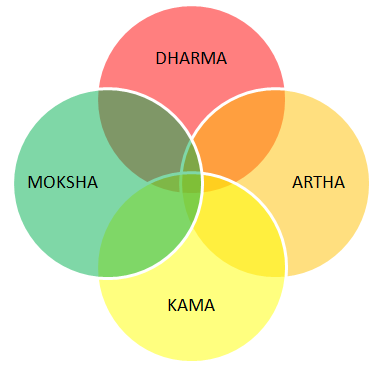
The Vedic shastras speak of human objectives or “purusharth:” “dharm, arth, kam, moksh.” These four objectives sum up the pursuits of humans: dharm or ethical duty towards oneself and the collectivity one is born into; arth or pursuit of affluence; kam or pursuit of desire. Kam is usually understood to be carnal desire, and this is not a deviation that leads to the gates of hell, but rather a natural and necessary part of an individual’s evolution towards the final stage of total spiritual liberation, or moksh. In the vedic tradition, the human lifespan is understood in 4 strokes: 1)Brahmachari ashram or early childhood and youth when one is primarily a student in many ways and where one abstains from sexuality; garhasta ashram or the stage of the householder when one is active professionally and personally; vanaprasht ashram or turning away from the “things of this world” to develop a detachment; and sanyas ashram or leading the life of a total renunciant.

Garhasta ashram is about being together with a partner, supporting one other to thrive and to develop through and as a family, inviting new souls into the world, to keep the wheel of evolution going. In this sense, in Ayurveda, the topic of maleFor Him virility is particularly important, as it goes hand in hand with the continuation of the world as we know it. The Charak Samhita devotes a specific chapter to this topic entitled “Vajikarna.” In this chapter, several approaches are discussed to maintain, cure, and improve male virility. From recipes to the use of single herbs or herbal synergies, different protocols are listed and explained (to learn more on this topic, listen to Vaidya Mishra’s Love and Prana II available on www.chandika.com
In particular, the chapter discusses herbs that carry the following “prabhava”s or ultimate subtle post-digestive and post-absortpion effect: vrishya – increases shukra dhatu or the reproductive tissue; bhringhana – supports all 7 tissues including shukra or the reproductive tissue; vajikarna – increases libido; and rasayana – overall rejuvenative also essential for healthy and graceful aging. The Charak Samhita lists and discusses herbs or recipes that containing any dravya-s or plant materials that carry these properties. Some of these herbs have already been the subject of scientific studies that have confirmed the conclusions of the ayurvedic texts – see Dr. Barbara Davis’ article for the scientific references. Here are some of these herbs that help balance and rejuvenate the male physiology physically, emotionally, and mentally, as discussed in the Sanskrit sutra-s.

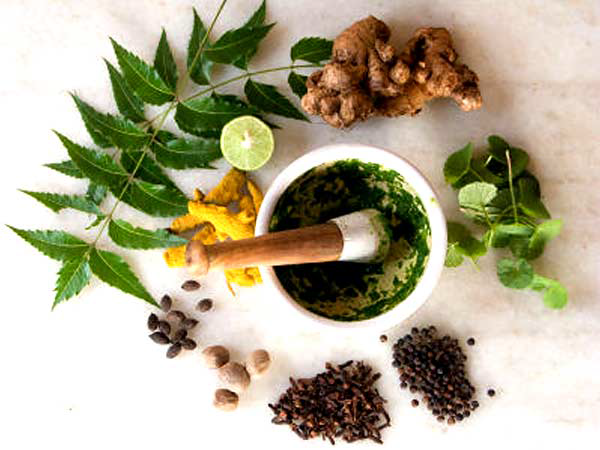
Mucuna – also called “kapikachu” in Sanskrit. The seed of the mucuna plant is “vrishya” or increases the reproductive tissue; it has a sweet rasa; it is bhringhana or nourishing to all the 7 tissues, and particularly the reproductiveForHim-img2 tissue; it can be a little heavy on digestion; bitter in taste; it pacifies vata or the principle of air and space in the body; it increases stamina, pacifies pitta and kapha doshas or principles as well. It is also vajikar or increases libido. It carries all 4 qualities that are needed for male stamina. It is cited by both Bhav prakash and Shodhal.

White Musali is another important dravya or plant. It is sweet, cooling, and vrishya – enhances the reproductive tissue. It supplies nourishment and stamina overall. Due to its slippery properties it supports kapha and pacifies pitta, eliminating inflammation and fatigue.ForHim-img3

For Him-img4Gokshura – tribulus: cooling, enhances stamina, sweet, and vhringhani – increases and nurtures all tissues particularly the reproductive tissue. Supports the flow of urine; de-crystalizes urinary stones; cools the urinary system; it’s a rasayana for the genito-urinary tract; enhances stamina; it’s vrishya – nourishes the reproductive tissue.ForHim-img5

For Him5Ashwagandha: just as famous as Gokshura, it is astringent in taste; pungent; bitter; it pacifies vata and kapha; enhances shukra or the reproductive tissue; enhances stamina; is a well known rasayana.ForHim-img6

Shring bhasma: or deer antler calcined ash, has been used by the ancient rishis or seers in so many ways, including the support of male health overall. For more information on this subject, watch Vaidya Mishra’s YouTube video on his SVA Health channel.

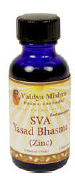
Yasad bhasma Zinc calcined ash, is a famed rejuvenative mineral that supports the nerves. It is an essential ingredient for male health as the prostate gland needs ample amounts of zinc to maintain its healthy balance. Watch Vaidya Mishra on YouTube on this topic for more details.

Daily Protocol: with the SVA alternative advanced delivery systems, you can add all these herbs to your daily routine.

Herbal-Memory Nectar Drops are a subtle efficient trans-mucosal way of getting the “intelligence” of these herbs into your physiology safely and effectively.

To 32 oz of high pH spring water, add:

  • 3 drops of zinc,
  • 3 drops of musli,
  • 3 drops of aswhagandha,
  • 3 drops VJK

Then take 1 capsule of Tribulus Plus after breakfast, and 1 capsule after lunch.

Crush 1 tablet of Ashwagandha with 2 tablets of Mucuna plus, add to spring water, bring to a boil, filter and drink as a tea after lunch.

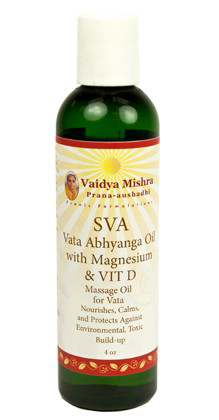
Needless to say, to get the full effect and benefits of any of these herbs you will need to keep an optimally fresh and intelligent diet and routine, also keep a balance between rest and activity. Daily self-massage or abhyanga with Vata massage oil with Vit D and magnesium will help nurture and relax the physiology. With a balanced life-style and the “prabhava” of these herbs, you are sure to live according to the tenets of the shastra-s enjoying the most out of each stage of life in accordance with the desires that animate us all humans.
What’s too much Zinc?

“Is it possible to still get too much zinc taking the Yasad Bhasma Nectar drops daily? As per this article I just read…
What happens if I take too much zinc?
Taking high doses of zinc reduces the amount of copper the body can absorb. This can lead to anemia and weakening of the bones.
What does the Department of Health advise?
You should be able to get all the zinc you need by eating a varied and balanced diet. If you take zinc supplements, it is important not to take too much because this could be harmful.

Do not take more than 25mg of zinc supplements a day, unless advised to by a doctor. Christiane F.”

WTMZ-img1Dear Christiane: at SVA we do not promote zinc supplements as these do have side effects when used without the guidance of a medical physician. Our SVA Herbal-Memory zinc drops are different. The zinc molecules in that formula are contained in an herbal synergy formula balanced by many ingredients, amongst which are cardamom and coriander. The cardamom helps prevent nausea, while coriander enhances the intelligence for the absorption and elimination of unused zinc. In addition, you are using the Herbal-Memory nectar drops inminimal quantities with plenty of water. For example you may be adding 1 drop of Zinc, which contains 4-5 mg of micro-molecules of zinc. This amount is easy for the body to absorb and use. Then, you are mixing 1 or 2 drops into one liter or 32 oz of water – this disperses the molecules in the water.
In addition, water is the best delivery medium because it is safe and effective. Finally, when you sip this water slowly throughout the day, it gives slow and sustained delivery of the zinc molecules without overwhelming any organ or organ systems in the body. It’san all benefits and no side-effects formula! Zinc is great to support the immune system, and this is the best season to start taking it to build your immune system.

Onion and Garlic vs Turmeric and Ginger

“Dear Vaidya first I would like to express my gratitude for all the precious knowledge that you have made available, this is a wonderful service.
May I ask you a question about onions and garlic?
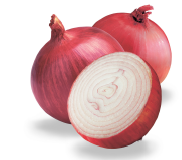
Most of the Ayurvedic views on onions and garlic dissuade one from their use due to their tamasic nature. You speak of the scientific point of view: onions and garlic kill the beneficial bacteria inOAGVTAG-img1 the intestine.
May I ask you: 
-Is this equally the case for cooked garlic and onions and raw garlic and onions?

Cooked vs. raw
Dear Aaron: yes, it is true that cooked garlic and onion have less of an effect – both therapeutic and harmful – because in the process of cooking much of the sulfur content evaporates since it is volatile in nature. However, enough of it remains to still harm the friendly bacteria in one’s gut, particularly if one does not already have a good colony and good environment for the bacteria to thrive in the colon. And, it will not be an overstatement to say that most individuals nowadays do not have a good environment because most of us thrive on an acidic diet, stressful lifestyle, and minimal sleep. So when you add ingredients high in sulfur content, such as onion and garlic, it only aggravates an already precarious situation. However, if an individual falls within the minority of those who do take care of their friendly bacteria, and do keep a good routine and diet, then in that case it will depend on actually how much onion and garlic that individual is consuming, how frequently, and what is eaten along with the onion and garlic – foods that buffer and balance the deleterious properties or aggravate them further. Taking such factors into consideration, cooked onion and garlic may be incorporated in the diet if desired.

Garlic as Prebiotic?
“I have found some references that cite garlic itself as a prebiotic, including even a very respected manufacturer of probiotics, Theralac, that recommends taking garlic, as a prebiotic, along with their probiotic! I did some research on this a while ago, and I found a study done by people who actually tested the effect of garlic on the intestinal flora: they found that raw garlic does indeed kill both harmful and beneficial bacteria in the body, whereas cooked garlic does not have this effect.”

This is only half the picture. Yes, garlic does contain prebiotics but it also has an anti-biotic effect. It is a common tendency nowadays to promote half-truths! This is part of the reason I always stress “satya sampurn gyan” – complete unadulterated (truthful) knowledge as the shastra-s stress. Whatever prebiotic molecules or properties garlic and onion may carry is nullified by their sulfur content. But again, thisOAGVTAG-img2 depends on various factors, it is not a straightforward answer: it depends on whether cooked or raw, if so, how much, cooked how and with what, consumed with what other ingredients that will buffer or accentuate, plus what is the state of the colon etc.

Garlic in Ayurveda
Otherwise, there seem to be about an equal number of information sources that consider garlic and onions to be prebiotics that are good for the beneficial bacteria, and sources that say they kill both the harmful and beneficial bacteria. The scientific view on this subject thus seems to be divided, as far as I have been able to learn.
The Ayurvedic view on the problematic nature of garlic and onions, as I understand, does not seem to be connected to their effect on beneficial bacteria, but on their subtle/energetic properties. Is my understanding right here?

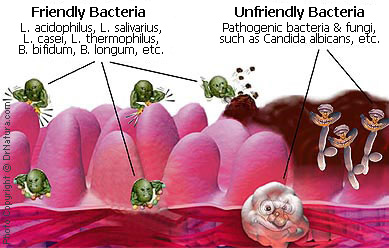
We have all been misinformed! That is why I always stress, with SVA, the journey is from Sutra to Science, as well as science to sutra…. SVA emphasizes the holistic nature of knowledge. And it is all already always there in Ayurveda. That we know for sure. In Ayurveda, the name for a friendly bacteria is “yogini.” You are right to the extent that no ayurvedic books or experts discuss or mention this. In my lineage, however, the yogini-s get front and center attention. Whether it is in the discussion of the probiotic effect of yogurt, as well as coconut yogurt, or the harmful effect of foods that deplete the gut of yogini-s or friendly bacteria. My father used to discuss at length the importance of friendly bacteria, and he used the phrase: “the brain of the brain resides in the gut” to express his conviction of the key role that friendly bacteria play for our total health. Even more than that, in our SVA lineage, this is exactly the reason why garlic and onion are notOAGVTAG-img3 consumed as part of our daily regular meals, because they are known to harm the colonies of friendly bacteria in our gut. Classical Ayurveda may not stress this out in the exact same way but it does it by emphasizing the importance of consuming foods that help nurture the friendly bacteria. The field of bacteriology in Ayurveda, “Bhoot Vidya” is a branch of that discusses the specifics of friendly and harmful bacteria, thousands of years before the invention of the microscope. But perhaps the best way to understand that garlic and onion are harmful for us despite beneficial properties they carry is metaphorically from the purana-s (the Sanskrit sacred writings containing Hindu legends and folklore), through the story of the genesis of garlic. When the gods were lined up to drink Amrit, the nectar of immortality, the demon Rahu snuck in with a cape pulled down over his features and got a bowl full of nectar to drink up. Just as he was about to swallow the nectar, he got caught and his head was cut off by Mohini, the femal avatar of Vishnu. Blood from his decapitated head fell onto earth, and since his blood was mixed with the nectar he was swallowing it sprouted into garlic, a dravya or food ingredient, that carries both beneficial and harmful properties, both “demon’s blood” and “nectar of immortality”! When one consumes garlic, one gets both this and that property…

Vs Turmeric and Ginger
– Turmeric and ginger are also antibacterial. From the point of view of effect on beneficial bacteria, would they differ from garlic and onions?

Turmeric and ginger are antibacterial due to their content of specific essential oils. Turmeric and ginger enhance the intelligence of the immune system, so that the immune system can distinguish between good and bad bacteria. Both turmeric and ginger are known to be immuno-modulators. So turmeric and ginger support the immune system by discouraging the growth of bacteria and that is why they are considered antibacterial.
OAGVTAG-img4.pngBut you can see this from another angle as well, from the perspective of the gunas or properties: rasa, guna, virya, vipak, and prabhava. These are the main 5 properties (which have sub-properties themselves) according to which we can categorize every edible thing under the sun. For ginger and turmeric, on the first step or rasa (taste) level, you can say that there are antibacterial properties, but by the time the turmeric or ginger cross the first level to go deeper in the body and display “guna, virya, vipak” properties in the stomach, intestine etc, they no longer carry any antibacterial effect. However, onion and garlic do.
Onion and garlic have an antibacterial effect in their vipak and prabhava, while turmeric and ginger are only antibacterial directly on the rasa level, and indirectly by supporting the immune system. This is why turmeric and ginger are not considered antibiotics, but garlic and onion can be.
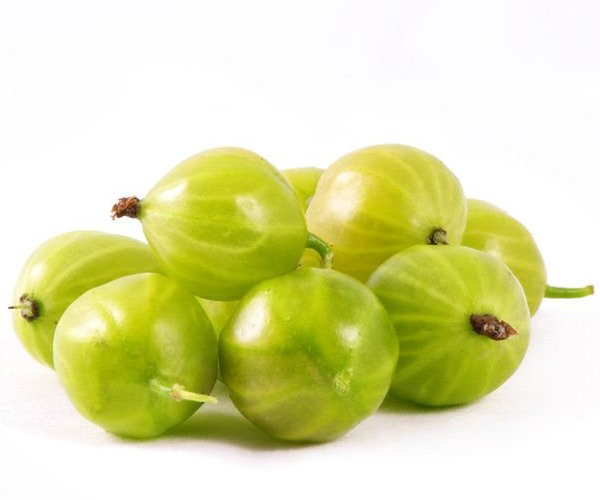
When ingredients are understood on the level of the pharmacodynamics of Ayurveda, not just through the perspective of modern neutraceutical logic, where it’s more a focus on the ingredient content and immediateOAGVTAG-img5.png chemical constitution and effects, then things can be understood in their total picture. With the “rasa, guna, virya, vipak, and prabhava” of Ayurveda, something sour and originally acidic can be known and used as an alkaline ingredient. An easy example is lime. Lime is a citrus fruit acidic in nature, and we know that any acidic food kills friendly bacteria, but lime actually does not, because its acidity is only on the rasa or taste level, once it is ingested and digested, it has not an acidic but actually an alkaline vipak or post-digestive effect. Same goes for the amla berry. Sour at first, it carries a “madhur” or sweet “vipak” or postdigestive effect which is alkaline so it supports the friendly bacteria.

I would be very grateful for any additional light you could shed on this subject. It is important for me to know, since I often incorporate cooked garlic and onions into my meals for their benefits (according to many ayurvedic sources) on physical health, with the idea that once the physical health is in good shape, they will no longer be necessary.
Thank you, Vaidya Mishra, for your time and attention in reading this, and with warmest wishes from France.
Sincerely, 
Aaron E.”

Dear Aaron, I hope I was able to show you that it is better for you to avoid onion and garlic. There are so very many other ingredients – particularly spices – that can be used to enhance and support health overall. And even if the argument for or against the role of garlic and onion is not conclusive for you, at least you can remember that they are confirmed “tamasic” food agents that can shroud spiritual insight, and when our spiritual antennas are blocked, health can’t but suffer as we may start to make unwholesome decisions…

Milk, ghee, and infertility

“Hello,
MGAI-img1I remember once hearing Dr. Teitelbaum speaking about women being unable to become pregnant due to lack of whole milk and ghee in the diet.
I currently have a “dairy-free” friend who is having trouble getting pregnant.
I was wondering if Dr. T (or Vaidye) could outline some of the key things that every couple should consider before conceiving (e.g. detox), if unable to conceive, and after conceiving.
Thank you,
– Joseph R.”

MGAI-img2Dr Teitelbaum responds:
“When I was younger, women stayed at home while their husbands went out to work. They had as many children as they wanted -­ many had 3, 4, 5, 6 or more. We never heard of the word “infertility” back then. Then, in the early 1970’s women went into the work force, working full-time jobs, while trying to maintain their household duties as well. Then, slowly but surely, women began to experience infertility. Now, it is almost at epidemic levels. So let’s see what happens in the physiology when someone is under stress.

From an Ayurvedic perspective, Vata dosha (remember this is the element in nature of air, lightness, dryness, movement, coldness) goes out of balance when there is too much stress placed on the physiology. Since it is the element of movement, too much movement, such as working too many hours in the day without having enough rest, will throw Vata out of balance.

In particular, the subdosha Apana Vata, that which resides in the pelvic and low back regions, will go out of balance. This is where the uterus and ovaries are located. So when apana vata becomes imbalanced, the uterus and ovaries become disrupted.

So, first you must check and see if the patient has vata disturbed, and especially apana vata.
If so, they must be instructed as to how to keep vata (anda pana, and other vata subdoshas that might be out of balance) balanced. Some things that come to mind, might be (and if she were a patient of mine, we would get much more specific): go to bed by 10:00 p.m., don’t rush during the day, don’t over-extend the senses, such as talking too much or too quickly. Since Vata is the element of coldness and dryness, we would recommend an unctuous diet utilizing warm cooked foods, as opposed to cold or raw foods. Unctuous means that the diet would contain whole milk and ghee.

(There are numerous other considerations we must take into account, but here we are only discussing why someone might need more milk and ghee in the diet to help make them more fertile).

Unfortunately, we are living at a time when low-fat diets are in vogue, partlyMGAI-img3 because modern medicine has convinced us that cholesterol clogs the arteries. We try to re-educate the patients that come to our office so they can see why cholesterol is in fact good for you, if you eat the right kind, which is not channel-clogging, such as warm milk and ghee.

If you combine living in a stressful world with a low-fat or even worse, a vegan or raw foods diet, then Vata dosha will definitely go out of balance increasing one’s infertility.

And one other thing to always keep in mind -­ the female hormones that make you fertile -­ estrogen and progesterone -­ are made out of cholesterol…and so are the adrenal gland stress hormones! So we must give our bodies the raw materials to make these hormones.”

Dr. Marianne Teitelbaum
Cinnaminson, New Jersey
856-786-3330

Massage oil before or after shower?

“I’m over 50, vata dosha for as long as I can remember. I live in the Northeast (Massachusetts) and started using SVA Vatta Abhyanga Oil with Magnesium & Vitamin D last winter. My question is that in our cold climate I want to apply it just  before getting out of my steam shower in the morning and then putting on warm layers of clothing. Last winter I followed the recommendation of applying,MOBOAS-img1 turning on the fireplace in my room and waiting 20 minutes to shower it off. Is it less effective if I use it at the end of the shower and don’t wash it off?
I also do the Samadhi set each day before meditation.
Any insight is much appreciated,
Namaste,
Wendy P.”

Dear Wendy: yes, it is possible to do it at the end of your steam shower. Just make sure you apply only a thin layer of oil, not a thick one. Although this is a massage oil rich in nutrients that nourishes your physiology, it is also, by its nature and by definition a detoxifying medium. By definition, oils pull out toxins, they bind the fat soluble toxins through the skin and pull them out of the cellular system. This is why I recommend to wait 20 minutes before washing it off, so you allow time for your body to detox and let your cellular system be nourished. Since this oil has additional nutritional content, you may apply and leave it on after shower for optimal absorption since your channels will be open and even more receptive of the transdermal nutrients. But make sure you are applying only a very thin layer, and not soaking yourself in oil, and make sure that you are wearing warm clothes after applying it, because the oil molecules retain temperatures for a long time.

Chyavanprash?

“Namaste SVA Support Person
I have a request for Vaidya Mishra : Please could he discuss Chyavanprash. Is it always good for everybody of all ages or should it be avoided in ama conditions like, low jatharagni, heavy phlegm, flu, sore joints, white coating on tongue etc, because it is a rasayan and therefore heavy to digest? I would like clarification because some vaidyas  say to avoid if there is ama and some say it is good anyway, especially for coughs and colds or boosting immunity. I have been reading Vaidya Mishra’s newsletters for the past 2 years and I take his word as the last definitive word on any topic. He has such depth of knowledge and such clarity in imparting the wisdom of Ayurveda.
Thank you.
Kind regards
Gita K.
Melbourne Australia”

Dear Gita: the Shastras say that all the “avaleha”s (semi-liquid pastes almost always made with sugar and ghee) including chyavanprash should only be taken when/if “jatharagni” (also known as “pachakagni” or the metabolic fire in the stomach) is sharp and optimal; otherwiseC-img1 consuming chayavanprash results in ama or toxins. There is no doubt that chyavanprash is a great rasayana, a rejuvenating blend of herbs and spices, an ancient effective formula; however, in the case of the flu, phlegm, congestion, etc, it is best to first address those with other ayurvedic means before resuming the use of chyavanprash.

But your question incites me to addressan important point in this context: you should be aware of using the chyavanprash available on the market, for many reasons. For one, many of the ingredients in the original classical formula are very hard to procure. It contains more than 45 original ingredients, and many of these ingredients are not easily available. The cost of gathering those ingredients is increasing. Many commercial chyavanprash brands are competing against eachother lowering their price. It makes me wonder how any company can manage to put together a pure and originalC-img2 chyavanprash formula but selling it at extremely low prices. In addition, one of the primary ingredients, the amla berry, is not even used in the form it should be: nobody makes chyavanprash with wild harvested amla, but rather with hybridized, and probably genetically modified, amla because wild amla has less yield and more fiber including larger seeds. Wild harvested amla is not a commercially viable product, specially since chyawanprash is in such high demand as a natural herbal product good for boosting immunity health from 6 to 66 years old! Yet another problem in the commercial manufacturing of chyavanprash nowadays is the use of refined white sugar crystals, as well as ghee derived from milk butter instead of yogurt butter. Last but not least, almost all brands of commercially available chyavanprash are packaged in plastic jars. Amla, its primary ingredient, being acidic in nature, will interact with the container leaching plastic molecules into the “prash” or mixture making it highly toxic. In addition, you should check the label, as sometimes they add preservatives. The original formula, when made right, has what it takes to preserve itself. However, when it is not done right with the right ingredients, a preservative is needed to make sure it can be stored on shelves for extended periods of time.

Bacterial/Yeast Overgrowth

“How does one overcome bacterial / yeast overgrowth in the gut? What herbs are good for treating yeast/candida issues? Thank You.
Vidhya P.”

Dear Vidhya: This is a really great question. I deal with this problem on a daily basis with almost every patient in my practice. This problem is one that is fairly easy to fix, but many people are having a hard timeBYO-img1 fixing it because they need to be under the care of someone who is familiar with the problem.

You really can’t take herbs that will fix this problem. Instead, you have to re-culture the friendly bacteria in the gut. This is not so hard to do, but I would refer you to one of the  SVA practitioners, so they can first get your history and then prescribe the correct remedies.

In general, however, if there is too much heat (pitta) in the gut or an acid pH in the system, the friendly bacteria that reside in the gut can die off. These friendly bacteria are responsible for preventing yeast and bacterial overgrowth in the gut. If you take any remedy to kill infection, such as oregano oil, pau darco tea, garlic (these are some of the remedies our patients have tried before coming in to see me) it won’t work. Even the pharmaceuticals, such as diflucan and flagyll don’t work,BYO-img2 because what all these things do is kill infection. Once you kill the infection, it will grow right back.
So the real key to the problem is to re-establish the friendly bacteria, which will automatically kill the infection in the gut and prevent any future re-occurrence. Re-growing the friendly bacteria is just like growing seeds in a garden -­ you need something that acts like a fertilizer, a good seed (probiotic culture which is alive -­ all the yogurts in the supermarket have very little active cultures and most of the probiotics on the market are dead cultures). These friendly bacteria are very delicate, so when you process a probiotic or make yogurt and keep it on the supermarket shelf for days, the cultures automatically die off.

And finally, Dr.Mishra made a formula to fix the lining of the gut so the friendly bacteria can grow -­ like bringing new topsoil into the garden.

Then, if you combine this with an alkaline diet, the gut will be free of any pathogens.

I treat patients via telephone conferences around the world. If you want a phone consultation with me, we charge $3.00 a minute, and I can go over your history with you and see what your program will be to fix the problem. My telephone # is 856-786-3330. Most telephone consultations usually last about 20 minutes.

Dr.Marianne Teitelbaum
Cinnaminson, New Jersey

Ayurveda vs Spirituality

“Good Morning. I am new to Ayurveda. I am enjoying the way I feel and how my daughters feel with the diet change and herb supplements. I do have a concern though. We are born again Christians. Jesus Christ is our only Lord. What are your thoughts on a family following Ayurveda diet & Medicine  withoutthe spiritual connection of chanting, etc. I have been told conflicting things on this subject.
Thank you for your insight.
Sue H.”

Dear Susan: welcome to Ayurveda! And rest assured that Ayurveda is through and through a secular health care science. As far as chanting goes, while it has and may be used by religious aspirants as an aspect of spiritual practice, by definition in Ayurveda, chanting and the recitation of sounds or mantra-s is part of a holistic healing protocol that aims to reset the physiology on a vibrational level, to relax and calm the nervous system and the mind to initiate total optimal healing. This is a purely scientific and observable practice that can be measured with modern scientific instruments. The PNI theory or theory of psycho-neuro-immunology hasAVS-img1 given many breakthrough conclusions through modern scientificresearch. Thousands of studies have been published in well-known journals showing the benefits of exposing the physiology to specific vibrational sounds (of (ayur)vedic or other origin) for therapeutic purposes. See, for example, the recordings I recently released with carnatic vocalist Aditya Prakash, the balancing mantras for the organs and different aspects of the physiology.

So in and of itself, the recitation of mantras or chants is not a religious activity as originally described and prescribed by Ayurveda. Through listening to chants or chanting oneself, the physiology is meant to be brought to relax, made to take the inward stroke by silencing the external sensory experiences. In this sense, chanting of specific syllables can be used by people of any credence or religion, without foregoing their faith, as a balancing tool that helps calm the nervous system, and silence the mind so there can be even better communication, for example, through prayer, between the individual and his/her God.

Why not bananas?

“I would like to know why banana is considered clogging. In my research I have only read good things about banana. I hope someone can help me with this question. I am a patient of Dr. Teilelbaum. Thanks, Faridah M.”

Dear Faridah: the ancient ayurvedic texts say that bananas are clogging because they carry “madhu rasa” and “guru guna” – in other words, a sweet taste and heavy aftereffect. But what does this mean? AnotherWNB-img1 way to understand this would be through other fruits, such as the orange or the apple. These fruits also have “madhu rasa” or sweet taste, but in addition they are also characterized by an “amla rasa” or sour taste. In Ayurveda, the sour taste is known to support digestion and metabolism more because it carries more “agni” or digestive properties in it. The sweet taste is said to be made up of the water and earth elements, while the sour taste is known to be made up of water and fire elements. So the sweet taste is considered to be heavy, but the sour taste has some inherent fire to it that supports metabolism.
That’s why fruits that carry a little sour taste are not clogging. Clogging? It means they don’t make toxins or “ama” – the first kind of toxins result from semi-digested food, heavy food that the body cannot break down properly and gets to sit in your body without being processed. This is one reason why people tend to eat a banana for lunch, it helps them feel full because it is heavy and sits in the stomach giving a feeling of satiation, while all it is doing is not getting digested! Long term consumption of bananas will results in severe imbalances. The micro and macro channels will carry semi-digested residues not only of banana but of overall food, because the regular consumption of bananas will dampen metabolism overall and affect the proper digestion and absorption of all food items. This is the “rasa” or taste based answer to your question.
Another way of understanding the answer to your question is based on the dynamics of pharmacology in Ayurveda – that is: the ultimate effect and impact a food item has on your body, chemically and even beyond that, vibrationally. There is a property called “prabhava” in Ayurveda that concerns the post-digestive effect of any food item, long after it has been completely physically digested and assimilated. The ayurvedic texts explain that the “prabhava” of banana is also channel clogging. You may have food items that are clogging on an initial physical level, but not ultimately, this is an exceptional make-up and very healthy for all body types. For example, the pomegranate fruit is initially clogging due to its sweet and cold initial properties, but as it goes deeper into the stages of metabolism and digestion, it has actually a channel opening “prabhava” which makes it a unique medicinal fruit.

Your findings show that bananas are good to consume because modern nutrition evaluates all food materials based solely on nutritional facts. They determine the physical nutritional benefits in terms of fat, sugar, minerals, and other properties, and they are not able determine whether that material is good for one and not another. The Ayurvedic way of understanding encompasses nutritional facts but also goesWNB-img2 beyond, because every individual’s condition is different, digestive and metabolic fire levels are different, and particularly, an individual may have a chronic condition where toxic residues or “ama” may be particularly unwelcome. Ama or toxic build-up from semi-digested food is considered to be the seed of all diseases, and the last thing one would want to do is to consume anything that can even remotely clog the macro- or micro- circulatory channels. Channel health and care is primary, because channels are detox pathways but they also nurture and nourish us by delivering life-supporting materials. So under no circumstances does one want to delay detox, or delay the delivery of the nutritional substances to are targeted to reach specific organs and organ systems.
Ironically, small bananas somehow have less channel-blocking after- effect. They also tend to be more aromatic. Aromatic principles are always channel opening. So if you must have bananas, favor the really small ones, but by all means, avoid the large ones if you want to maintain healthy and clear channel pathways.

Can we Detox and Nourish our Eyes with Ghee?

“Dear Vaidya Mishra, My sister was told by an ayurvedic vaidya in Europe that to help lubricate the eyes, before retiring at night, rub a small amount of ghee on the outside of the eyelids and also rub aV-img3 little ghee clockwise over the navel to help the eyes. My husband I both tried that. Each morning we both woke feeling there was grit or sand in our eyes. This cleared after 10 minutes or so. Also, my husband experienced partially blurry vision due to the ghee application. It took about 2 hours for his vision to become clear again. My question is what causes the grittiness? Is it toxins being drawn out  by the ghee being absorbed into the eye during the night or is the ghee aggravating the eye and causing the dry, gritty feeling? Would coconut oil be as effective in helping the eyes or must it be ghee? How is ghee supposed to help the eyes? – Christine C.”

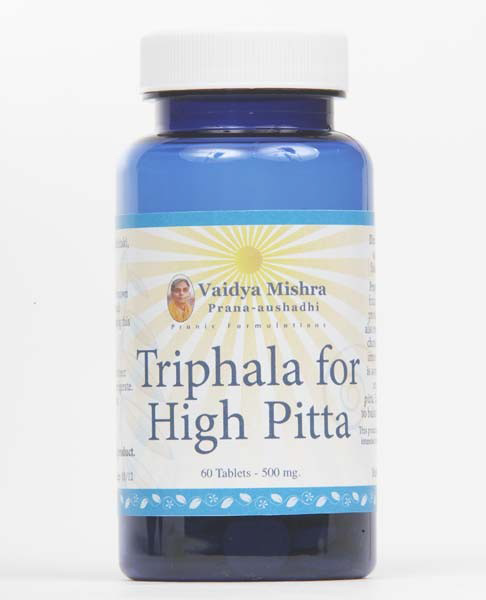
Dear Christine: Instead of just applying ghee, you should make Pitta Triphala ghee. Use Mum’s Ghee – as it is ligther because it is made form yoghurt instead of butter. Here’s how to do it: take 10 capsules of SVA High Pitta Triphala for 4oz of ghee. Warm the ghee until it gets to boiling point, add the content of the capsules. Remove from the fire and cover it. Let it sit for 5 minutes. Strain using a coffee filter, andV-img1 store in an airtight container. Use this High Pitta Triphala ghee to apply around the eyes, on the eyelids, and on the temples – apply in a clockwise motion as if your temple had a clock. After applying let it sit for 5 minutes but then wipe it out before going to bed. You can make a batch and keep in airtight container for 10 days. No need to refrigerate. Grittiness in the eyes is caused by both toxins being released as well as the ghee application. In the SV tradition we do not recommend to apply only ghee. Ghee alone can pull out toxins but it can also clog the channels depending on many individual and environmental factors. Triphala, on the other hand, binds toxins and opens the channels. Triphala is known to be a great “dravya” for the eyes, for nurturing and detoxifying. My formulat for High Pitta Triphala contains rose which is very good for pitta pacification without blocking the channels. And the eyes are governed by alochak pitta, so anything soothing and cooling is additional support.
Ghee is in general good for the eyes because it is pitta vata pacifying, and nurtures the nerves, nurtures and detoxifies mildly, lubricates the channels. Do not use coconut oil as it will freeze and clog the channels particularly in cold weather so it is not recommended to use coconut for the eyes. Try the High Pitta Triphala ghee recipe and let me know how you like it!