Jagjit G. from New York, NY asks: I am an ayurvedic practitioner residing on the east coast. I studied Ayurveda with various vaidyas in India over many years. I recently signed up for your newsletter and have been reading your emails regularly for almost a year. In the last newsletter on Lectin, you mention that Castor oil is 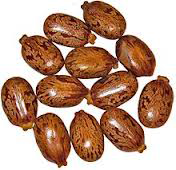 toxic. While reading the newsletter, that same day, while watching the news, it was reported that a “ricin” stained toxic letter was used in a terrorist act here in the US. I researched ricin to find that it is a highly toxic protein obtained from the pressed seeds of the castor-oil plant. This was shocking to me because, in India, 2-3 tbsp. of Castor oil is administered during purgation (virechna) before panchkarma. I was also taught that “Kroor Kosthi” (or hard bowel tendency) requires either 1 tbsp. of castor oil every night or “panchsakar churna.” I am now confused and curious as to what you can say about this? If you could pair your scientific vision with the traditional sutra and shed some light on this matter for me? I would like to know what are the side effects of Castor oil and whether the “Panchsakar churna” is safe for Virechna for “Kroor kosthi” condition. – Jagjit G., NYC.
Dear Jagjit: It is true that many ayurvedic practitioners use castor oil in their practice. Castor oil has been used for many centuries, and continues to be currently used in many cultures to treat various conditions. In general, castor oil has immediate toxicity when used in heavy doses. But it also carries a long-term toxic effect when consumed regularly even in small doses. But that there are ways to use the “intelligence” of castor oil without succumbing to its toxic side-effects. Ayurveda has ways of de-toxifying it so that the physical molecules are present in minimal quantity. In my SVA lineage, we always follow the principle that to help people we should not create any side effects whether after long or short-term use. We do not recommend nor do we use the physical molecules of castor oil in our formulations. The same rule applies to “Panchsakar churna,” which calls for large quantities of Senna leaf that help soften the stool for evacuation for “kroor kosthi” individuals. Because we know that Senna leaf is habit forming, that is: your body learns to depend on it for evacuating the bowel and eventually becomes unable to perform this function on its own when Senna is discontinued. Not to mention that the long-term usage carries deleterious side effects as well.
In my opinion, and based on tri-sutra Ayurveda, when you are dealing with a kroor kosthi condition, you must first try to isolate the reason (hetu) for severe constipation. Besides having a genetic predisposition, or prakriti, you can look for additional trigger factors. For instance: stress; poor routine; eating less fiber; drinking less water; eating too much salt; suppressing the urge of bowel movement; eating drying food like too much breads and pasta; having to consume allopathic medicine with may have constipating side-effects; or not doing physical exercise and leading mostly a sedentary lifestyle; consuming less probiotic, etc.
The primary objective always is to isolate the existing etiological factor(s), the trigger factors, so as to be able to address the issue successfully. However, certain additions can counter these trigger factors. In general, there are some across-the-board recommendations that can help all bowel movement tendencies, such as: adding Lassi (or probiotic fresh yogurt drink) to your diet; taking the time to do a vata calming selfmassage; adding more vegetables to the diet for an increase in fibers; consuming only fresh cooked grains and lentils – no leftovers and/or preservatives; using only good salts – ideally Soma Salt, but in less quantities. Other things that can also be done: adding extra ghee or olive oil to your meals; eating more seasonal sweet juicy fruits, etc.
To supplement you diet with herbal formulations, I have put together several classical and SVA family recipes. For example, we have the SVA Lax regular strength and SVA Lax mild strength.1-2 capsules at night before bed can be taken with a big glass of water. In addition, applying Prakrit Transdermal cream on the lower spine and abdomen can help support the bowel movement. Taking care of the colon may seem to be easy when you use castor oil or panchsakar churna, but with little bit of effort and tri-sutra Ayurveda-etiological factors, and addressing the symptoms, you can get good results without running the risk of long-terms side effects.
I choose the ingredients of my formulations very carefully. Triphala, for example, is blended with Aloe vera. Slippery elm is an important ingredient in SVA Lax – a very balanced formula. Castor oil in solutions above 10% or more than 14 grams (equivalent to 1 tbsp.) are known to be toxic. So while it may be efficacious as a laxative when 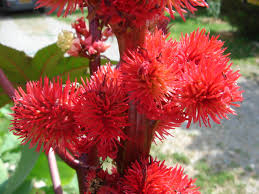 undergoing Panchkarma, long-term usage will prove deleterious. When ricin is ingested it can has an immediate toxic effect (in less than 10 hours) and give symptoms such as: nausea, vomiting, diarrhea and stomach pain. When ricin is in your system and gets inside your cells, it stops them from making the proteins your body needs. This can result in cell death. When ricin is inhaled – this is by far its most immediately toxic form – it is very damaging to the lungs and can cause asthmatic symptoms, chest tightening, shortness of breath, even death. So it is best to avoid it altogether. There are very many other options available. In my lineage, we always addressed this issue very seriously and offered different solutions.
That is why to address the different kinds of bowel tendencies, I have formulated several products, but I always only implement their use after I figure out the “hetu.” So SVA LAX is ideal for kroor kosthi (hard bowel tendency). Prakrit cream and Prakrit tablet contains Haritaki, with the vibrational intelligence of castor oil that helps kroor kosthi and Madhya kosthi (hard bowel and medium bowel tendency). Another is Tri-phala, made from vijaya haritaki the most powerful haritaki, in addition to wild Amalaki, and good Bhibitaki. This is very safe and efficient for Madhya kosthi (medium bowel tendency). Triphala for High-Pitta- very special formula for people with pitta body type or with aggravated pitta. This special formula pacifies pitta and helps to regulate the bowel movement.
It is important, as a practitioner or a householder, to always take care of your colon because “the brain of the brain resides in the colon!” Do not treat your colon as if it is only a pipe. The mucus membrane lining of the colon is quite delicate and we should not disturb that intelligence to ensure that we do not kill or wipe off the yogini-s (friendly bacteria) that populate our gut.
