Male health as a medical specialty, or andrology (from the ancient Greek for andros or man, + logia or study), developed only in the late 1960-s. But it has been in place for thousands of years in Ayurveda. Ayurveda has known and used many different herbs, plants, preparations and methods to address ill-being and diseases for men, specially pertaining to the reproductive organs.
The Vedic shastras speak of human objectives or “purusharth:” “dharm, arth, kam, moksh.” These four objectives sum up the pursuits of humans: dharm or ethical duty towards oneself and the collectivity one is born into; arth or pursuit of affluence; kam or pursuit of desire. Kam is usually understood to be carnal desire, and this is not a deviation that leads to the gates of hell, but rather a natural and necessary part of an individual’s evolution towards the final stage of total spiritual liberation, or moksh. In the vedic tradition, the human lifespan is understood in 4 strokes: 1)Brahmachari ashram or early childhood and youth when one is primarily a student in many ways and where one abstains from sexuality; garhasta ashram or the stage of the householder when one is active professionally and personally; vanaprasht ashram or turning away from the “things of this world” to develop a detachment; and sanyas ashram or leading the life of a total renunciant.
Garhasta ashram is about being together with a partner, supporting one other to thrive and to develop through and as a family, inviting new souls into the world, to keep the wheel of evolution going. In this sense, in Ayurveda, the topic of male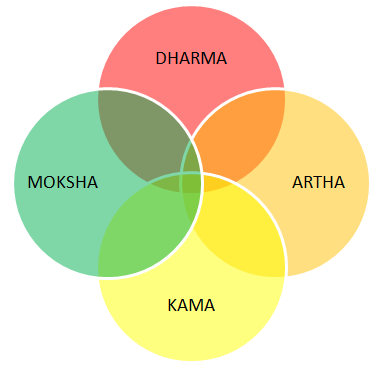 virility is particularly important, as it goes hand in hand with the continuation of the world as we know it. The Charak Samhita devotes a specific chapter to this topic entitled “Vajikarna.” In this chapter, several approaches are discussed to maintain, cure, and improve male virility. From recipes to the use of single herbs or herbal synergies, different protocols are listed and explained (to learn more on this topic, listen to Vaidya Mishra’s Love and Prana II available on www.chandika.com
In particular, the chapter discusses herbs that carry the following “prabhava”s or ultimate subtle post-digestive and post-absortpion effect: vrishya – increases shukra dhatu or the reproductive tissue; bhringhana – supports all 7 tissues including shukra or the reproductive tissue; vajikarna – increases libido; and rasayana – overall rejuvenative also essential for healthy and graceful aging. The Charak Samhita lists and discusses herbs or recipes that containing any dravya-s or plant materials that carry these properties. Some of these herbs have already been the subject of scientific studies that have confirmed the conclusions of the ayurvedic texts – see Dr. Barbara Davis’ article for the scientific references. Here are some of these herbs that help balance and rejuvenate the male physiology physically, emotionally, and mentally, as discussed in the Sanskrit sutra-s.
Mucuna – also called “kapikachu” in Sanskrit. The seed of the mucuna plant is “vrishya” or increases the reproductive tissue; it has a sweet rasa; it is bhringhana or nourishing to all the 7 tissues, and particularly the reproductive tissue; it can be a little heavy on digestion; bitter in taste; it pacifies vata or the principle of air and space in the body; it increases stamina, pacifies pitta and kapha doshas or principles as well. It is also vajikar or increases libido. It carries all 4 qualities that are needed for male stamina. It is cited by both Bhav prakash and Shodhal.
White Musali is another important dravya or plant. It is sweet, cooling, and vrishya – enhances the reproductive tissue. It supplies nourishment and stamina overall. Due to its slippery properties it supports kapha and pacifies pitta, eliminating inflammation and fatigue.
 Gokshura – tribulus: cooling, enhances stamina, sweet, and vhringhani – increases and nurtures all tissues particularly the reproductive tissue. Supports the flow of urine; de-crystalizes urinary stones; cools the urinary system; it’s a rasayana for the genito-urinary tract; enhances stamina; it’s vrishya – nourishes the reproductive tissue.
 Ashwagandha: just as famous as Gokshura, it is astringent in taste; pungent; bitter; it pacifies vata and kapha; enhances shukra or the reproductive tissue; enhances stamina; is a well known rasayana.
Shring bhasma: or deer antler calcined ash, has been used by the ancient rishis or seers in so many ways, including the support of male health overall. For more information on this subject, watch Vaidya Mishra’s YouTube video on his SVA Health channel.
Yasad bhasma Zinc calcined ash, is a famed rejuvenative mineral that supports the nerves. It is an essential ingredient for male health as the prostate gland needs ample amounts of zinc to maintain its healthy balance. Watch Vaidya Mishra on YouTube on this topic for more details.
Daily Protocol: with the SVA alternative advanced delivery systems, you can add all these herbs to your daily routine.
Herbal-Memory Nectar Drops are a subtle efficient trans-mucosal way of getting the “intelligence” of these herbs into your physiology safely and effectively.
To 32 oz of high pH spring water, add:
- 3 drops of zinc,
- 3 drops of musli,
- 3 drops of aswhagandha,
- 3 drops VJK
Then take 1 capsule of Tribulus Plus after breakfast, and 1 capsule after lunch.
Crush 1 tablet of Ashwagandha with 2 tablets of Mucuna plus, add to spring water, bring to a boil, filter and drink as a tea after lunch.
Needless to say, to get the full effect and benefits of any of these herbs you will need to keep an optimally fresh and intelligent diet and routine, also keep a balance between rest and activity. Daily self-massage or abhyanga with Vata massage oil with Vit D and magnesium will help nurture and relax the physiology. With a balanced life-style and the “prabhava” of these herbs, you are sure to live according to the tenets of the shastra-s enjoying the most out of each stage of life in accordance with the desires that animate us all humans.
