Bacterial/Yeast Overgrowth

“How does one overcome bacterial / yeast overgrowth in the gut? What herbs are good for treating yeast/candida issues? Thank You.
Vidhya P.”

Dear Vidhya: This is a really great question. I deal with this problem on a daily basis with almost every patient in my practice. This problem is one that is fairly easy to fix, but many people are having a hard timeBYO-img1 fixing it because they need to be under the care of someone who is familiar with the problem.

You really can’t take herbs that will fix this problem. Instead, you have to re-culture the friendly bacteria in the gut. This is not so hard to do, but I would refer you to one of the  SVA practitioners, so they can first get your history and then prescribe the correct remedies.

In general, however, if there is too much heat (pitta) in the gut or an acid pH in the system, the friendly bacteria that reside in the gut can die off. These friendly bacteria are responsible for preventing yeast and bacterial overgrowth in the gut. If you take any remedy to kill infection, such as oregano oil, pau darco tea, garlic (these are some of the remedies our patients have tried before coming in to see me) it won’t work. Even the pharmaceuticals, such as diflucan and flagyll don’t work,BYO-img2 because what all these things do is kill infection. Once you kill the infection, it will grow right back.
So the real key to the problem is to re-establish the friendly bacteria, which will automatically kill the infection in the gut and prevent any future re-occurrence. Re-growing the friendly bacteria is just like growing seeds in a garden -­ you need something that acts like a fertilizer, a good seed (probiotic culture which is alive -­ all the yogurts in the supermarket have very little active cultures and most of the probiotics on the market are dead cultures). These friendly bacteria are very delicate, so when you process a probiotic or make yogurt and keep it on the supermarket shelf for days, the cultures automatically die off.

And finally, Dr.Mishra made a formula to fix the lining of the gut so the friendly bacteria can grow -­ like bringing new topsoil into the garden.

Then, if you combine this with an alkaline diet, the gut will be free of any pathogens.

I treat patients via telephone conferences around the world. If you want a phone consultation with me, we charge $3.00 a minute, and I can go over your history with you and see what your program will be to fix the problem. My telephone # is 856-786-3330. Most telephone consultations usually last about 20 minutes.

Dr.Marianne Teitelbaum
Cinnaminson, New Jersey

Ayurveda vs Spirituality

“Good Morning. I am new to Ayurveda. I am enjoying the way I feel and how my daughters feel with the diet change and herb supplements. I do have a concern though. We are born again Christians. Jesus Christ is our only Lord. What are your thoughts on a family following Ayurveda diet & Medicine  withoutthe spiritual connection of chanting, etc. I have been told conflicting things on this subject.
Thank you for your insight.
Sue H.”

Dear Susan: welcome to Ayurveda! And rest assured that Ayurveda is through and through a secular health care science. As far as chanting goes, while it has and may be used by religious aspirants as an aspect of spiritual practice, by definition in Ayurveda, chanting and the recitation of sounds or mantra-s is part of a holistic healing protocol that aims to reset the physiology on a vibrational level, to relax and calm the nervous system and the mind to initiate total optimal healing. This is a purely scientific and observable practice that can be measured with modern scientific instruments. The PNI theory or theory of psycho-neuro-immunology hasAVS-img1 given many breakthrough conclusions through modern scientificresearch. Thousands of studies have been published in well-known journals showing the benefits of exposing the physiology to specific vibrational sounds (of (ayur)vedic or other origin) for therapeutic purposes. See, for example, the recordings I recently released with carnatic vocalist Aditya Prakash, the balancing mantras for the organs and different aspects of the physiology.

So in and of itself, the recitation of mantras or chants is not a religious activity as originally described and prescribed by Ayurveda. Through listening to chants or chanting oneself, the physiology is meant to be brought to relax, made to take the inward stroke by silencing the external sensory experiences. In this sense, chanting of specific syllables can be used by people of any credence or religion, without foregoing their faith, as a balancing tool that helps calm the nervous system, and silence the mind so there can be even better communication, for example, through prayer, between the individual and his/her God.

Why not bananas?

“I would like to know why banana is considered clogging. In my research I have only read good things about banana. I hope someone can help me with this question. I am a patient of Dr. Teilelbaum. Thanks, Faridah M.”

Dear Faridah: the ancient ayurvedic texts say that bananas are clogging because they carry “madhu rasa” and “guru guna” – in other words, a sweet taste and heavy aftereffect. But what does this mean? AnotherWNB-img1 way to understand this would be through other fruits, such as the orange or the apple. These fruits also have “madhu rasa” or sweet taste, but in addition they are also characterized by an “amla rasa” or sour taste. In Ayurveda, the sour taste is known to support digestion and metabolism more because it carries more “agni” or digestive properties in it. The sweet taste is said to be made up of the water and earth elements, while the sour taste is known to be made up of water and fire elements. So the sweet taste is considered to be heavy, but the sour taste has some inherent fire to it that supports metabolism.
That’s why fruits that carry a little sour taste are not clogging. Clogging? It means they don’t make toxins or “ama” – the first kind of toxins result from semi-digested food, heavy food that the body cannot break down properly and gets to sit in your body without being processed. This is one reason why people tend to eat a banana for lunch, it helps them feel full because it is heavy and sits in the stomach giving a feeling of satiation, while all it is doing is not getting digested! Long term consumption of bananas will results in severe imbalances. The micro and macro channels will carry semi-digested residues not only of banana but of overall food, because the regular consumption of bananas will dampen metabolism overall and affect the proper digestion and absorption of all food items. This is the “rasa” or taste based answer to your question.
Another way of understanding the answer to your question is based on the dynamics of pharmacology in Ayurveda – that is: the ultimate effect and impact a food item has on your body, chemically and even beyond that, vibrationally. There is a property called “prabhava” in Ayurveda that concerns the post-digestive effect of any food item, long after it has been completely physically digested and assimilated. The ayurvedic texts explain that the “prabhava” of banana is also channel clogging. You may have food items that are clogging on an initial physical level, but not ultimately, this is an exceptional make-up and very healthy for all body types. For example, the pomegranate fruit is initially clogging due to its sweet and cold initial properties, but as it goes deeper into the stages of metabolism and digestion, it has actually a channel opening “prabhava” which makes it a unique medicinal fruit.

Your findings show that bananas are good to consume because modern nutrition evaluates all food materials based solely on nutritional facts. They determine the physical nutritional benefits in terms of fat, sugar, minerals, and other properties, and they are not able determine whether that material is good for one and not another. The Ayurvedic way of understanding encompasses nutritional facts but also goesWNB-img2 beyond, because every individual’s condition is different, digestive and metabolic fire levels are different, and particularly, an individual may have a chronic condition where toxic residues or “ama” may be particularly unwelcome. Ama or toxic build-up from semi-digested food is considered to be the seed of all diseases, and the last thing one would want to do is to consume anything that can even remotely clog the macro- or micro- circulatory channels. Channel health and care is primary, because channels are detox pathways but they also nurture and nourish us by delivering life-supporting materials. So under no circumstances does one want to delay detox, or delay the delivery of the nutritional substances to are targeted to reach specific organs and organ systems.
Ironically, small bananas somehow have less channel-blocking after- effect. They also tend to be more aromatic. Aromatic principles are always channel opening. So if you must have bananas, favor the really small ones, but by all means, avoid the large ones if you want to maintain healthy and clear channel pathways.

Can we Detox and Nourish our Eyes with Ghee?

“Dear Vaidya Mishra, My sister was told by an ayurvedic vaidya in Europe that to help lubricate the eyes, before retiring at night, rub a small amount of ghee on the outside of the eyelids and also rub aV-img3 little ghee clockwise over the navel to help the eyes. My husband I both tried that. Each morning we both woke feeling there was grit or sand in our eyes. This cleared after 10 minutes or so. Also, my husband experienced partially blurry vision due to the ghee application. It took about 2 hours for his vision to become clear again. My question is what causes the grittiness? Is it toxins being drawn out  by the ghee being absorbed into the eye during the night or is the ghee aggravating the eye and causing the dry, gritty feeling? Would coconut oil be as effective in helping the eyes or must it be ghee? How is ghee supposed to help the eyes? – Christine C.”

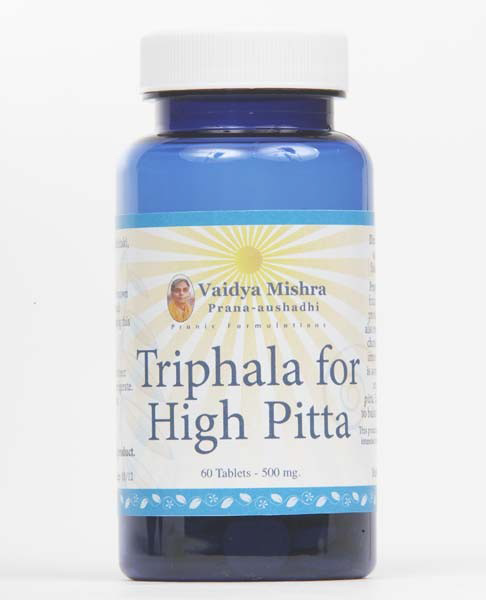
Dear Christine: Instead of just applying ghee, you should make Pitta Triphala ghee. Use Mum’s Ghee – as it is ligther because it is made form yoghurt instead of butter. Here’s how to do it: take 10 capsules of SVA High Pitta Triphala for 4oz of ghee. Warm the ghee until it gets to boiling point, add the content of the capsules. Remove from the fire and cover it. Let it sit for 5 minutes. Strain using a coffee filter, andV-img1 store in an airtight container. Use this High Pitta Triphala ghee to apply around the eyes, on the eyelids, and on the temples – apply in a clockwise motion as if your temple had a clock. After applying let it sit for 5 minutes but then wipe it out before going to bed. You can make a batch and keep in airtight container for 10 days. No need to refrigerate. Grittiness in the eyes is caused by both toxins being released as well as the ghee application. In the SV tradition we do not recommend to apply only ghee. Ghee alone can pull out toxins but it can also clog the channels depending on many individual and environmental factors. Triphala, on the other hand, binds toxins and opens the channels. Triphala is known to be a great “dravya” for the eyes, for nurturing and detoxifying. My formulat for High Pitta Triphala contains rose which is very good for pitta pacification without blocking the channels. And the eyes are governed by alochak pitta, so anything soothing and cooling is additional support.
Ghee is in general good for the eyes because it is pitta vata pacifying, and nurtures the nerves, nurtures and detoxifies mildly, lubricates the channels. Do not use coconut oil as it will freeze and clog the channels particularly in cold weather so it is not recommended to use coconut for the eyes. Try the High Pitta Triphala ghee recipe and let me know how you like it!

Are Triphala and Prakrit Necessary?

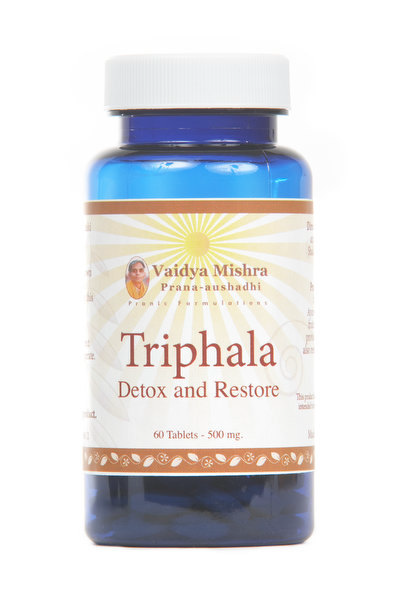
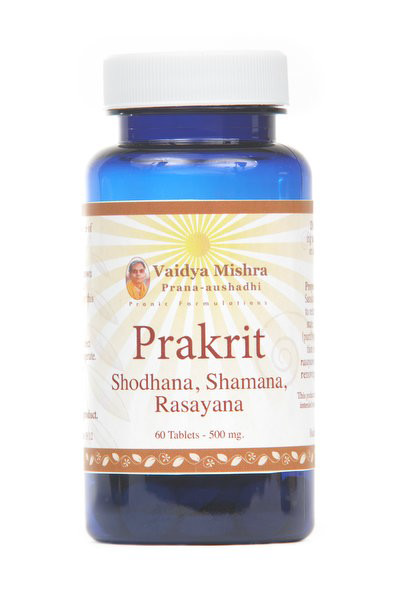
ATAPN-img1“Dear Vaidya, hope you are doing good. Thank you for all the good information, I would like to ask a question about Triphala if I may. I follow a diet of grains, vegetables, and paneer, which I make with lime; I eat yogurt at my lunch meal for which I also follow your directions and add water to it. I also eat a lot of fruit through out my day and my drink of choice is warm water. I have been taking Triphala 2 times a day and at night I add Prakrit. My question is with this kind of diet why do my bowels not work with out the use of these things?
Thank you, Respectfully – Jim K., Bethlehem,
Pa.”

“Dear Jim: The Charak Samhita explains that there are 3 types of innate bowel tendencies in an individual:

  1. ATAPN-img2Krur kosthi tendency which means an individual is by birth prone to constipation regardless of what kind of diet they keep;
  2. Madhya kosthi which is a bowel tendency that is neither loose nor constipated;
  3. Mridhu kosthi – bowels that tend to be always on the soft loose side. Everybody is born with one of these kosti prakriti-s or innate natural bowel tendencies. It seems that you belong to the first group, that you are “krur kosthi,” that is why you need to support your physiology by taking the supplements. But remember, both the Triphala as well as the Prakrit tablets are derived from fruits, so you are in fact just adding more fruits to your diet. Fruits that do not have any side effects. These fruits have a short and immediate as well as long term benefits.
    In the short term, you are supporting your bowel movement to be regular and optimal; but in the long term, these fruit tablets act as a “rasayana.” Rasayana means: that which can slow down aging, or give optimal graceful aging, as well as support your immune system. The fruits that Triphala – literally formed by the words “tri” for three and “phala” for fruit – is made up of, as well as the fruit that Prakrit is made up of are renowned for their health supporting properties and are helping connect your colon to your mind, so that your bowel movement occurs daily and regularly. Plus they create a very good environment for friendly bacteria to thrive in. And you know that a gut populated by friendly bacteria is the key to optimal health as they facilitate not only elimination but absorption of nutrients as well.
    Having at least one good daily bowel movement through which one evacuates toxins from the physiology on a daily basis can be the ultimate secret for a long and healthy life…

Tips for your Nectar Drops and a Bottle!

Since Vaidya Mishra introduced his pioneering Herbal-Memory Nectar drops a couple of years ago, we have received much feedback with respect to their effect, questions about their usage, and incredible testimonials. Today, we would like to share with you some practical tips about the drops, but also give you a recommendation about the containers you should use for drinking them. Specially since after much research, we have located the perfect glass bottles for you. Read on!

  • How many drops? Vaidya and his SVA practitioners recommend one drop of Nectar to one liter (33.8 oz) of high pH Spring water. Sometimes, however, your SVA practitioner may recommend another amount of water or number of drops based on your current imbalances.
  • Temperature: your water should be room temperature. Unless/until your SVA practitioner recommends otherwise. Sometimes warm water may be recommended. Almost never cold water though.
  • Types of water: it is best to use a good brand of spring water, properly bottled, preferably in glass. Filtered tap water, reverse osmosis, or other kinds of416 red bottle treatments are not recommended even if they are not harmful. The primary point is the pranic content of the water and that is why Vaidya recommends spring water rather than any type of treated water. Treated water will carry less pranic charge from the source. The water also contains a memory of its where it’s been, where it’s come from. Chemical or other treatments do not erase or cleanse that memory when it is necessary to do so. The pranic intelligence of good spring water will facilitate the delivery of the herbal intelligence of the drops, making them more effective. Remember: our bodies are 75-85% water, and the better water we infuse into them, the cleaner and more intelligent our bodies will be, with higher alkalinity. Low body pH indicates higher chance of inflammation, and inflammation creates the best conditions for chronic diseases.
  • General recommendation for frequent/daily use: add 1 or more drops of Nectar as recommended by your SVA practitioner, to 1 liter of water. Consume the bottle within 4-5 hours.
  • What kind of containers? Either 100% stainless steel or glass containers with thick walls – which can handle some heat – will be best. This is because the drops contain some citrus fruits (grapefruit and/or sweet orange) as natural preservative. The citrus addition does not interact or tamper with your body’s or the drop’s natural alkaline balance. The formulas are made in such a way as to support eachother ingredient-wise. As to the body, the citrus gets buffered by the body’s homeostatic system, it becomes neutralized. But, unlike glass or steel, plastic, or aluminum or any other mixed metal containers can react with the citrus and leach out molecules of the plastic or aluminum that will get blended into your nectar drink and absorbed by your body, leading to toxicity over time.
  • Proper care of your bottle: Vaidya’s Nectar drops are organically and synergistically preserved in each formula, and they are almost like a food supplement. You should clean your container everynight: rinse it well with hot water.
  • During the day, do not expose your drop-water to direct heat (sun, etc), do not leave your drop bottle to cook in the heat of your car, this will reduce the potency of your drops. You can cover your bottle or put it in the shade, to protect it from extreme temperatures.
  • Water is the best medium: Do not blend your drops with fruit juice or any other liquids besides good old plain high pH pranic spring water!

TURMERIC TUBERS

“Do you sell turmeric pieces (like shown in your YouTube video “How to use turmeric?” In the video it was explained that turmeric “powder” oxidation occurred very rapidly, and for that reason it was better to buy the pieces of turmeric that are peeled and cooled dried in your plant. Thank you, Monica R”

ANSWER: yes, that is the case, that is why we grind the turmeric roots in our facility with a hammer grinder, and only on demand, and then we vacuum pack them and recommend that people consume and not store them for long periods of time. We also recommend that you keep the ground powder in your kitchen in an air- tight container. It is not necessary to refrigerate it though. However, the turmeric tubers are also available for sale if you so desire. You will need a highly efficient grinder though, as they are tough to pulverize, and that is why we make the powder available as well.

For more information for our clients, you can watch the Turmeric Youtube video on this link: http://youtu.be/cafoiHQiwPw


GREEN PROTEIN RECIPE

“Hello,
Would you kindly send me the Green protein recipe as presented in this Youtube

video: http://www.youtube.com/watch?v=Fw99ChA_uXI
My wife and I would also be very grateful if you would kindly let us know the ‘brand/model’ of the blender you have used in preparing this recipe.
Thank you so much for posting this information online.
Thank you,
Sincerely,
Gaurav N.”

Dear Gaurav: the recipe is below. And the brand of the blender is Cuisinart. But nowadays, we have discovered a small very handy blender/chopped that goes by the name of Ninja and is sold for only $20 at the Target stores. It is very powerful, can blend quit a bit of quantity (enough for 6-8 people) and is quite powerful as it has 4 blades instead of 1 or 2 plus it is small and easy to clean… Hope this helps.

Green-Protein

It’s delicious, it’s quick, it’s nourishing, and kids will love it – young and old! It’s Vaidya’s magical SVA recipe, a powerhouse of protein and iron. You can use any leafy greens: baby spinach leaves, collard greens, Swiss chard, dinosaur or purple kale. Steer away from mustard greens as they tend to be a little heating and pitta aggravating. Recipe:
80% weight by weight leafy greens
20% weight by weight fresh cheese (paneer) 1/4 cup spring water
1/2 tsp Mum’s Masala
1/2 tsp Mum’s Ghee
1/4 tsp Soma Salt
Fresh Thai Chilli (optional)
Fresh ginger 2 slices (optional)
1/4 tsp Olive oil Add the ghee to your pan, along with the Mum’s Masala (and chili and ginger if you are using these). Add the paneer chunks and sauté for a couple of minutes. Remove stems (may keep some) from your greens. You can mix Swiss chard, collard greens, purple or dinosaur kale. Add also a few sprigs of flat Italian parsley (curly will also do if you can’t find the flat). Chop everything roughly. Add to your paneer pan and add some water. Cover the top and cook for only as long as it takes (depending on how much greens you put) to allow the greens to turn bright green in color). Remove from the stove and put everything into your blender. Add a little water and blend to a perfect smooth texture (you may add more water as needed). Hot water is recommended, but room temperature will also do. When you are ready to serve, squirt some fresh lime on top and mix it in. Enjoy your protein!

DEVI INCENSE

“[Do] I get the same benefits from putting the Devi Incense in one of those [electrical] aroma pots? I did htat last night and it did put a wonderful aroma in the air. I put in a little of the incense with a little water. Carol Brown”

Yes, this is a great idea. This is a good way of still getting the benefits of the Boswellia and the incense ingredients without the smoke. The heat will activate and release the properties into the air.

WHOLE WHEAT OR WHITE FLOUR?

“I’ve been hearing for many years that white wheat flour is not good for health. It’s claimed that white flour is quickly transformed into fat and increases the sugar level in the blood, while whole flour takes longer to digest and for this reason won’t create much fat and it’s better for the digestive system. I tried hard to convince my wife and kids to move to whole wheat flour. Now, [I also just heard] that whole wheat flour is not used in India and it is considered as food for animals. You know, people have the tendency of assuming that if it comes from India it’s based on Vedic knowledge. But I would like to hear from a reliable Ayurveda expert.
Do you know what is true, regarding this subject? Do you know what Vaidya Mishra thinks about it?
I’ll really appreciate if you can get the answer for this issue.
Cheers,
Marcelo”

Dear Marcello: In Vedic India or traditional not contemporary India, we always favored and used whole wheat flour. Stone-ground whole wheat flour. Whole wheat flour not only physically contains all the nutrients and micro-molecules of the bran, but it is also pranically very rich. That’s why, the complexity of the carbohydrate makes it slow on metabolism and digestion, but at the same time making it more nourishing and sustaining as well. Energetically speaking, it won’t spike your blood- sugar and then give it a dive. This is because of the slow sustaining release of the carbs. During the refining process or when it is bleached and the bran is totally removed, wheat loses its total nutritional value, the one it was endowed with by Mother Nature. In this sense, it also loses Prana. Often, bleached refined flour is favored for its cosmetic appeal, etc. but whole wheat is always preferable to use. The only time someone should avoid whole wheat flour is if the individual is gluten intolerant. In that case, I recommend incorporating quinoa into the diet.

One last but important point to remember in this context is that according to Ayurveda, refined wheat flour also tends to create constipation because it does not contain enough fibre.

CASEIN IN MILK?

“Can you please answer a question for me. I been told by some authorities that casein in milk does not get absorbed at all, and that in fact consumption of milk is one of the biggest causes of osteoporosis. I agree that regular milk from stores, homogenized and pasteurized, full of hormones, shouldn’t be consumed, but organic milk isn’t that different then? Thank you.
Alexa”

Casein (pron.: /ˈkeɪs.ɪn/ or /ˈkeɪˌsiːn/, from Latin caseus, “cheese”) is the name for a family of related phospho-proteins. These proteins are commonly found in mammalian milk, making up 80% of the proteins in cow milk and between 20% and 45% of the proteins in human milk. Casein has a wide variety of uses, from being a major component of cheese, to use as a food additive, to a binder for safety matches! As a food source, casein supplies amino acids; carbohydrates; and two inorganic elements, calcium, and phosphorus.

It is true that casein in found in milk, but if milk is organic, and consumed according to the vedic tradition, that is when it is boiled with some spices, such as clove, green cardamom, turmeric, cinnamon, and only then used or consumed, then all the casein- related heaviness goes away. The only time casein becomes problematic for digestion and absorption is if someone is really born with milk intolerance or allergies. But when the consumed milk is good, organic as you mention, not carrying additives, and preferably neither homogenized nor pasteurize, or raw as it is called, then there should be no problems. And there should be no problems at all according to the Vedic tradition, if milk is not not consumed cold, or it is not highly processed. The vedic tradition gives specific samyog (combination) and sanskar (preparation) methods to help avoid any side-effects from consuming even good milk, and in particular cow’s milk. This is because cow’s milk, rich and nourishing, is considered the most auspicious milk after mother’s milk.

Here is an SVA recipe to help you with processing all the molecules from milk.

50% organic milk
50% water
or 4oz milk to 4 oz water
add ¼ tsp Vaidya SVA Madhur Masala (a specific blend of spices to be consumed with milk and sweet available from www.chandika.com)
Boil. Bring down the room temperature and enjoy!

OR make your own blend with:
cinnamon 1 stick
cardamom 1 part
fennel 10 parts
nutmeg 1 part

Mix all of the above in a spice grinder and pulversize to a fine powder

Then add ½ tsp of this mixture to your milk and water mixture
Boil and cool down a little and sip slowly before bedtime.

Contra­indications: if you are lactose or casein intolerant, or have any disease and your medical doctor has recommended that you do not use milk, do not use this recipe. Or if you are a high kapha type individual, it is best to avoid milk altogether.

SVA ROSE PRESERVE: WHY IS IT SOUR AND THICK?

“I love the rose petal jam!! Wow, it is so intense!! Celestial ambrosia! Were I asked to tweak the recipe at all, I would decrease the as corbic acid as it gives it a little more lemony flavor than I prefer. Perhaps you need it in there for the canning process? The texture is quite thick for jam, but I like the stiffness of it since I don’t use it as jam, I eat it out of the jar for a candy treat. Mine had almost a nougat texture. It was interesting comparing it to [a competitor’s] jam, […] which I ordered last month before knowing you were making it.In case you haven’t had theirs, [it] is a darker, sweeter jam, more jam like in texture, and less pronounced in rose flavor. Theirs is also considerably less expensive than yours, I guess because you are using the rose absolute and you use more roses. FYI I mentioned your rose jam to a friend, who said she saw yours on the Chandika website but bought [the competitors’ instead] because it was so much less expensive. So you might need to do a little more of a sales job to point out the uniqueness of yours, if you are going to keep it at a price point that is more than twice that of [the competitors’]. It’s hard to know the difference online if you haven’t tried both. Thanks. Gail H.”

Dear Gail, thank you for your feedback. Ayurveda says it is always best to try to incorporate all six tastes. The common rose petal jam available on the market is not sour, rather totally sweet taste predominant. Because of its high sweet content, it can aggravate the kapha dosha. The shastra-s say: “ati yoga” or too much of any taste in long term or even short term usage is not good for health. In this case, too much sweet can result in weight gain, uneven sugar metabolism, stiffness, fatigue, etc. that’s why our rose petal Preserve has been formulated to first taste sweet, then sour, then also you will notice the astringent taste coming from the petals, and finally a little bit of the bitter after taste, and last you may also notice the very subtle salty taste… I tried to keep it balanced and delicious by incorporating all the tastes (minus the pungent).

Our preserve is thick because we have added more organic rose buds. Usually, manufacturers tend to use more sugar syrup, some rose powder, or some synthetic rose fragrance. Their preserve may smell rosy soft, look good, but you the total therapeutic value of rose will not be present. I have seen many formulators using only sugar syrup, synthetic rose color, and synthetic rose fragrance while we use organic rose buds and Rose Absolute essence – so you can understand why the SVA Rose Petal Preserve costs twice as much! We will be offering free samples to people know what we mean before having to buy it to experience it. Thank you for your feedback, we hold your words to heart.

OIL PULLING AND HIGH PITTA TYPE

“I am a hight pitta person, I learnt about sesame oil gargle from the Vaidyas in India 15 years ago. I started to gargle with sesame oil but it gave me blisters in the mouth. In your last newsletter I saw that Carak recommends the same thing, so how come it did not work for me? I have very sensitive gums and the only toothpaste that works for me, after so many trials, is your SVA HighCalcium toothpaste. I would love to resume doing Oil pulling, so which oil should I use? Amanda L.”

Yes, you are right. For high pitta people or those with high-pitta aggravation, sesame oil is not good nor recommended to use. Coconut oil is your best option. Melted coconut oil. And the SVA HighCalcium toothpaste is good for high pitta body type people or pitta aggravated people because it is rich in coral calcium and fennel. And it also takes care of common de-mineralization problems occurring in pitta predominant individuals. To find out more about high pitta type, you can watch: http://youtu.be/e8YIt0_TEH4

Can I Nourish All Seven Layers of the Skin At Once?

Lalita’s Age-Defying Cream, our most popular face cream, was designed specifically to nourish all seven layers of the skin.  It is a water-based cream which the skin readily absorbs, and is great for daytime use.  Before you expose your face to the cold winter wind, apply Lalita’s Age-Defying Cream.  You will immediately feel it’s rejuvenating effect as your skin absorbs the essence of the many divine herbs that it contains.  Don’t be surprised if people comment on your lustrous, healthy looking skin.

Which Is Better, Lalita’s Facial Oil or Facelift Cream?

In this gift basket we give you a choice between Lalita’s Facial Oil and Lalita’s Facelift Cream.  Both provide deep oleation, which is important to get to the root of dryness in the skin.  Healthy skin needs both water and lipid to maintain proper moisture.  Lipid is especially important because it protects the water in the skin from evaporation.

For everyday dryness, use Lalita’s Facial Oil.  Its contains very fine, micro-molecules of lipid which penetrate into the skin to nourish the lipid layers.  For deeper wrinkles, or deeper dryness, use Lalita’s Facelift Cream.  This lipid-based cream goes even deeper than Lalita’s Facial Oil and provides more lubrication to the skin.  It also takes longer to penetrate the skin and should only be used at night so that it has many hours to be absorbed.

Lalita’s Facial Oil is very light and fine for oleating the face without clogging.  It can be used during the day without giving an oily appearance to the skin.  For deeper nourishment or deep wrinkles, Lalita’s Facelift Cream is best to use before bed.  Daytime use would make the face look oily.

Does Your Health Take A Nosedive When You Travel?

All your muscles ache, and you don’t care if you ever eat again.  The thermometer reads 101 as you lie on the bed feeling sorry for yourself.

You traveled 3,000 miles to be here with everyone, and now you can’t even attend the party.  What will you do for the holiday meal, look over from the couch and watch the others eat?

There’s nothing worse than being sick when you travel.

It’s easy to avoid sickness when you travel by following these tips:

Keep Your Channels Open

Prana is corrupted when you travel, especially when you are flying.  The body tries to restrict the corrupted prana from entering the body by closing the nadis (vibrational channels).

This puts pressure on the nadis and slows the flow of prana in the body. The digestive system, bowel movements and ojas are all adversely affected.  Immunity goes low, making you susceptible to viral infections.

If you want to stay healthy when you travel, you have to keep the channels open:

  1. Use a Nadi opening spray  (e.g.: Flex’nFlow Body Mist) on your palms and inhale during the flight.
  2. Use a good nasya oil (for example Ida Pingala Oil) to your nostrils during the flight.
  3.  Practice gentle deep breathing at regular intervals to keep the nasal passages open.
  4. Avoid ice cold drinks, sodas, cold foods, and raw foods, all of which block the channels.

Prepare Yourself For Travel

Sometimes you don’t have much choice, but wherever possible get extra rest before you travel.  Plan ahead for all the last minute things that must be done before you go.

Don’t stay up late the night before.  If you can get to bed early for a few nights before you travel, your nadis (vibrational channels) will naturally be open and your immunity will be strong.

Try to avoid red-eye flights and late night arrivals whenever possible

Airports and airplanes are full of the highest EMF/EMR.

Prepare your nadis for this by getting a spinal treatment (with Flex’n Flow Transdermal Cream) before you leave.  (You can get a professional treatment session with one of Vaidya Mishra’s Shaka Vansya Ayurveda practitioners or you can have a friend swipe your spine several times from top to bottom with the cream).

Also, use Flex’n Flow cream or Mist on your feet before wearing socks.  This opens the channels in the feet (the slowest area of circulation in the body) and keeps prana flowing in the extremities.

Finally, apply Maha Marma Oil, Ida Pingala Oil, Karna Oil and Guda Oil before travel. These are all designed to open the nadis of the body and to prevent the build-up of corrupted prana in the nadis.

Food Is Your Friend (Or Can Be Your Enemy!)

Pay attention to your digestion when you travel.  Don’t overeat.  Digestion becomes weak when the channels shrink during travel.  If you eat more than you can digest, you further block the channels, decreasing the flow of prana, and increasing your risk of getting sick.

Take small portions and eat slowly.  Keep mealtimes consistent whenever possible.  Minimize dining after dark when you are traveling.  When the sun is up, there is more agni in the environment to keep your digestive fire high.

Favor sweet juicy fruits like pears, apples, and pomegranate when traveling.  Include channel opening spices that enhance circulation, such as black pepper, cardamom, cumin, mint, turmeric, nutmeg, rose, coriander, fennel and ginger.

Rehydrate yourself by drinking natural spring water with good pH balance frequently.  Don’t confuse the dehydration and fatigue that accompany jet lag with hunger.

Take Care Of Yourself Immediately After Your Trip

Whether you have full scale jet lag, or are arriving after a short flight or a modest drive, you can start feeling great in no time:

SVA Facial Marma Massage

Wash your face with natural herbal soap.  Apply Facial Clay and leave on for 10 minutes.  Rinse with warm water.

Do facial marma self-treatment with Lalita’s Age Defying Cream, Deep Moisturizing Lotion, or Lalita’s Facial Oil. You will immediately feel more relaxed and will find yourself breathing more deeply.

If you don’t have any of the products above, just do a dry massage. You will still feel the benefits of flowing prana to your head and neck area through the opened marma points. The herbs in the creams will help re-balance the vata on a deeper layer, but just re-activating the marma points with touch will also help.

Eye Care

Make a thick paste with Vaidya Mishra’s Skin Clay, place a tsp of clay on each side of a cheese cloth corresponding to the location of the eyes, lie down, close your eyes, and place the cheesecloth strip on the eyelids.  Leave on for 10 minutes.  Rinse with cool water.  This helps remove puffiness and is very refreshing and cooling to the eyes.

For The Mind And The Whole Body

Use Vaidya Mishra’s Samadhi Set creams, give yourself a nadi treatment, or do the Self Massage for Vibrational Balance.

Remember, this holiday season when you take care of yourself you will have much more to give to your loved ones!