The Magic of Turmeric Unveiled!

Turmeric has long been known as an auspicious spice in India. It has been used not only in cooking but also in spiritual and social rituals. The vedic shastras laud its benefits. So much so, that even a pinch of turmeric is considered enough! Click here to watch Vaidya talk about the top 20 benefits of turmeric. But should we just gowith what the shastras say or is there any scientific validation for this? Is it just an ancient indian myth or can it have meaning for us in our modern daily lives?
If you have not had the opportunity to check, you might want to google turmeric and scientific findings. The literature is recent, vast, and growing. Over the past few years, interest in turmeric has grown exponentially, hundreds of studies have been conducted not only confirming what the ancient vedic scriptures spoke of thousands of years ago, but also showing the potential this spice has for healing and preventing so many of our modern chronic and fatal diseases. So it’s good for you! But what does that mean? And how and why is it good for you? The scientific world will say that it contains specific chemicals (curcumin) that behave a certain way when ingested, and therefore heal. But there is a much bigger picture to things. Here is what Vaidya Mishra has to say about turmeric. His SVA explanation of turmeric is very distinct and as always particular to his lineage. You will not be able to read this anywhere else!

THE SVA PERSPECTIVE :
Vaidya explains that turmeric is highly pranic. We have learnt that Prana is itself made of three components, Soma, Agni and Marut. Turmeric is mostly made up of Marut and Agni. Because turmeric has more Marut and Agni, it is a very active ingredient that acts as a catalyst when ingested or applied transdermally. It does not sit idle. The healing and health-supporting effect of turmeric derives primarily from its characteristics of Agni and Marut. This is why detox is its primary property. In addition, it target a specific organ first and foremost: the liver. To define it in one sentence: turmeric detoxifies the liver. That is its primary target. Because it addresses the liver first, it also supports and helps the whole cellular system of the body – through its primary action on the liver it supports all the 5 Agni-s or metabolic factors that are seated in the liver. Each Bhutagni (or agni of the liver) corresponds to an element: space, air, fire, earth and water. The liver is primarily made of Agni and Marut but it also has some Soma. When the liver is intelligent (meaning it is able to perform its activities in the way it was meant to) and does not meet any hindrances for absorbing, processing and transforming Soma, then it can produce intelligent blood. When blood is intelligent (meaning it is not overloaded with toxins due to a weak liver, it carries all the information it is meant to, and is full of Prana due to a good satwic diet), then such blood supports the immune system and helps maintain the health of all the organs and organ systems in the body, maintaining as well the pH of the blood. This, in turn, reduces inflammation in the body overall. Inflammation can be the number one cause of many diseases. Turmeric is thus an alkalizing and therefore an anti-inflammatory. Its ability to support the liver in processing and transforming Soma results in alkalinity in the body. In scientific terms, researchers confirm that turmeric is an immuno-modulator, anti-inflam atory, it helps balance cholesterol, as a result it repairs DNA, is good for chemo-prevention, helps in senile dementia… and these are just a few of the findings… (see the column to your right for additional research references). Does this mean we should be ingesting large doses of turmeric? Nowadays curcumin capsules are prevalent in health food stores across the country, and countless people are swallowing a couple capsules a day. SVA explains that this can be highly detrimental to your health. In fact, if used improperly, turmeric can have unwanted negative results. So what is the proper use of turmeric then? Click here to watch Vaidya explain all about it.

HOW MUCH TURMERIC IS TOO MUCH?
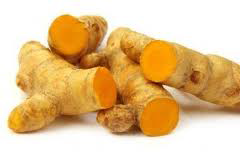
In traditional ayurvedic medicine, it is not recommended that turmeric be used alone. It is also not recommended that turmeric be consumed raw. Why? As explained, the primary effect of turmeric is on the liver organ. Turmeric activates the TMOTU-img1liver and promotes its detox. turmeric brideWhen the liver starts to leach out toxins with the help of turmeric, and if the detox pathways found all over the body are not ready (they could be blocked, or incapable to handle a sudden toxic load efficiently) then this will affect the rest of the organs. Similarly, if the other organs such as the kidneys, or the urinary tract , or the colon, have not been prepped to handle the release of large toxic loads, then the toxic waste being released by the liver all at once without previous preparation will surely result in a “detox crisis.” It can rupture the circulatory channels while moving here and there, and worst of all, if it does not find its way out of the body safely and effectively, it will get reabsorbed which can result n auto-immune conditions. To use a simple analogy: a fast-forward detox with turmeric when you have never done any gentle detox protocols would be like trying to clean your house when you’ve not done it in years (5,10, 15 or more!). One fine morning you bring in this expert contractor, Turmeric Inc., who tells you have to start from the most important room in your house (your liver) that happens to be in the middle of the house (situated in terms of its role). So while you are discharging loads of junk and garbage from that room you have to be able to move and throw it all out, but all the pathways are filled with clutter, there’s barely any room to move or walk, so you start to put little little bags here and there in an effort to clean that first room, but you end up making the rest of the house even more cluttered, even more messy. What’s worse, you move things that had been sitting in their place and putrifying for a long long time, and naturally when you move them, you notice that there are strong chemi al reactions, toxic gases that are released but you are not able to open your windows and doors to bring in some fresh air as everything is backed up against walls… What a mess! So the first rule of thumb: 1) never consume turmeric raw. The second: 2) never eat it alone. After discovering turmeric for the first time and tasting its gentle bitter taste and reading about its health benefits, many people start to leave it on their tables along with the salt and pepper in a little shaker! When you visit Whole Foods market, you will in fact see next to their salad bar a little shaker with turmeric in it for those who are more health conscious! Someone should notify their management that it is a health risk…

A DELICIOUS AND SAFE SPICE MIXTURE:
SVA recommends that turmeric be cooked. If you are introducing turmeric to your diet for the first time, you must do so only in pinches.
TMOTU-img2SVA also recommends that turmeric be cooked with other spices. Here is a safe and delicious spice recipe with turmeric. Combine 1 part turmeric powder with 1 part cumin, 6 parts coriander, and 6 parts fennel. The cumin, coriander and fennel seeds will be measured in seed form, then ground and then added to the turmeric powder. This recipe is not only delicious but it also has very specific effects. This is what the rest of the spices do.
Cumin helps to open the circulatory channels and restore their intelligence. Cumin has more Marut than Agni, it is not as pungent as chilies. It also knows what to absorb and what to eliminate. Coriander has the amazing quality of collecting and binding toxins from and in the blood and exiting them through the urinary tract.
Fennel is added to this mixture because the detox process initiated by the previous spices creates a little more cleansing activity in the body, and something is needed to overlook the cleansing operation to make sure everything is progressing on schedule. Fennel creates a friendly and cooling environment at the same time supporting the enzymatic processes to make sure detox happens safely and effectively.
Even though this recipe is balanced and balancing, if this is your first time introducing spices to your diet you must start using this mixture only in pinches. Add a pinch or two to your food while it is cooking. Increase a pinch every three days and go up to half a teaspoon and eventually up to a teaspoon. Do not sprinkle on your food for added flavor!
If you experience unwanted rash or nausea, or bloating and gas, reduce the dose until you feel comfortable again. Do not make tea out of this mixture, always only cook with it (protein, vegetables, lentils).
Put enough water in your vegetables or lentils so that the water becomes the medium for the transformative power of the spice. And then add a lipid medium as well, like ghee or olive oil, that way you can get both the lipid soluble and the water soluble factions of the spices. It is recommended that you cover your pot while cooking so as to preserve the aroma in the Soma.

TURMERIC AND SOCIAL RITES AND RITUALS:
Turmeric is considered a divine tuber. For any auspicious ritual celebration turmeric is used either as a powder or a paste. Clothes are dyed in turmeric. A mixture of turmeric and sandalwood paste is made to and applied on the body (face, limbs, etc) of brides and grooms before their wedding ceremony.

TMOTU-img3Only if death occurs, then turmeric should not be used. Why? When you grieving, mourning, your Sadhak Pitta is high. All the Pitta subdoshas (the metabolic principles of the physiology) are related to the liver and its 5 Agnis. If you ignite the fires in your liver, it will also increase the fires residing elsewhere in your body, and you don’t want to increase Sadhak Pitta when it is already high due to loss. In vedic India, when a person passes away, no turmeric is used during the 13 day vedic ritual. All close members dress in white as a sign of mourning, and avoid eating heating foods or agni-enhancing foods (turmeric, ginger, onion, garlic, or other spicy foods).
You need more Soma during periods of high grief or emotional turmoil, more Soma and more Ojas to connect your brain to your heart. Anything that consumes Soma is counter-indicated.

COUNTER-INDICATIONS:
Since turmeric ignites the five Agni-s of the liver Turmeric is also contraindicated in cases of high fever, chicken pox, small pox, active hemorrhoids, tuberculosis. if you are currently on any medication or are experiencing any serious health conditions, you must check with your medical doctor before perusing any turmeric or turmeric products.

Your Typical SVAntastic Day – or Lifestyle as Medicine!

YTSVD-img1Do you ever feel like you are not getting the most out of your day? Out of your body? Out of your own life?!!! Of course, there could be a myriad of reasons for experiencing lassitude in general! However, there is one thing you might want to try before you call your health expert to get to the bottom of things: how attuned are you with Nature?
In other terms, is your daily routine in-sync with Mother Nature’s daily cycles? The relationship between our biological bodies and the environment goes very deep as our bodies and the environment are mutually co-dependent. Nature needs us to care for her, just as she cares for us by supplying us with bountiful blessings. We give back to her when we take care of the gift of life and the miraculous bodies she has endowed us with.

Chose Right!
But sometimes things go wrong because we chose to ignore Nature’s prodddings…! Just because we can! While we can count on the early morning birds chirping outside our bedroom windows, others may be able to count on us to be just as fresh and full of life in the early morning  because we might have chosen to work or party through the night. We might have decided to keep on going ignoring our bodies telling us to rest, that exhaustion had set in and it was time to recoup. Instead we had reached out for yet another cup of coffee to pump our body body chemistry and get second wind! Another expample of being out of sync with Nature’s rhythms: our stomachs tell us that the Chinese dish served in the restaurant next door is not really sitting well and causing quite a few physical and even emotional upsets, but the taste of that soy sauce on the deep fried spring rolls is just too irresistible to our palate…
YTSVD-img2These are small signals that Mother Nature communicates to us through our own bodies. And modern science itself is on to them.
What Science is Saying:
In the 1950s, the term “circadian” was coined to refer to our bodies’ attunement with the cycles of nature. The word “circadian” comes from “circa” = about and “diem” = day, so it is a daily cycle.
In nature, there are large (macro) and small (micro) cycles, that is, some that take a really long time, and others that happen much faster. The circadian cycle is all about what happens to our bodies in one day in terms of metabolism, hormonal balance, etc. It defines the relationship between our bodies and the environment, explaining how and why specific functions and results can be optimal at specific times of the day and not at other times.So we can understand that working through the night on high caffeine is not necessarily a good idea even though we can do so, because our bodies are prone to optimal activity on the physical, mental, emotional, spiritual levels, when specific conditions and situations are satisfied.

But so what if we are a little tired the next day, we can catch up! So what if we get heartburn continuously, we can get some anti-acid tablets etc… Because both science and ancient ayurvedic wisdom confirm that this is what amounts to aging. And aging can be an experssion of an overworked body that has never really gotten the opportunity to recover from constant work; or it can be the expression of mental and emotional exhaustion where an individual simply breaks down even when faced with the minutest of daily happenings. Over time, the cumulative effect of delayed bedtime, of acidic food residues, of non-processed emotional stress work their way into the physiology creating a slump in our personality and outlooks! When this happens, no medicine, no herb, no strong will-power can do anything! There is a biological and chemical reality that has set in that needs to be altered through the original cause. And this is where “lifestyle medicine” becomes so signficant.
YTSVD-img3For example, in Vaidya Mishra’s Prana Center, many clients have come in complaining of mental fog, overall fatigue, lack of appetite, lack of spirit. Much to their surprise, their recommendation has been to do one thing only: re-schedule their lives to be back on track with the rhythms of Mother Nature. Even modern science is on this! See the diagram below:
Things as simple as correcting the sleeping/waking routines, our eating times and frequency, etc. have much to do with our output and thus pre-determine the success of our actions and the happiness of our lives! In Ayurveda, the importance of being in-sync with Nature’s cycles has always been known. In fact, the discussion of this very important subject is very detailed and interesting, because the understanding of the human physiology and its relationship to Mother Nature is much more in-depth and layered.

The SVA Perspective
More specifically, in Vaidya Mishra’s SVA tradition, we find many unexpected details to help reset our internal metabolic and other clocks, so as to stay on the right path of bliss and balance.
The Charak Samhita explains that there are 3 Upasthambas, or subpillars, of life: Ahar, Nidra, and Brahmacharya. What do these 3 support? They support the reception and flow of Prana. Because, as Vaidya explains, life is defined as the flow of Prana. So health and happiness, in a nutshell, depend on the proper reception and flow of Prana. Then supplying Prana to every organ and system and molecule is the ultimate healthy thing to do. Click here to hear more about the 3 sub-pillars of life with Vaidya Mishra on youtube. The discussion of these sub-pillars of life shows us the value of “lifestyle as medicine” in Ayurveda. We talk a lot about “food as medicine” but lifestyle plays an even greater role as a preventative modality. All the shastras of Ayurveda talk about the importance of balance between rest and activity, about morning routine, daytime routine, night routine, what are good activities to maintain, what would be bad and not recommended activities. In Ayurveda that section is called “Swastha Vritha.” In SVA, the primary recommendations are based on Swastha Vritha, because we believe that unless daily routine and dietary protocols are proper, no herbs or medicine can help correct an imbalance! Although in this day and age, given the rhythm of our daily lives, it is not easy to follow the right lifestyle 100%, sowing the seed of knowledge and its value always give the desire to follow and wherever deep desire is, there Mother Nature supplies the means to follow…

Why to Follow Swastha Vritha? The SVA Perspective:
We know by now that the components of Prana are Soma, Agni, and Marut. Prana is found in the environment, in Nature, and enters our bodies. The environment and our bodies are connected through the flow of Prana and the ratio of Soma, Agni, and Marut in the environment changes on a daily basis as well as a seasonal basis. It also gets influenced by the planets and their orbits, their vicinity to earth. There are thus many varying factors that are constantly changing and affecting the body on a daily basis. That is why it is even more important to try to follow as much as possible, on a daily basis or seasonal basis, all the proper dietary and lifestyle guideline routine so as to keep the body grounded despite all the ongoing changes, since so many activities in the body are of a repetitive nature and thus need constant continuous repetitive feedback as well from us – we cannot survive long without eating, drinking, resting, etc. We have to go through these activities on a daily basis to maintain life…
There are even distinct terms for the different times of day that require specific routines. For example, the daytime routine is referred to as “Dinacharya” while the specific routine for the nighttime is called “Ratricharya.” The lifestyle medicine of Ayurveda is all about teaching us to cope up with the daytime environmental and other changes that affect our behavior and aptitudes; and the nighttime routine is about helping us adjust to the environmental changes at night so that the reception and flow and delivery of Prana are not interrupted in our physiologies.

Samadosha, Samagni and Samadhatu:
If we were to summarize everything that comes under topic, we would say that it is all about maintaining Samadosha, Samagni and Samadhatu. Because, as we have seen, Soma, Agni, and Marut are the raw material for Kapha, Pitta, and Vata, and these doshas, in their turn, govern all the Agni-s (metabolic principles). This is all it takes to maintain perfect health: Samadosha – that all the doshas are maintained in perfect equilibrium so that the body has the opportunity to run all its organs and organ systems optimally; Samagni – making sure that all that is ingested is properly transformed into the next stage, so that energy is gained, and the body is not carrying a load of unprocessed materials that are slowing it down; Samadhatu – so that when the body is functioning perfectly then it renews all its tissues and systems on the physical level, and then the subtler connections that pervade the consciousness are able to thrive supplying more bliss to the mind and heart…

Living Sutras with Malvika Takvorian-Mishra

Happiness Now or Later?
There are no immediate external signs. Being in one’s dharma means primarily one thing: no matter what the external circumstances are, richness or poverty, sickness or health, whether the path is clear and free from obstacles or whether we are meeting with roadblocks every step of the way, we have and we maintain a sense of inner peace and balance that comes from the knowing, the assurance that I am where I am supposed to be, I am doing what I am supposed to do, and going in the direction I am supposed to be going in. It is a state of equanimity that comes from having found the core that defines us by having let go of mental preconceptions about what/who we should be. Difficulties that accompany us on this path may be part of the cleansing process. And as discussed earlier, once the cleansing process is complete, things do always smooth out. If they don’t, it means more cleansing is needed surely. But the end is always beautiful no matter what!  Having said this, it does not mean that we should now all ready ourselves for a life of suffering for a possible happy ending one day maybe! We do not postpone happiness and SVA offers many practical insights and tips into this.

Clean your Food Clean your Karma!
Through Ayurveda, and particularly SVA, we can accelerate the cleansing process so as to materialize our ideal condition of happiness faster. We have all heard about the food-mood connection. But it goes deeper than that. Of course, it helps to be in the in the right mood in order to accomplish things, but a mood is just that: here one second and gone the next! You can consume food items that give you a quick high (white sugar) and then let you down; or you can consume food substances that nourish not only your physical body, your emotional heart, but that also affect your Satwa, the light of your soul, and that then help you on your path to dharma or maintain you in your dharma. This is Ayurveda. An ancient science revealed by seers whose secrets are now being brought out to benefit one and all. And SVA (Shaka Vansiya Ayurveda) is a lineage of practitioners whose dharma has been and is to perfect the skill of bringing peace and happiness into people’s lives through their healing knowledge of diet and lifest le, and when needed, their knowledge of herbal formulations.
In other words: strange as it may sound, there are foods that you can eat that facilitate your access to dharma, or that make your path smoother while you are in your dharma. And then there are foods and lifestyle patterns that create more roadblocks and weigh you down as you try to do your dharma. You have to choose right. But it is not guesswork! That’s where the knowledge comes in through the help of the sutras. The sutras are here to guide us and help us be our best.
Next week we will talk about this connection between food, Satwa, and Dharma, from the sutras.

But wait, there is more!
There is also one other thing you can do as well in addition to diet and lifestyle changes. A great thing about the Sanskrit sutras is they work on many levels. They offer intellectual knowledge that can help structure our lives. They incite us to further action through inspiration. But more than anything else, their mere recitation (or listening to) helps purify the physiology of karmic sanskaras (past life actions and their effects in your current life). It is always so inspiring to hear about them and understand the messages they have to relay to us, but the best thing is they work on the levels beyond the intellect. Listening to or reciting the sutras, learning them “by heart” cleans the vibrational gaps in our physiology and accelerate our process of growth and evolution towards greater happiness. If you feel you are not in your dharma yet, or are experiencing great trouble while being in your dharma, I encourage you to listen to, repeatedly, and learn the sutras, by heart, as we explore them together.

Namaste!

Your Beauty Now Inside and Out! (part 1)

It’s a beautiful thing beauty, even though we are never quite done talking about it and trying to actually understand what it is , where to find it, and how to make it last forever! The burning question is:  how do we stay beautiful by reversing or slowing down the aging process? We are all born beautiful with a divine light that shines bright within us. By connecting to our own beauty within, our physical beauty and total beauty will follow, flowing with the glow of our consciousness. Our perceptions, judgments, conditioning, and the opinions we form in our mind may define what we think of as beautiful in others and ourselves, but ultimately we are all beautiful.
Ayurveda offers a unique and all-encompassing perspective on beauty that begins with good physical and mental health. The following sutra from the Shaka Vansya Ayurveda (SVA) lineage describes the three pillars of beauty and how together they embody total beauty – spiritual beauty.   The Charak Samhita[1], the original text of holistic Ayurvedic science, also discusses ways for keeping ourselves beautiful, and speaks to techniques we can follow for optimum health, beauty, rejuvenation, keeping ourselves young at heart, and contentment in life.

As the above sutra states, the three pillars or foundations of beauty include; roopam, gunam, and vayastyag. Roopam refers to outer beauty, which is exemplified by our physical characteristics of beauty. Gunam refers to our inner beauty that shines from within us. Vayastyag refers to our lasting beauty and how we can look younger than our chronological age. Ayurveda offers us ancient guidelines and time-tested truths around these three pillars so that we can achieve total and true beauty that goes beyond skincare and cosmetics.
Roopam – outer beauty
Roopam is characterized by radiant skin, shiny hair, sparkling eyes, etc. Roopam is unrelated to body size, skin, hair, or eye color, and is a direct reflection of good health. Roopam, our outer beauty is categorized into two types; chhaya, and prabha. Chhaya refers to close-up beauty and the beautification techniques we use such as creams, lotions, herbs, makeup, plastic surgery etc. Prabha is the specific radiance and natural vibrations coming from ones consciousness that reflects as outer beauty. Prabha is our true essence of beauty and radiance and enhancing it should be a priority before enhancing our chhaya.
Gunam – inner beauty
Gunam reflects the beauty of our mind and soul and manifests itself as thoughts, actions and words. Gunam can be referred to as our aura that comes from inside. Our minds are the medium, and the mirror that reflects the good and bad vibes that our consciousness carries. Our gunam is governed by three main mental functions; dhi or learning, dhriti or retaining, and smriti or long-term memory and recall. A well disciplined mind that is coordinated with our senses and inner consciousness will indeed behave beautifully. By connecting with our mental intellect, we can enhance our gunam value.
Vayastyag – lasting beauty
Vayastyag is focused on how we can look younger than our chronological age and is supported by both roopam and gunam beauty. Vayastyag in itself is a complete science of how to achieve lasting beauty through shiri kamya rasayanas or skin rejuvenating regimes to slow down the aging process and promote luster and beauty.
Ayurveda classifies four types of aging; biological, psychological, social, and chronological. Chronological aging of course cannot be stopped – we age, this is a fact. Biological aging is a process of nature by which certain components in our lives will age us. For example, toxins, doshic (Vata, Pitta, Kapha – our biological humors) imbalances, EMF and EMR – electromagnetic fields and radiation, our diets, our routines, rest, exercise, lifestyle etc. Psychological age reflects how old or young you feel in your mind. It is your age attitude – your perception of how old you feel. The concept that the mind and body should be treated as a whole has been taught and practiced for thousands of years in Ayurveda. However, in 1975 the term Psycho-neuro-immunology[2] was coined based around the belief that there is a link between what we think (i.e. our state of mind), our health and our own ability to heal ourselves. The Charak Samhita discusses social aging in quite some depth and teaches us to socialize with people that are young at heart, mind and chronological age. Conversations among your social circles should also not address signs of aging as this can affect you psychologically. The seven layers of our skin reflect the qualities of our health, and if they are not nourished and nurtured adequately, will display signs of ill-health regardless of how much makeup we apply. Ayurveda supports us with a three-pronged approach known as Tri (three) Sutra (link) Ayurveda to help up solve our skincare problems. Tri-Sutra Ayurveda is explained as; hetu – the cause of the illness, lingam – the symptoms, and aushadhi gyanam – the solutions, remedies and treatments. Hetu is understood as etiological factors that create problems and directly affects our chhaya, or close-up beauty. Examples of etiological factors include synthetic skincare, unnatural preservatives, excess alcohol, poor diet, lack of sleep, excess exposure to electromagnetic devices etc. These factors then manifest themselves as lingam symptoms, such as dryness, redness, flaking, wrinkling, excess oil, rashes, acne etc. Aushadhi gyanam states that we should avoid the etiological factors we are exposing ourselves to as much as possible and formulate treatments based on the individual’s constitution and imbalance.

What We All Need to Know About Cholesterol! by SVA Dr Marianne Teitelbaum

The word cholesterol conjures up many negative emotions nowadays.  Doctors have taught us that cholesterol causes heart attacks and strokes and that if our cholesterol becomes too elevated, it should be brought down with diet and exercise. If we are not able to lower our cholesterol through changing our diet and lifestyle, then they resort to the use of “statin” drugs, or, drugs that lower cholesterol.
The “holistic” doctors in America feel that these drugs are too dangerous, since they come riddled with side effects and toxicity for the liver and kidneys.  Instead, they try to address the cholesterol issue through the use of red yeast rice and fish oil. All in all, there is little consensus on how to ideally control and lower bad cholesterol, but it would be helpful to understand this issue a little more.
For example, let’s look at the issue of carbohydrates. We know now that white sugar and white flour, both carbohydrates, are highly refined nutrients that have been shown not to be good for our health.  But does this mean that we need to avoid all carbohydrates all the time?  “Carbs” have suddenly been lumped into one category, and everyone goes to extremes in avoiding all of them.  This means that the good carbs, such as whole grains like millet, oats, barley, buckwheat, rice, quinoa are also left out of our diet… We, as americans, have developed a typical mind-set of throwing out the baby with the bath water!
The same thing holds true for the cholesterol issue!  Yes, there are some foods that contain cholesterol that are not good for you to consume, such as red meats, aged cheeses, fried foods.  However, to avoid all cholesterol in the diet is not a good idea either. Why? To find in-depth yet practical answers I go to the ancients teachings of Ayurveda, the time-old medicine of India as practiced and taught to me by Vaidya R.K. Mishra.
Since Ayurveda is an ancient science, it was given to man through the revelations of seers and not the microscopic vision of lab tools and research; yet modern science is nowadays confirming every single one of its findings. So according to the ancient seers who cognized Ayurveda, the human body is made up of many physical channels (srotas) which which act as elimination channels for discarded materials – such as urine, sweat, blood, food, toxins, and so on.  The seers knew and explained that if these channels were to either shrink, clog up or become inflamed, then whatever was trying to get through the channel would have a difficult time being evacuated. Like anything else, these channels need proper care to function optimally. Diet constitutes a very important aspect of their care.
In line with that thought, Vaidya Mishra teaches how to identify modern foods that shrink our channels, such are the family of the nightshades (eggplant, bell peppers, white potatoes and tomatoes).  Then, the foods that clog them can be such items as hard aged cheeses, soy products, large beans (garbanzo, pinto, kidney, lima beans, etc), bananas, heavy meats, cold dairy, processed foods, leftovers, etc.  The foods that inflame the channels are sour/acidic and pungent foods – vinegar, onions, garlic, to name a few.
To give you a concrete example from our clinic in Cinnaminson, N.J.,  I had 3 patients who followed a vegan diet, eating a lot of soy, never consuming any animal products like butter, cheese, meats or milk, and all 3 dropped dead of a heart attack at a young age.  The high reliance on soy clogged their channels.  The artery is one type of channel, so in this case, their heart attack and their clogged channels were directly co-related.  Yet, all 3 patients had low cholesterol and were very thin…
On the other hand, if you are eating certain food items that contains a type of cholesterol which can be easily absorbed from the channels into the cells, such as warm milk and ghee, the arteries or other channels won’t clog, even though both these foods contain cholesterol.
So, the real issue is whether the food is channel-clogging, not whether or not it contains cholesterol!  Trans fats and hydrogenated oils, which are one molecule away from plastic may not have cholesterol, yet they can severely clog the arteries since our bodies can’t metabolize that type of chemical, they cannot accept it in from the channels and absorb it into the cells.
In addition to the issue of the food being channel-clogging or not, we need to address our own digestion, and make sure it is in good shape, so that we can digest food into small enough particles that can go from the channel and be absorbed across a delicate cell wall (which is itself made of cholesterol!) and nourish the cell.  Once the food is inside the cell then the cell can use it to make energy, etc.
The liver manufactures the bile, which is held in the gall bladder.  The gall bladder squirts the bile into the small intestines when we eat.  The bile itself contains two “detergents” which emulsify the fats in the foods we eat into small enough particles so we can use them.  In many people, probably the majority of people in the world, the bile gets too thick over time, turning into a “sludge”.  At this point, we need to thin out this sludge so that the bile can flow, otherwise it can remain stuck in the gall bladder, giving symptoms over time (heartburn, gas, bloating, gall bladder attacks, fullness under the breastbone or under the ribs on the right). If the bile remains thick for too long, cholesterol gall stones can develop.  At this point, the patient will have severe gall bladder symptoms usually and will require removal of the gall bladder. I see many patients, several every single week, where the bile is too thick, and we use certain remedies, such as SVA Triphala or SVA High Pitta Triphala (and other remedies) to thin out the bile. Once the bile starts flowing, they can digest better, their acid reflux goes away.  In fact, at least half of my acid reflux patients don’t technically have a problem with making too much stomach acid, but instead have this problem with sludge in the gall bladder instead.  In these cases, the drugs like Prilosec and Nexium do not help them, since the underlying problem is the gall bladder and not the stomach.  I can’t tell you how many patients I’ve had through my 26 years in practice who had instant relief of these symptoms once we addressed their gall bladder.  I’ve saved hundreds of patients from having gall bladder surgery as well.  When the doctors see the sludge in the gall bladder, they want to remove the gall bladder.  But they do not realize that all that really needs to be done is to thin out the bile.
So, what happens when the bile gets too thick and doesn’t flow well?  You guessed it!  The cholesterol remains in the bloodstream because the bile is not there to remove it out of circulation.  Now you can see that just taking a remedy, whether it’s a statin drug or fish oil (which will only bother the gall bladder even more) or red yeast rice isn’t the answer!
We need to help the patient digest their fats better so that the cholesterol goes out of the “channel” (here the artery) and into the cell so that the cells can use this much-needed cholesterol. And where is cholesterol used? First, the brain and all the nerve cells, including the myelin sheath (covering to the nerve cells) are all made of cholesterol.  This is why the ancient doctors said ghee would be good for the brain.  (They also said that ghee made from yogurt cream was the easiest to digest, containing rare and much-needed essential fatty acids, and wouldn’t make the cholesterol go up or put weight on the body – we are so fortunate to have Vaidya Mishra making the divine “Mum’s Ghee” for all of us!) The adrenal glands themselves are made of cholesterol and their hormones are also made out of cholesterol.  The reproductive hormones are also made out of cholesterol (which is why the ancient doctors said that women who ate ghee would be fertile.  Latest research shows that women who take whole milk got pregnant much more easily than those who drank skim milk.)  I can’t tell you how many infertile women I’ve helped conceive by adding back whole milk and ghee to their diets. And speaking of whole milk – there is an epidemic of osteopenia and osteoporosis (thinning of the bones) in our country since we started drinking 2% and lowfat/non-fat milk.  It turns out the fat in the milk delivers the cholesterol to the bones, and if you take the fat out of the milk, then the calcium in the milk goes in one end of the channel and out the other end, never properly nourishing the bones along the way!  But always boil milk first and drink it warm, to make the fat more digestible. And finally, did you know that the cholesterol in your blood migrates up to your skin – and when the sun hits your skin, this cholesterol is converted into Vitamin D?  And if you’ve been listening to Vaidya over the past few years, he has lots to say about Vitamin D and its absorption.  He now makes his transdermal creams and roll-ons of Vitamin D since this vitamin is fat-soluble and if taken orally can upset the liver.
So, now you can see how important cholesterol is to our minds and bodies! And one other important point – our bodies need about 1,000 mg of cholesterol every day.  We can’t possibly get enough of that in our diets (we can get about 200 mg in the diet), so our liver has to manufacture the rest – that’s how important it is to our life! I have had tremendous success treating Multiple Sclerosis in my practice.  I have identified numerous reasons why a patient might get MS – mercury, aspartame, MSG burning the myelin sheath, EMF toxicity, parasites eating the myelin sheath.
But I remember the very first patient I treated with MS told me that hers developed after following a strict low-fat diet and doing too much aerobic exercise (which burns fat).  She too had starved her nerve tissue and myelin sheath of fats.
Once I showed her how to reincorporate the good fats in her diet, she was pleased to see that she did not gain weight, that her body was actually absorbing these good fats and using them, and she was shocked to see her MS go away!
Thank you to the ancient rishis for leaving us their divine knowledge of Ayurveda to help alleviate tremendous suffering in the world.  And even more thanks to Vaidya Mishra for training us doctors to help our patients at this very deep level.  So many of us are grateful for all the work you do on our behalf!

Light Up Your Holidays!

LUYH-img1From the beginning of civilization, all over the world, people of every culture and tradition have organized festivals to celebrate special occasions. In India, many festivals are celebrated throughout the year and they’re often dedicated to the remembrance of a particular God or Goddess. In Sanskrit, the word for any festival is utsava. Utsava means an occasion that uplifts and enhances positivity (utsaha).
According to the shastras, utsaha is that which cleans the light of the soul (sattwa). This is a state in which silence reverberates into dynamism. The Uts-A represents the vibration of A, the seed of all creation, which emanates from the source of the soul’s light and illuminates the mind so that the mind is empowered by the nurturing, all-knowing light of consciousness. The mind that becomes connected to the soul’s light in this way reaches a state of joy, clarity, and purpose that reinforces the soul’s embodied quality of bliss and pleasure (sukha), and decreases grief (dukha) and aversion (dwesha).
The nature of festival celebrations allows for this dynamic to occur automatically. Most festivals embody a common association with the universal light of the soul through the lighting of candles or ghee lamps. The practical purpose of using candles and ghee lamps to dispel outer darkness also plays a role in deepening the connection between the mind and the soul.
When we pray or chant in candlelight, the sound vibration of prayer, coming from the deep silence of the light within us, vibrates with candlelight and becomes a part of it. Wherever the unified sound and candlelight travel, inside and outside the body, they create waves of positivity that melt away karmic shadows of deep grief, doubt, and aversion from the light of the soul. When people gather in festivals and aversion is transformed into bliss, enemies become friends and despair and fear turn into hope.
Carak Samhita offers more detail about spirituality-based psycho-therapy. For almost all mental and emotional imbalances, Carak recommends a therapy called Sattwaujaya. It means winning over the light, enriching the light, and cleaning the light. According to Carak, there are three kinds of soul light (sattwa):

  1. clean light (pravar sattwa)
  2. medium light (madhya sattwa)
  3. low light (heen sattwa).

Pravar sattwa people remain always connected to their inner light whenever the heart lotus is open. No matter what goes on around them, they stay upbeat, kind, and ready to help. They lead dynamic lives but do not become attached to any specific outcome. They remain blissful and free of aversion and when they encounter mental, emotional, or physical trauma, which is a natural part of life, they bounce back quickly without feeling bad or looking for someone to blame. On the physiological level, Pravar Sattwa people are able to respond to trauma without releasing cortisol because when the soul light is clean and the heart lotus is open, any mental or emotional trauma can be met head-on without any long-term effects. Medium light or Madhya Sattwa people have either a half-open heart lotus or carry the shadows of karma in their soul light. When Madhya Sattwa people experience emotional or mental trauma, they tend to go back and forth between positive and negative thought. They doubt. Often, they believe and don’t believe in God at the same time. This dynamic creates cortisol, which can eventually lead to illness.
If the light of the soul (sattwa) carries any bad shadows of aversion and misery, the light can be cleansed by raising the bar of bliss (sukha) and determination (iccha) and by connecting the pure intellect (satya buddhi) to the mental intellect (mano budhi).
The way we celebrate festivals, with candles, light, prayers, and gratitude, raises the bar of bliss, which opens the heart lotus and allows the universal vibration of A to cleanse the soul light. Then, Madhya Sattwa can become Pravar Sattwa.
Carak recommends attending festivals as therapy for most any kind of emotional and mental imbalance, and it is not rocket science to see why. We can all testify that going to celebrations uplifts our mood, inspires us to recognize the best in ourselves and others, and empowers us to pursue life-affirming action.
The third kind of light, or Heen Sattwa, can be created by one of two situations. Either the soul light carries a lot of darkness caused by karmic misery, doubt, and aversion so that the darkness goes to mind and plunges the mind into deep negativity. In another case, a person’s soul light might be clean and sharp, but the heart lotus has shut down due to emotional shock, so the mind cannot receive the light of the soul. If the heart lotus is shut down and the light is clean, attending festivals can open the heart lotus, and all of sudden, that deep, dark negativity turns into a great vitality, enthusiasm, and hope. Those who carry darkness imprinted in the light of the soul due to karma from this or prior life will need to devote more energy and focus into creating a positive outlook on life.
Even those people who have strong, clean light of the soul can respond to life’s challenges by shutting down the heart lotus. When this happens, they too become as negative as those who don’t have a clean light. For this reason, opening the heart lotus has been the primary focus of the Shaka Vanshiya Ayurveda for ages. That’s why we recommend the Heart Lotus Mantra and the Samadhi Set. Doing Samadhi Set offers a lot of support in uplifting the mind because it opens the heart lotus, gives mind more power to receive the light of consciousness, and enhances coordination between the mind and the senses.
Of course, there is no substitute for celebrations. Unconditional enjoyment of celebrations provides an opportunity to renew mental and emotional harmony by feeding both mind and heart. Celebrations, prayers, eating together, and sharing gifts enhance the experience of the divine light within us so that Heen Sattwa can transform into Madhya Sattwa and Madhya Sattwa can become Pravar Sattwa.

When India Beckons: Highlights

208“If we could just pack a few things and go…”. But a trip to India takes planning, preparation, time. And there simply was not enough time for India after we tentatively plugged it into our schedule: we needed time for rest, then days to be spent with family and close friends etc. The winter break was not terribly long anyways and, after all, you can’t just go to India for 10 days! So we gave up on the idea.

But India had not given up on us! Nearing the end of our winter retreat, weeks after we had stopped talking about it, a friend called: a last minute change of plans for non-refundable mileage tickets: would we go? To India? For free? Next morning, January 8, we were bound to Kolkatta!
Our trip was not at all what I expected it to be because the next 10 days or so would be fully packed with more plane rides to different cities, as well as endless hours of car rides for meetings with farmers and herb vendors all over South India. No Bharat Natyam dance concert in Chennai, no festive Pongal celebrations in Coimbatore, no ayurvedic treatments in the world capital of Ayurveda in Kerala…. Instead, an apprenticeship in seesing, smelling, touching, feeling exotic herbs and spices for the first time… Here are some highlights of this short but beautiful trip.

Amrita:
Hearing Vaidya speak of Guduchi or Amrita, for many many years now, I know the herb well. About how “magical” it is, so fully charged with prana that you could just clip a part of it and hang it from your ceiling without water or soil and it would grow shoots in no time!WIBH-img1 I’ve had guduchi powder in my tea and am familiar with its bitter taste. But it was something else to actually take a small piece of it with you, and keep it in your purse, without water or soil, and see how day after day, it was still green, miraculously still alive, and full of prana!

A Farmer Named Chandi:
As our car rushed through the South Indian landscape, our eyesWIBH-img2 feasted on miles of lush and scenic,  picture-perfect coconut an d banana plantations, interspersed with beautiful blue back-waters.  En route to meet Chandi: a  healthy farmer in his late 80s, barefoot and bare-chested, wearing a cotton lungi and a small silver cross on a black thread around his neck. After welcoming us in his home, Chandi invited us to set out to see his farm.  Click here to watch Vaidya and Chandi at the farm. Chandi’s 7 Acres of lush greens lands covered with trees, backed by a beautiful river whose name I still cannot pronounce let alone type! Click here to see the beautiful river and learn its name!  That day, the weather was perfect, sunshine lit up the trees, the air carried wafts of aromas of nutmeg, herbs and fruits, along with the smell of wet soil, and the silence on the farm was animated with exotic chirps and bird songs. If this was not heaven on earth I don’t know what was!

Nutmeg:
Chandi’s farm now specialized in growing exclusively organic nutmeg, nutmegs but it was a haven for all kinds of herbs and plants. We found wild Sensitive Plant growing everywhere.  Click here to watch Sensitive Plant shrink to our touch. Vaidya was also very thrilled to find his favorite plant: Mankand, We did not want to leave this haven but after having a glass of organic nutmeg “aasav” (fermented nutmeg with sugar, almost like sweet wine or port), Nutmeg Aasav we were ready for our almost 6 hours uphill drive to visit a government facility in that specializes in the production of green cardamom and black pepper.
WIBH-img3WIBH-img5WIBH-img4WIBH-img6After a 6 hour drive back the same day, we slept for a few hour and then caught a flight to Hyderabad. I was unhappy to leave beautiful South India, but the herb treasury that awaited us there was breathtaking. In a “galli” (back street) in a small town, where single cars can barely pass, floshubh labhoded with cows, pedestrian, and hand-pulled rickshaws, we arrived at an unidentified address – no house numbers or street names!  We had only a few hours to look at the inventory before flying back out.
WIBH-img7Had we known, we would have probably planned things otherwise, because the warehouses were filled with all kinds of exotic herbs and plants and seeds. In all the years, I had never seen Vaidya so happy! He was in his element. Like a little boy in a toy store!!!
WIBH-img8In just about less than 2 weeks, we had been to Mangalore, Coorg, Bangalore, Chennai, Coimbatore, Tekri, Cochin, Erode. Once I realized this would not be my first and last trip to South India, I was able to let go of the desire to try to slow down our expedition to experience things at a slower more relaxed pace. I told myself that this was like a trailer, a small taste, for the bigger better trip I had already started to plan in my mind, where I would also visit temples for which South India is so famous, amongst other things. In the meantime, click here for my famous “almost last” words!

“Oops! Sorry we were wrong…” How the latest scientific findings confirm SVA dietary principles!

2889 out of 10 misunderstand what Vaidya Mishra means when he speaks about healthy channels, or problems in circulation. The immediate guess is he is discussing blood vessels. But Vaidya Mishra has been educating us about the importance of healthy channels for the past 15 years, and science has only now just caught up with that important truth. Click here to read Dr Lundell’s powerful article about how the health of the channels is priority, specially when it comes to heart disease. But more than that, about our rampant misconceptions concerning the consumption of fat, and the chronic diseased state of affairs here in the US. Do you see the connection between what he says and what Vaidya Mishra has been teaching for years about amavisha and garavisha?

— Thank you Todd Smith,  for forwarding us this link.

What is the Sutra for this science?

“Dear Mishraji, I am a teacher of Ayurveda in India. I read your newsletter most of the time I am very happy that you are teaching from the sutras in the western world. And I like your “Sutra to Science” slogan. In your last newsletter, I saw a glimpse of your talk in your conference about herb drug interaction where you are talking about two main interactions: synergistic interaction and antagonistic interaction. I am wondering the source of this wisdom is from the sutras or you just went online and got from modern medical research? Because I can see that modern medicine is talking about herb drug interaction in the same way, thank you! Shiva P. “

Dear Shiva Ji: I am very happy that ayurvedic scholars such as yourself are reading my newsletter. Whenever scientificr esearch is based on truth, most of the time I find sutras that are equivalent to those statements. I do see a lot of sutras being practiced and researched in modern medicine. Likewise this fact about synergistic and antagonistic herb drug or food drug interaction or drug to drug interaction is, as you mention, discussed in modern medicine. I know that scientists may not be aware that there is an ancient text, the Charak Samhita, which has a verse that exactly says what they are currently finding. The verse is the following:

WITSFTS-img1

The first portion of the verse says: sarvadā sarvabhāvānāṁ sāmānyaṁ vṛddhikāraṇam| which means – always in all circumstances the similar quality or similar properties of a material increases the effect or compounds the property. Meaning: if you add 2 or more items that carry identical or similar properties, you enhance that quality or property. In my talk, during the SVA conference, I explained what is nowadays called “Synergistic interaction” through the following example: if someone is taking blood thinners and if, at the same time, they are consuming blood thinning food materials, such as turmeric, garlic, and ginger, they will be compounding the effect or as the sutra says: vṛddhikāraṇam. The other part of the verse says hrāsaheturviśeṣaśca that is, if somebody is using the drug and an herb is antagonistic to that drug, then the effect of the drug will decrease, just asWITSFTS-img2.png the verse explains: “hras” means decreasing, “hetu” means reason, and “viseshascha” means opposite quality. This also means that the pravṛtti or behavior/action, also changes. Dear ShivaJi, this is a big topic, and I hope this brief answer will do for now.

Confused about Coconut!

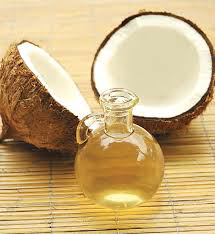
“I read Dr. Teitelbaum’s coconut article in your recent newsletter and she does not recommend cooking with coconut oil unless you have a strong digestive fire. However,WITSFTS-img3.png Dr. Mishra’s article mentions cooking turmeric in coconut oil, so he approves using coconut oil for cooking. I don’t know if I have a strong digestive fire but Nancy Phillips, my ayurvedic practitioner who trained with Dr. Mishra, told me I am pitta/vatta and have too much pitta. I always cook with organic coconut oil (Dr. Bronner’s brand) and add Mum’s ghee after cooking my vegetables. I also add ghee in my mung dahl and lentils and also add some organic red palm oil and organic olive oil on top of my food to get a lot of good fats in my diet since I am underweight. I also eat organic coconut butter (Nutiva brand) and I make my own organic coconut milk by blending finely grated organic coconut in a blender with water. I don’t bother to strain it afterward. I soak organic chia seeds for an hour in the coconut milk and add fruit. I know coconut is very healthy for you so I hope the way I am eating it (cooking, eating coconut butter and coconut milk with soaked chia seeds) is considered appropriate and healthy. Thank you in advance for your advice. Lorraine D.”

Dear Lorraine: being a pitta vata, you should always be on the watch out for your vibrational channels or nadi-s, avoiding anything that disrupts the flow of your vibrational channels. You have high pitta as your SVA expert has determined, and most likely, like the majority of the vata-pitta constitution people out there, you have a “high pitta low agni” situation which generally results from an imbalance in the “burners” in the stomach and in the liver – the pachak agni in the stomach and the 5 burners or bhutagnis in the liver. These burners and their sandhi-s or gaps tend to get challenged in pitta-vata constitutions. As a pitta-vata, your being underweight has as much to do with this dimension as it has to do with your diet, what you are eating. Modern nutritional science has no concept to understand and incorporate this aspect of metabolism into the equation, no concept to bring in the role importance of the sandhi or gap where all metabolism occurs; of pittaor the digestive fuel; or agni or the digestive flame that transforms food matter into digestible packets.
In this context, according to the precepts of my SVA lineage, coconut butter is tooWITSFTS-img4.png muchto digest for a low flame or agni. In high pitta and low agni situations, the flame is low because there is a problem in the gap, or the vibrational burner. So you have to be very careful with dravya-s or food materials such as coconut butter. Even though you may need to consume rich and heavy foods, your pitta-vata constitution may not be able tofully benefit from it. For you, fresh coconut water from mature coconuts is recommended, not the young ones. During the maturation process of the coconut, the coconut water receives the vibration of fire or agni from the sun, so it is lighter on your metabolic system. In addition, coconut oil cooked with turmeric is good for you, because turmeric has the right amount of agni and marut, and it will balance the soma of the coconut oil. Also shredded/grated and cooked coconut is good for you. When you cook coconut with spices and salt, the process of cooking adds agni to the coconut, even though shredded coconut is heavy and contains a lot of soma, it becomes lighter and easier on your digestion after interacting with the spices, heat, and the salt.
As far as chia seeds are concerned, according to the precepts of my lineage and based on my own personal experience, they can disturb the intelligence of the sandhi-s, the gaps in the burners, even though it may have a lot of nutritional components.WITSFTS-img5.png
In general, as a pitta-vata bodytypes, with high pitta low agni situation, make sure you always take care of your gut, and keep your friendly bacteria healthy. In this sense, the SVA coconut probiotic is ideal for you. You may watch Malvika’s YouTube video to learn how to make it.
You will also support your overall weight gain by making and eating the SVA Green Protein recipe. Externally, try to incorporate self-massage with Pitta oil with Magnesium. Use Pitta Masala in your cooking. Drink fresh buttermilk (lassi) if your digestion is able to handle it. Make your lassi with some SVA Rose Petal jam – do this only for lunch. Incorporate the Amla and Tamarind paste into your food and cooking to enhance your protein synthesis and absorption. As a pitta-vata, a gentle meditation twice a day is ideal. Eat in silence. And if you can find the way to take rest 30 minutes after your lunch meals daily, it will help tremendously. In general, take life easy.

Clearer Skin for my 20 year old

“I would like to get some products to support my daughter in college. 20WITSFTS-img6.png years, fair to olive skin. Very active girl. She currently has some bumps under her skin on her forehead, chin and cheeks along hairline. Most of the time they do not come to a head. She is wearing makeup to cover. Please advise. Thank you! Carmela C.”

Dear Carmela: it looks like she is accumulating toxins in the fat tissue. First recommendation for her is to consume only good clean fat (ghee, olive oil, grapeseed oil). Also good salt (Soma Salt), balanced spices like Mum’s Masala, etc. Then for topical use, she can apply the Semal Plus Cream Clay on areas of concern (before shower), leave it on for 5-10 minutes, and then rinse off with warm water, then apply the Semal Plus Lotion and leave it on.

Celebration Nectar and Radiation Therapy?

“Good day, is It safe for my mother whilst receiving low levels Of X-ray Radiation for her eyes, which are protruding with swollen upper eye? Andrew B.”

Dear Andrew, yes it is safe and ok to use the celebration nectar.

Calming Hot Flashes…

“Hi, I wasn’t sure where to send this but I recently received my replacement transermal Vitamin B12 and really love it! It is so much easier to use than the first one. I really appreciate you sending that out to me. Also, I have a question for Vaidya Mishra and wondered if you could get an answer for me or if he could perhaps include it in the next newsletter: I seem to be going into a pre-menopausal condition and go through very uncomfortable phases of hot flashes – I already eat a very pitta pacifying diet as I tendto be quite pitta imbalanced so I don’t eat any spicy or hot foods so I don’t think diet is triggering it. I first had them about a year ago, then they stopped and now they’ve recently started again. Is there a way to calm this down? Thanks! Emily B.”

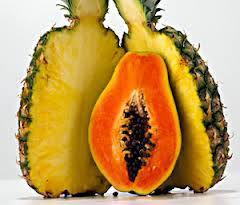
Dear Emily: very happy you are enjoying the newer richer and thicker base of our creams. For your hot flashes, there are many basic pitta-pacifying things you can do,WITSFTS-img7.png such as: never skip or delay meals; always carry some juicy fruits to snack on in case you are delayed in your meals; make sure you go to bed by 9:45pm; before going to sleep, do something soothing for your sadhak pitta, such as reading an uplifting book or listening to gentle uplifting soft music; laugh often; incorporate regular self-abhyanga with Pitta Massage oil with Magnesium; use Pitta Masala; eat more seasonal sweet juicyWITSFTS-img8.png fruits – pineapple and papaya will be particularly good as they are estrogenic, and these fruits can be eaten either with your meal for lunch and dinner or after your meal, since they contain digestive enzymes and will not create ama; add asparagus to your diet for lunch or dinner 3-4 times a week, it is also estrogenic; add coconut in some form or another into your diet (many SVA recipes are available or you can just add ½ to 1 tsp grated coconut into your dahl or vegetables while it is cooking). Last but not least, add 2 drops of Yasad or Zinc Nectar drops, and 2 drops of Flash Freeze Nectar.

Turmeric and Eye Problems?

“I saw Vaidya’s remark not to use turmeric at all if one has liver problem. A Vaidya told me that there is ama in my liver and it is not light or free and this liver problem is affecting my eyes. I have advanced glaucoma and nothing doctors do seems to stop the extensive loss of sight (using surgery and drugs). Please would Vaidya Mishra suggest something that I could use to clean and free the liver in some gentle way as I cannot use the turmeric. My Prakriti is Pitta-Vata with almost no Kapha; I am very Vatta unbalanced always & very thin, with delicate intestines, age 65. I have seen Vaidya Mishra 3 times in the past – some years ago. Thank you for your advice. Warmest wishes from Daf S.”

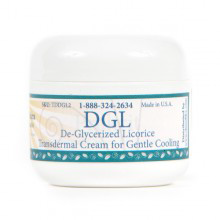
Dear Daf: Stay under the observation of your eye doctor(s) and follow what they say. But at the same time, use pitta pacifying ayurvedic remedies, diet, lifestyle. Coconut will be a great dravya or food matter for you, as well as fresh coconut water. Add some coconut flakes to your meals, as they are cooking. Apply SVA DGL cream onWITSFTS-img9.png your liver area in a clockwise motion (your belly is the clock) at night before sleep. Also, with your middle and ring finger, gently touching, do gentle circular massage of your temples, for 2 minutes, in a clockwise manner (your temple is the clock). Then swipe your eyelids with the same fingers inside out – place the tip of your fingers on the innermost part of your eyes that meets the nasal  bone and gently slowly go out,  in repeated strokes. Last but not least, have 2 tablets of SVA Triphala, crush them, boil in ¼ cup (2oz) water, cool off to room temperature, and then dip a clean cloth (or some cotton balls)  inside to absorb the liquid, lie down and place the cotton balls on your eyes and leave on for 10 minutes and relax, then rinse off with fresh water.”

Turmeric and Liver Disease

“Dear Dr. Mishra, I read with great interest your article on turmeric, especially your caution about the use of turmeric for those with a liver damaged by  disease. My daughter has autoimmune hepatitis (diagnosed two years ago) which has caused some mild liver damage (I believe in her bile ducts). We have consulted with a […] [Vaidya and an MD] and they did recommend including turmeric in her diet, including fresh turmeric root. I’m just wondering if there is anything more to consider about the use of turmeric for those with  a liver damaged by disease. Thank you! Joseph Q. H.”

Dear Joseph: everybody is entitled to their opinion. In my SVA tradition, we tend to be extra careful. If you reside on the east coast, I recommend you go see SVA expertsWITSFTS-im10.png Dr. Beech or Dr. Teitelbaum, as they have unique protocols that may help your daughter with her autoimmune condition. In general, however, you can support your daughter’s overall condition through her diet. Adopt the SVA Green Protein recipe (available on YouTube on my SVA Health Channel and demonstrated by Malvika). Also add coconut probiotic to her daily regimen. Finally, according to me and the SVA lineage, your daughter should not be consuming any turmeric at all, particularly raw turmeric. Raw turmeric, being raw and untreated, is extremely heating for the liver. Traditionally, Ayurveda recommends that turmeric be processed to cool it off and make it safe and edible on a daily basis. But again, basedon their diagnosis and their way of recommending, they think she should have turmeric and raw turmeric root. But we wouldn’t, in the SVA tradition, because one thing we definitely do not want to do in any kind of autoimmune situations is to boost the immune system, this is also why, in modern medicine, in auto-immune conditions, they primarily prescribe immuno- suppressants not immuno-boosters. We believe, in the SVA tradition that we need to slowly try to re-esatablish the intelligence of the immune system. Hope this helps, and again if you can go to see one of those SVA experts, they can tailor an individual protocol for her.

Raw Milk, Yogurt, and Kefir : a Question

Thank you Sally for sending in this question. Vaidya Mishra’s response in italics and red.

“Hello Friends at the Prana-Center, Thank you for all the wonderful knowledge, inspiration and recipes in the newsletters.
I’m hoping you will be able to let me know Vaidya Mishra’s thoughts about the following questions:
1.Is it okay to drink fresh raw organic milk, cow or goat, without boiling it first? Some people say milk should always be boiled, according to Ayurveda.
Yes, according to classical Ayurveda, milk should always be boiled. Shaka Vansiya Ayurveda explains this in terms of Soma, Agni, and Marut. With SVA we understand that milk is a liquid-soma predominant dravya or material, that is: it is soma in liquid form. We know by now that soma is the propertyRMYAKQ-img1 that makes any dravya or  black pepper material heavier so that it will need strong agni or metabolic fire to get transformed and digested, and to allow for the full synthesization of the protein content of the milk in this case. This is why it is better to boil the milk. Boiling the milk infuses the vibration of agni energetically into the milk, so the milk can get easily broken down in the digestive system and metabolized, and its proteins better synthesized. In the ayurvedic tradition milk is further “warmed” with spices such as cardamom pods, cinnamon sticks, black peppercorns. Cardamom enhances the break-down of the protein molecules; black pepper opens the circulatory channels and thus counters the clogging e fect of milk due to its high soma content; cinnamon supports the metabolization of the naturally occurring sugar content in milk. When you boil milk with these spices, RMYAKQ-img2additional interaction happens on the more subtle molecular levels and make the milk lighter and more easily digestible to the body. Otherwise milk can remain in the body undigested or semi-digested and it can create ama or toxic build-up in the form of semi-digested food material. We know that ama is the seed of all physical diseases. There is no disease without ama by ayurvedic  cardamomdefinition. But you may ask: if we have to boil the raw milk, why not just buy pasteurized milk? In Ayurveda, we believe that boiled milk should be consumed within 24 hours, because after 24 hours, vibrational as well as subtle molecular changes occur and the energy of the milk is altered. In Ayurveda, particularly cow’s milk is considered to be a divine but also very delicate dravya or material. I hope that science will be able to discover and prove this point eventually. So the necessity of boiling is not just out of sanitary concern. It has to do with the “alpa-abhishandi” or somewhat heavy and clogging properties of milk. In order to get the most out of your raw milk, you then need to allow it to interact with agni, boil it, and/or add spices to it.

2. Same question re making yogurt: is it okay to use unboiled warm raw milk for this?

We do not recommend to use unboiled raw milk for making yogurt because the yogurt then receives even more earthy energy. Yogurt is also considered “abishandi”, that is clogging to the physical and vibrational channels, because of the earthy nature of the friendly bacteria it contains.RMYAKQ-img3 When milk is pre-boiled and then made into  cinnamon yogurt, it carries some agneya or fiery digestive/transformational energy into the yogurt so the yogurt becomes lighter and more agneya on the digestion and the channels. The friendly bacteria in the milk may die when you boil it, but remember that you are re-infusing more bacterial colonies when you make the yogurt! The idea is that it is ok to sometimes lose something in order to gain something more than what you may have lost. The ultimate goal is for the body not to make ama. How do you know you are making ama? Your tongue gets a white thick coating in the mornings, you feel sluggish after a meal, your stomach area feels blocked and heavy, and you feel you do not digest f od well. You can make ama out of useful good food materials too, if your digestive agni is not in top shape and is not performing well. The ultimate goal is to maintain an ama-free body. The concept of agni and ama is a very big thing in Ayurveda. No other health science has this kind of concept. Everybody’s agni level is different based on age, season, ethnicity, individual body type. This is why we have different recipes for milk and yogurt in Ayurveda.

3. What are Vaidya’s thoughts on live kefir culture? Is it okay to use this as well as normal yogurt starter?

Normal yogurt starter is better. It is more satwic in nature. It has a history in the shastras. Yogurt starter is easier on the colon, it will not  kefir overwhelm it.RMYAKQ-img4 Kefir carries high yeast which may overwhelm the immune system by jump-starting it. If an individual has a sensitive immune system they can experience complications or additional symptoms when ingesting kefir. Also: yogurt and buttermilk are not contraindicated for pregnant women, or different medical conditions, unlike kefir.

4. Also is it good to use the yogurt making system with coconut milk (i.e. water blended with coconut flesh and strained) as well as with coconut water?
   SVA recommends making the coconut yogurt only with the coconut water. Coconut is also considered a heavy fruit, in that it needs proper metabolic fire. When you make yogurt out of its flesh it becomes too heavy for most individuals to be able to consume without making some ama out of it. But just using the coconut water is good. You get the health benefits of the coconut without the clogging properties of the physical coconut flesh.

I look forward very much to your reply. I appreciate that this info may be in a newsletter that I haven’t seen, so please direct me there if so.

With very best wishes

Sally B.”