“Hello, I had a question about probiotic beverages such as kombucha and eating yogurt within the 24 hour period of consuming things like turmeric. What is your stance on kombucha and yogurt? [Some very prominent ayurvedic practitioners in the USA] […] [have] been supportive of both, I’d love to hear your take on it. Thanks again for making such great deodorant and ghee. I’ll be sure to order again soon.”
Kombucha Wonderland: Can we Sip our Way to Perfect Health?
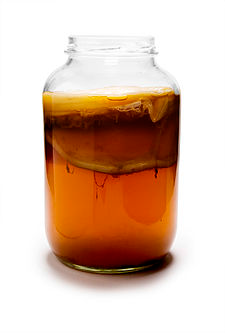 You may not have tried it yet, but you have probably heard of Kombucha (kom-BOO-cha) somewhere somehow because it has taken over our imagination and the market since the early 1990s –Whole Foods Market only recently removed the drink from its shelves because it contains alcohol as a result of the fermentation process. Kombucha tea is also known as Manchurian tea, or Manchurian mushroom; or Kargasok tea; or simply “tea fungus” or “tea mushroom.” It originated in East Asia. It was introduced to Germany at the turn of the century and reached the American continent in the early 1990s when the publisher of “Search for Health”, a bi- monthly magazine in Naples, Fla., touted its virtues.1 But what’s the big hype about anyways?
Seemingly, a one-size-fit-all healing nectar, Kombucha tea has been promoted as a cure-all for a wide range of conditions including aging, anorexia, arthritis, atherosclerosis, cancer, constipation, diabetes, gallbladder disease, gout, hemorrhoids, hair growth and color restoration, headache, hypertension, HIV, immune boosting, indigestion, increased vitality, treatment of alcohol and coffee addictions, and wrinkle reduction. How come? Supporters say that Kombucha tea can boost the immune system and reverse the aging process. Kombucha tea is said to contain antioxidants, compounds that block the action of free radicals (activated oxygen molecules that can damage cells). For people who have cancer, proponents claim the tea can improve the body’s defenses (especially in the early stages of cancer) by detoxifying the body and enhancing the immune system. But how does it work, if at all?
1 Mr. Valente became the American distributor of one of the few books on the subject, “Kombucha: Healthy Beverage and Natural Remedy From the Far East,” by Gunther W. Frank (Wilhelm Ennsthaller, Austria, 1991).
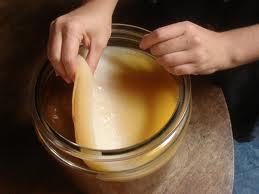 Kombucha tea is made by fermenting sweetened black tea with a culture of yeasts and bacteria called the “Kombucha mushroom” – it is not actually a mushroom, but is called one because of the shape and colorof the sac that forms on top of the tea after it ferments. The white, gelatinous blob of about 12 inches in diameter propagates quickly. It is brewed by placing the fungi in a glass bowl with three quarts of cooled black tea that contain one cup of sugar. It is then covered with cloth and placed in a dark, warm place for a week to 10 days, until it spawns a second disk. The tea is then strained and stored in glass in the refrigerator. The culture contains enough antibiotic to discourage bacteria and its high acid content is quite resistant to invasion by foreign organisms. The tea does not become sufficiently acidic until it has fermented for four or five days. When fermented, the Kombucha creates a sparkling beverage that tastes like hard apple cider.
 Dr.Jeffrey Gates, who studied the medicinal properties of food at Cornell University, has analyzed Kombucha tea and said that the hope it offered for better health should be tempered. The tea, he said, appears to work primarily in the gastrointestinal track and because it is high in certain acids, it may make it easier for the body to absorb vitamin C and certain B complexes. But, he added, “the anti-carcinogenic qualities of Kombucha are not as great as other folk remedies, such as garlic and yogurt.”2 What about adverse side-effects? Mr. Stamets researched the Kombucha for a pharmaceutical company 15 years ago. He found that “the Kombucha is not a mushroom, but several yeasts living symbiotically with several bacteria that produce a powerful antibiotic […] It could be a fabulous addition to drug therapies, […]but we have little idea of what it is, no idea what its side effects are and no doubt that it can become contaminated by spores in the air. You could kill yourself or your friends with a contaminated culture.” 3
Contamination and yet more adverse effects
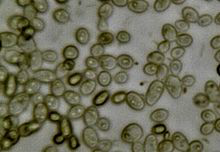
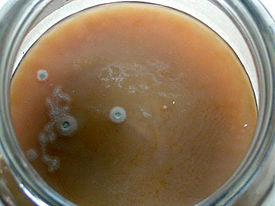 The culture used in Kombucha tea varies, but consists of several species of yeast and bacteria.4 Because there are several types of yeast and bacteria that can grow under distinct conditions, different Kombucha brews may contain different types. Of course, since cultures and preparation methods vary, Kombucha tea may contain contaminants such as molds and fungi, some of which can cause illness. In addition,after the tea is fermented, it is usually highly acidicand contains alcohol, ethyl acetate, acetic acid, and lactate. In April 1995, two women who had been drinking the tea daily for 2 months were hospitalized with severe acidosis — an abnormal increase of acid levels in body fluids. Both had high levels of lactic acid upon hospitalization. One woman died of cardiac arrest 2 days after admission. The second woman’s heart also stopped, but she was stabilized and recovered. The mushrooms used by both women came from the same “parent” mushroom. While no direct link to Kombucha tea was proven in this case, the U.S. Food and Drug Administration (FDA) warned consumers to use caution when making and drinking the tea.5 In 2009, a 22-year-old man was hospitalized with trouble breathing, fever, confusion, and high lactic acid levels within 12 hours after drinking Kombucha tea. He recovered, but his doctor believed that the tea was the cause of his lactic acidosis – a rare but serious and often fatal condition. 6 Here is another case of intoxication. It was a case of hyperthermia, lactic acidosis, and acute renal failure within 15 hours of Kombucha tea ingestion: a 22 year old male, newly diagnosed with HIV, became short of breath and febrile to 103.0F, within twelve hours of Kombucha tea ingestion. He subsequently became combative and confused, requiring sedation and intubation for airway control. Laboratories revealed a lactate of 12.9 mmol/L, and serum creatinine of 2.1 mg/dL. Several case reports exist of serious, and sometimes fatal, hepatic dysfunction and lactic acidosis within close proximity to ingestion.7 While Kombucha tea is considered a healthy elixir, the limited evidence currently available raises considerable concern that it may pose serious health risks as it may be associated with life-threatening lactic acidosis.8 Deaths have been linked with the excessive drinking of the tea as shown. In addition, several experts warn that since home-brewing facilities vary a great deal, the tea could become contaminated with harmful germs. These germs could be especially dangerous to people with HIV, cancer, or other immune problems. Anthrax of the skin has been reported, as has jaundice, a yellowing of the skin and eyes that is usually caused by liver damage. Allergic reactions, possibly to molds in the tea, have also been reported.9
Rigorous scientific evidence for or against kombucha is still slim, especially since the existing studies and article citations refer to (as you can see for example on pubmed.com) studies originating in China or India, and consist of testing done on rats or mice. Human tests have not been conducted. Only a few papers tested effects on human cancer cells in vitro. Some beneficial effects were seen but one study concluded that “Comparable effects and mechanisms in humans remain uncertain, as do health safety issues, because serious health problems and fatalities have been reported and attributed to drinking kombucha.” 10
In short, available scientific evidence neither supports nor claims that Kombucha tea promotes good health or prevents ailments, neither does it discard it potential health benefits, even though several serious side effects as well as occasional deaths have been linked to its consumption.11
- A study conducted by SungHee Kole A, Jnes HD, Christensen R, Gladstein J. Division of Pulmonary/Critical Care Medicine, Department of Pharmacy Services, Cedars-Sinai Medical Center, Los Angeles, CA 90048, USA. (http://www.ncbi.nlm.nih.gov/pubmed/19460826)
- A study conducted by SungHee Kole A, Jnes HD, Christensen R, Gladstein J. Division of Pulmonary/Critical Care Medicine, Department of Pharmacy Services, Cedars-Sinai Medical Center, Los Angeles, CA 90048, USA. (http://www.ncbi.nlm.nih.gov/pubmed/19460826)
- http://www.cancer.org/treatment/treatmentsandsideeffects/complementaryandalternativemedicine/dietandnutrition/kombucha-tea
- (http://www.kevinmd.com/blog/2010/07/kombucha-tea-dangerous-health.html)
So what are we to do?
Here is Vaidya’s response.
With the growing technologies of our times, we are not only experiencing the shrinking of geo-spatial distances, but the cross- contaminationof cultural trends – both desirable and undesirable! Kombucha is not the first “alien” item to have penetrated western culture. Soy, for example, is another one. Such foreign food items initially come with great marketable promises of a long history of healthy and safe usage. While there can be much benefit and much to be learnt from exposure to ancient cultures and civilizations, the ayurvedic shastra‐s always recommend we be careful in adopting anything new too readily. This applies even to protocols and formulas from Ayurveda, as I have always repeated this over the past two decades. Ayurveda’s precepts also need to be adapted to our current psycho-physiological needs. My formula has always been “sutra to science” – taking the age- old knowledge to make sure it works for us now, and is also in line with the scientific findings of our age that confirm their eternal truths.
So when it comes to kombucha, the question really is not whether kombucha is a miracle cure or another misleading fad that can cause more harm than help, but whether we can appreciate how kombucha, along with soy and all the many other herbs and ingredients that have travelled thousands of generations and miles to reach us, are part of a greater more complicated cultural and healing protocol(s) that needs to be considered as well. Once we extract such ingredients from their greater whole, we are sure to create more trouble than help. The consumption of soy thousands of years ago by Asian cultures cannot be used as a confirmation of its total health benefits for us today if we are not taking into account the amounts they consumed back then, the ratio of soy in their diet in relation to other ingredients, the actual physical state of their bodies and the kind of work it was submitted to back then, and the lack of exposure to constant EMF radiation that our bodies have to go through with the use of machines and electrical devices today. The agni or digestive metabolic properties of the human living thousands of years ago cannot be compared to our current one, even though the physiology is the same, the mode of operation is not the same. The modern human body has to deal with many more stressors that were not in existence then.
The scientific world has not yet made its statement about Kombucha, but we can determine what Ayurveda has to say about this new ingredient by studying it through the ayurvedic precepts. The big hype about Kombucha is brought about by its pro- and pre- biotic properties. Now, more than ever, we are becoming aware of the essential necessary healthy properties of a well‐populated gut.
Kombucha is touted to be an espresso shot of friendly bacteria! But let us consider the unwanted attachments that accompany it:
- ) Kombucha is highly acidic as maintaining acidic conditions are favorable for the growth of the kombucha culture. An acidic environment is also important to inhibit the growth of molds and bacteria. The pH of any given kombucha batch range from 2.5 and 4.6. A pH of less than 2.5 makes the drink too acidic for normal human consumption, while a pH greater than 4.6 increases the risk of contamination.12 In addition, many bat chesare made by using vinegar instead of tea as a starter, givingit an additional acidic nature. While this low pH helps the mixture resist contamination by airborne molds or bacterial spores, it also reduces the body’s pH dramatically and can result in greater harm than good. Due to this content of vinegar as well as caffeine (from the black or green tea leaves), the body is not able to buffer this low pH. We have learnt that low pH harbors inflammation in our bodies, and inflammation makes our bodies prone to many imbalances that can result in chronic ill-health.
- ) Fermented food products, such as Kombucha, travel much faster in the body as they are more agneya, carrying the properties they are endowed with and delivering them in deep tissue and organ levels. This is why, in general, results or side-effects are quickly visible. But on the flip side of this, harm is also accomplished much faster – within 12 hours as we saw in the some of the medical cases cited above.
- ) Sugar and Vinegar: refined white sugar and vinegar in general are of course not desirable as we have learnt through SVA. These further lower the body’s pH and immunity. If good quality sugar and vinegar are used, then the issues of the acidity of the mixture still predominates.
12 http://www.organic-kombucha.com/kombucha_and_ph.html
13 Department of Nutrition and Food Science, Utah State University entitled: Survival of Lactobacillus acidophilus and Bifidobacterium bifidum in Ice Cream for Use as a Probiotic Food (http://www.sciencedirect.com/science/article/pii/S0022030292778953)
Having said this, I would recommend taking a safe and effective route, adopt the vedic way of supporting the pre- and pro-biotic bacteria in your physiology, or the “yogini”-s as they are called in Ayurveda. Having a healthy thriving population of yogini-s in your gut is essential not only for the proper absorption of minerals and nutrients from your food, but these yogini-s also help to connect your brain, your mind with your body overall; in addition, they help support and boost your immune system. For more information on this, please refer to our first volume of the SVA news letters where you will find a full article on the topic (available on www.chandika.com).
So the best thing you can do, without running the risk of aggravating pitta or lowering your body’s pH is to eat specific foods. There are many ways to eat your probiotics safely, evenas ice-cream! A study conducted in 1992 by the Western Dairy Foods Research Center13 found that probiotic ice cream is a suitable vehicle for delivering beneficial microorganisms such as L. acidophilus and B. bifidum to consumers. The bacteria can be grown to high numbers in ice cream mix and remain viable during and from storage.
But if ice-cream is not really your thing, then consider good old home- made fresh yogurt. This is, hands down, the best time-tested pro-biotic. We have learnt that in order to maintain a good population of pro-biotic bacteria, we need to have also an optimal level of nourishment in the form of pre-biotic bacteria. For that, you can also do several side-effect free safe things, such as: incorporate okra into your diet; or Taro root. Add some arrowroot powder to your soups – this will act as a thickener but is also primarily an excellent pre-biotic.
If cooking is not your thing, then I have created the Pre-Biotic SVA Nectar drops. Add 2 drops to a room temperature glass of water and have twice a day. See the recipes in this newsletter for more information and detail.

Dear Vaidya,
Thank you for generously sharing your knowledge and wisdom. My family and I are so grateful and have benefited from your consultations and advice for many years now. I have a question about immunization. I’m about to have to another baby and unsure about immunizing him. My first was immunized before 1 year, but I discontinued the immunizations when a flux of info in the late 90s started coming out about the link between immunization and ADD and ADHD were concerning parents. Do these vaccine formulas now contain more harm than good or have our physiologies now changed to a more toxic state that our bodies cannot handle them? What is the SVA perspective on immunization? Should a child or any person receive vaccinations as preventive medicine? In addition to breastfeeding, what SVA protocols can I apply specific to building my baby’s immunity?
Thank you, Evangeline
Hello-
I had been receiving your newsletters and consulted with Marianne Titlebaum about two years ago.
I had great results to a really perplexing problem.
Please add me to your email list again. I changed email addresses a while back and I think my request to change it in your list got lost in the shuffle.
Thanks so much. As usual the above article was very helpful.
Lezley Suleiman
good article. I had to do some keyword digging to find this in the search engines. Kombucha has given me, personally, adverse affects. There are times (very short lived times) that it made me feel good, but mostly bad effects (bloating, stomach cramps, stuffy nose, etc). I think the whole “day time eating” concept is what is most promising and actually works. It makes sense. Life on earth thrives in day light, most things not at night. More life activity during the day, which means digestion works better during the day. I have personally tried so many “fad diets” and they do not work longterm. Ayurveda eating during the day cycles has been the best for me.
Dr. Marianne Teitelbaum has posted a free lecture on her website discussing the subject. You may find it interesting: http://drmteitelbaum.com/online-classes/ – SVA Customer Service Team