Act II, Scene II of Shakespeare’s “Romeo and Juliet”
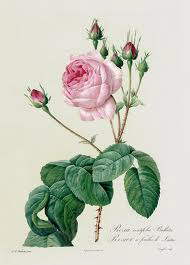 You may remember Juliet’s famous line from Shakespeare’s play. In her monologue, Juliet is trying to reason away the family feud that threatens the budding love between her and Romeo. However, in Ayurveda, unlike what Juliet states, the name of a thing and its actual properties cannot be disassociated without altering the essence of that thing. For example, in Ayurveda, rose is called “taruni,” which means “everyoung.” Its name stands for the youth-promoting benefits and properties it carries: it is good for the emotional heart; pacifying the mind; nurturing the skin; balancing the digestive system; rejuvenating the colon; enhancing metabolism; and it can even be used to promote physical and emotional love… There are hundreds of genera of rose, but one amongst them stands out and carries all the above qualities. It is called “shatpatri” in Ayurveda or known as “Rosa Centifolia” in the west. It is the rose with a hundred (or very many) petals. To better understand how a rose, and particularly, Rosa Centifolia, can have all these benefits all at once, we take a look at its 5 fundamental ayurvedic properties. Every plant, herb, spice, edible item in Ayurveda carries specific pharmacodynamic properties. These are known as the “dravyaguna” – properties or guna-s of that “dravya” or item.
Know your rose from the inside-out
The first property is known as “rasa.” Rasa is the immediate taste that you experience after you put something in your mouth, and it is also the immediate effect that particular taste has on your body. Rose has 3 rasa-s or tastes and effects: bitter, astringent, and sweet. These tastes have different functions and nourish different tissues and pacify doshas. You can read more about this further down.
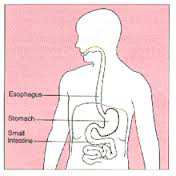 The guna is the second physical property. Rose’s guna is “lagu” which means light, and it is also “snighdha” which means unctuous. This means that when you ingest rose, it behaves like an unctuous but light ingredient in your physiology, lubricating and not clogging any channels or pathways. Then third property is called virya and this is its potency. The rose’s virya is cooling. This means that it acts like a cool ingredient in your body. Imagine the contrast between consuming vinegar, or hard liquor! Compare that hot acidic sensation down your oesophagus to a cool glass of milk. When you consume anything with rose, it cools you up from the inside out. Then there is vipak, which is the post-digestive taste. This means that once you ingest rose petals and they are digested in your stomach and move on to your colon, the bitter and astringent properties it carries are transformed to leave a sweet effect. It is as if you had eaten something sweet. Sweet vipak is soothing, cooling, balancing. It is a highly desirable vipak or property. As the digestive and metabolic process progresses, things become more and more subtle. So the last and most important property is vibrational, meaning it is not possible to measure or analyze under a microscope. It is Ayurveda’s gift to us that it teaches us how to categorize the prabhava of hundreds of thousands of items found under the sun.
The prabhava of rose is “hridya” – this means it moblilizes and supplies prana or the cosmic energy we thrive on to the heart area. Consuming rose redirects more prana to the heart area, balancing and recharging and rejuvenating it.
In this sense, this is what a rose does to your physiology specifically: because it is sweet and unctuous it pacifies Vata dosha – as you know the sweet rasa or taste pacifies vata. The rose’s snigdha or unctuous property also balances vata that tends to be dry. Any dravya or item that has the unctuous lubricating guna or property is pacifying to vata. Then due to its cooling virya or potency, as well as bitter and astringent taste, it is pacifying for Pitta dosha. In its essence, rose is Pitta and Vata pacifying. These properties have a nourishing effect on the nervous system, because rose is known to be a medhya. That is, it enhances dhi dritti smriti. These are the 3 primary functions of the brain for the actions of registering, storing and recalling knowledge and information. When they are operating in a balanced and coordinated manner, the brain is in a stress-free state of bliss.
Another unique property rose has is called “Som Nasya Janana.” This means that rose creates good coordination between the mind and Satwa, the light of the soul, so it’s an instant bliss generator!
What effect does rose have on the digestive system?
According to Ayurveda, rose is balakarika, meaning it strengthens the stomach, intestine and liver organ systems. Bala means strength. In addition,due to its deepana properties, it balances appetite. It is also pachana – it enhances overall metabolism. Another of its properties is anulomana: it helps pacify apana vata by making sure the downward movement of apana is maintained. However, it is not a laxative, unless you consume excessively large quantities of rose. When consumed in small but regular quantities, it enhances absorption of nutrients.
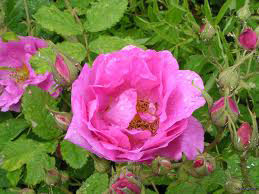 Consuming rose petal products is particularly beneficial when people have high pitta and high vata imbalances. These imbalances are also usually associated with low agni or low metabolic fire in the stomach and tissues. Low agni results in toxic build-up, weight gain, body aches and pains, etc. Eating rose will pacify these two doshas and help reset the physiology on its way to blissful balance.
Rose pacifies the heat in the blood, and thus keeps imbalances in the skin from erupting. Other specific ailments that Rose has been known to help with are amenorrhea (absence of menstrual flow), inflamed eyes, dizziness,headache due to Pitta aggravation, sore throat, enlarged tonsils, nervousness, grief, dullness of the skin and acne caused by Pitta imbalances. There is also another condition where excess pitta gets stuck in the blood tissue, and rose is the ideal remedy for this. Either ingested orally or applied transdermally. Rose is known to help individuals who experience unidentified burning sensations in their body, burning sensations that do not tie in to a diagnosed medical condition. Scientific research on this aspect is not in yet, but Ayurveda promotes the use of rose in such conditions.
And even more balancing properties…
As if all this was not enough, Rose is also considered a wonderful remedy for the physical circulatory system. It is a cardio-tonic, or hridya.
 Rose is also known for its vajikarna properties. We find a lot of recipes in Ayurveda that use Rose to enhance physical and sensual love between partners.Yet one of the most important uses of rose is for the skin. When taken internally, it purifies the sweat of hot acidic toxins that cause harm on the surface of the skin when a person sweats. Regular transdermal use of rose either in poultices or cream formulas cleans the sweat externally, by neutralizing the pH of the sweat, so that when it is released through the skin, it does not cause irritation.
So ultimately rose petals are pitta and vata pacifying. How about the kapha dosha? Does it aggravate this dosha? It depends on the preparation. That is why Vaidya has made a special SVA formula, his Rose Petal Preserve is prepared in such a way as to become almost all Vata, Pitta, and Kapha pacifying. Another option is also to add some freshly ground black pepper when consuming the preserve to make sure it will not aggravate Kapha dosha.
Gulkand
Making preserve out of rose petals is a very old tradition in many cultures, in India, but in the Middle East as well as Europe. However, not all recipes and preserves will have a balancing effect. In India, Rose Preserve is very popular and is called: Gulkand. It is readily available everywhere. But it is usually made with white sugar – we know that the consumption of white sugar depletes our bodies of minerals and lowers our pH, so you want to avoid that. Also, many recipes do not use Rosa Centifolia. Other varities of rose have different properties, so you want to be careful when you are purchasing a rose preserve that it was actually made with Rosa Centifolia.
In addition, many times, the recipes use vinegar, or citric acid, as well as synthetic scent or aroma, or color, to enhance the look and flavor. These are all carcinogenic ingredients you want to steer clear of.
Sometimes preserves sitting on shelves get oxidized or fermented if the formula is not balanced enough. You should watch out. Vaidya Mishra has carefully formulated his SVA Rose Petal Preserve according to his ancient ayurvedic family precepts. He uses natural ascorbic acid balances the sugar molecules. In addition, he uses pectine which microencapsulates the sugar molecules, so that they do not rush into your blood stream and give you a sugar high. Pectine also modulates the sugar molecules to give sustained release into the body. He has added natural essence of Rose Absolute, for enhanced rose properties in addition to organic rose bud petals. Fall in love once more, with and through Vaidya’s SVA preserve jars of pure rose bliss!

