
 This article is authored by Dr. Barbara Davis, MD. Dr Davis has an active practice in Fishers Indiana where she brings together allopathy and ayurvedic knowledge, specifically from Vaidya Mishra’s SV tradition, to address contemporary health issues and concerns. Her practice is called “Mind in Light/Body in Balance, LLC”. For more information or to setup an appointment, contact her clinic at (317)842-5771.
Vaidya Mishra has asked me to outline the benefits of four Ayurvedic herbs that individually and collectively nurture the male physiology: ashwagandha, gokshura, mucuna, and deer antler. Herbs that support the male machine need to support certain energetic principles while balancing those energies with others that are complementary. Students of Vaidya Mishra’s Shaka Vansiya Ayurveda (SVA) are familiar with these, but let’s briefly review.
Male physiologies generally have a lot of agni, the heating, activating, energizing, and accomplishing energy in nature. Agni is complemented by soma and marut. Soma is the stabilizing, lubricating, nurturing, cooling, and connecting energy of nature, transformed into kapha and ojas in the physiology. Ojas is the purest and semi-vibrational form of biological intelligence. Marut is the circulating, distributing, managing, and regulating energy of nature. Together, agni, soma, and marut operate as the three sub-energies of prana, the life-supplying vibrational substrate of the material universe.
You’re probably thinking, “Dr. Davis, that’s a lot to absorb in a single paragraph.” True, but we will use these abstract concepts as we now shift to the concrete, beginning with the most common of the aforementioned herbs, known in Sanskrit as ashwagandha and Latin as Withania somnifera.
Ashwagandha
“Ashwagandha” is typically translated as “having the smell (gandha) of a horse (ashwa),” no doubt appealing more to lovers of all things equine than to the rest of us. Vaidya Mishra, as a Sanskrit scholar, takes a fresh look at the etymology of the word by noting that “gandha” also means “character.” In the latter sense, ashwagandha gives us certain characteristics of a stallion, in particular its stamina, endurance, and ability to ramp up the stress it bears to meet the need of the moment. Think of Secretariat, the most famous racehorse ever, and how many of his own records he broke. If you seek your next level of best mentally, physically, and sexually, especially if you are male, ashwagandha could be the right herb for you.
From the standpoint of Ayurveda, ashwagandha is pacifying to vata and kapha, indicating that it is to some degree heating. Perhaps its key benefits physiologically are as a rasayana or adaptogen, a substance that improves the body’s ability to tolerate stress and adapt to new situations, and as a so-called aphrodisiac. Ayurvedic aphrodisiacs, known as vajikarna herbs, increase the strength of the sexual organs and the reproductive tissues. Rather than increasing sexual desire, as some might assume, they give the ability to have fulfilling sexual relations and to be more fertile, though they can also raise libido that has fallen to unhealthy levels. Reproductive tissue is known in Sanskrit as shukra. Ashwagandha creates lots of both the subtle and gross forms of shukra. The subtle form, full of soma, converts to ojas in a healthy physiology. In men, the gross form is semen. Vaidya Mishra’s ashwagandha Herbal Memory Nectar drops and transdermal cream focus mainly on enhancing the subtle form of shukra and moving the herb past the blood-brain barrier.
The six other tissue types defined by Ayurveda are also strengthened and balanced by ashwagandha, most prominently majja, the tissue type related to bone marrow and nerves. Beyond use as an adaptogen or aphrodisiac, indications for ashwagandha include inflammation,1 autoimmune problems (especially vitiligo),2 and tissue emaciation,3 the most extreme form of which is tuberculosis. Because ashwagandha can provoke pitta, contraindications include peptic ulcer, acid stomach, and high blood pressure caused by excess pitta. Authentic Ayurvedic preparations containing ashwagandha have balancing factors or processing to prevent undesirable side effects. It is very important not to use ashwagandha indiscriminately, without proper understanding of its energetics.
Animal research studies point toward future clinical applications such as:
- radiosensitization (for cancer treatment)4
- anti-tumor5
- anti-lipid peroxidization6
- cardioprotective7
- nootropic (“smart” drugs)8
- Parkinson’s9
- anti-dementia10
Gokshura
“Gokshura,” the Sanskrit name for Tribulus terrestris, translates as “having the shape of a cow hoof.” In some respects, gokshura has related nourishing benefits to ashwagandha and shatavari (a rasayana for women). In fact, men’s rejuvenative formulations commonly contain gokshura and ashwagandha, along with mucuna, which we’ll discuss next. Women’s rejuvenative formulations can contain gokshura as well, but in combination with other herbs more appropriate to female physiologies. Although not technically a vajikarna herb itself, it is useful as a component of a vajikarna formulation in that it increases both the subtle and gross forms of shukra, while also building all the other tissues. In men, this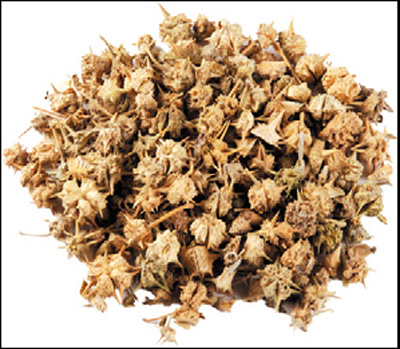 promotes the production of semen as well as ojas.
Apart from its physical value, gokshura is a satvic herb. Satva is the principle in nature of purity, expansion, and evolution; it is the light (consciousness) of the soul, radiating into and enlightening the mind. Vaidya Mishra’s SVA tradition recognizes the primary importance of satva for those on a spiritual path (which is really everyone, whether they yet know it or not). Gokshura brings the light of the soul into the mind. It is also full of soma. Nature has given this herb an unusual property of having the cooling quality of soma alongside the ability to increase the body’s transformative “flames,” ensuring that the soma gets used by the tissues. These qualities help bring balance to the qualities of both ashwagandha and the agni-dominated male physiology when the herbs are used in tandem.
Animal studies indicate gokshura increases testosterone,11 though to date this has not been demonstrated in human males. Nevertheless, Ayurvedic tradition holds that it does increase physical and sexual stamina. Gokshura is thought to support the intelligence of the urinary bladder and of the whole genitourinary tract. Individuals prone toward renal stones can be helped by gokshura, so long as their diet is correct (especially avoiding the nightshade family). In general, gokshura is a great friend to apana vata, the downward, eliminative force in the body, due to its generous helping of soma. The soma restores the dryness caused by acidic toxins in the elimination organs. Constipation, menstrual problems, prostate issues, hemorrhoids, bladder infections, and slow urination all are symptoms of imbalanced apana vata.
Ayurvedic texts tell us that gokshura gives strength to the lungs and blood and is helpful in chronic cough and breathing problems. Also, the heart needs gokshura’s ability to prevent harmful toxins residing in the urinary system from traveling back to it and causing cardiac imbalances. Men are more prone to heart disease, so this is yet another reason for them to use gokshura.
Research studies of gokshura include its role in:
- diabetes mellitus12
- antihypertensive13
- diuretic14
- BPH15
- anti-inflammatory16
- adaptogenic17
Mucuna
This herb is known in Sanskrit as kapikacchu and atmagupta. The Latin name is Mucuna pruriens, from which the common name comes. It is also called cowitch and cowage. “Pruriens” comes from the Latin “prurire,” to itch. This refers to mucuna’s itch-provoking pod barbs. Occasionally, that which superficially annoys has a deeper value. This annual climbing shrub provides one of the best rasayanas for the reproductive system.
Mucuna is best known in Western science as containing high concentrations of L-dopa, a precursor of the neurotransmitter dopamine and the gold standard in the treatment of Parkinson’s. Ayurveda has long known that mucuna is an effective treatment for Parkinson’s, and modern science can specify why. A small clinical trial in 2004 indicated that mucuna possibly offers a superior benefit to Parkinson’s patients than L-dopa.18 Most notably, primate studies show that mucuna does not induce involuntary movements, compared to conventional medications.19 Despite these encouraging findings, Parkinson’s patients are not advised to use mucuna without the supervision of a qualified medical practitioner. Patients should add SVA protocols—including diet, lifestyle, and other herbal support—as a foundation for success with this herb.
The other primary use of mucuna, as mentioned, is maintenance of reproductive vitality. In this respect, mucuna is often combined with ashwagandha, shatavari, and gokshura. Animal studies and long-term traditional use confirm mucuna’s powerful effects of normalizing sexual dysfunction and erectile problems20 and reversing oxidative stress causing reduced sperm count, motility, and viability.21 Other areas of study include:
- diabetes22
- anti-tumor23
- metal chelation24
Deer Antler
The first known use of deer antler as a medicine comes from China. A 2000-year-old Chinese scroll documents 52 diseases responding to it.25 The growing bone and cartilage that develop into deer antlers lie in an unusual zone of biological activity. In general, mammals cannot regenerate complete bodily appendages. Apparently, deer somehow use a stem-cell-based process to regenerate antlers, a mechanism distinct from limb regeneration in amphibians. Despite their enormous growth rate, antlers resist malignant transformation, and this makes them of interest to cancer research.
Traditional uses of deer antler preparations include:
- high blood pressure
- increasing hemoglobin levels
- recuperation from exertion
- glandular health
- inflammatory arthritis
- erectile dysfunction
- menstrual disorders
- enlarged prostate
- raising testosterone levels
Clearly, deer antler has related benefits to ashwagandha, gokshura, and mucuna. It can help both men and women, in that it contains both androgens and estrogens. It also contains enzymes, minerals, vitamins, anti-inflammatory prostaglandins, and IGF-1 (insulin-like growth factor).
A review of the scientific literature indicates that this complex substance is powerful and poorly understood and must be used with caution. Vaidya Mishra’s bhasma (calcined ash) of deer antler reduces it to a more gentle, non-toxic form that can be used safely in a balanced formula, as part of comprehensively applied SVA.
Conclusion
The outlined herbs are a pharmacopeia unto themselves and deserve much more coverage than the present overview allows. Nonetheless, this quick survey makes an adequate case that combined use of the herbs can provide the male physiology with a significant boost of energy and sexual vigor. Men desiring peak performance in the bedroom and boardroom have an important ally in Ayurvedic herbs coming from antiquity.
- Mishra, L.C., Betsy B. Singh, and Simon Dagenais. “Scientific Basis for the Therapeutic Use of Withania somnifera (Ashwagandha).” Alternative Medicine Review 5 (2000): 334.
- Venkata Subbaiah, K.P., and N. Savithramma. “Antimicrobial Efficacy of Silver Nanoparticles Synthesized from Withania somnifera—An Important Ethnomedicinal Herb of Kurnool District, Andhra Pradesh, India.” Int. J. Pharm. Sci. Rev. Res. 22(1), Sep–Oct 2013; no 40: 216–222.
- Nagavalli, D., T. Vetrichelvan, N. Gayathri, P. Poongothai, K.P. Sivasankari, and S.V. Vadamalai. “Validation of Ashwagandha Churnam.” Ancient Science of Life 20, no. 4 (2001): 86.
- Devi, P. Uma. “Withania somnifera Dunal (Ashwagandha): Potential Plant Source of a Promising Drug for Cancer Chemotherapy and Radiosensitization.” Indian Journal of Experimental Biology 34, no. 10 (1996): 927.
- Mishra et al., “Scientific Basis” 335.
- Ibid., 339.
- Mohanty, I., D.S. Arya, A. Dinda, K.K. Talwar, S. Joshi, and S.K. Gupta (2004). “Mechanisms of Cardioprotective Effect of Withania somnifera in Experimentally Induced Myocardial Infarction.” Basic & Clinical Pharmacology & Toxicology, 94: 184–190.
- Tohda, C., K. Komatsu, and T. Kuboyama. “Scientific Basis for the Anti-Dementia Drugs of Constituents from Ashwagandha (Withania somnifera) (Chemical & Pharmacological study).” (2005) http://hdl.handle.net/10110/2316.
- RajaSankar, S., T. Manivasagam, and S. Surendran. “Ashwagandha Leaf Extract: a Potential Agent in Treating Oxidative Damage and Physiological Abnormalities Seen in a Mouse Model of Parkinson’s Disease.” Neuroscience letters 454, no. 1 (2009): 11–15.
- Tohda et al., “Anti-Dementia Drugs.”
- Hussain, A.A., A.A. Mohammed, H.H. Ibrahim, and A.H. Abbas. “Study the Biological Activities of Tribulus terrestris extracts.” World Academy of Science, Engineering and Technology 57 (2009): 433–435.
- Amin, A.M.R., M. Lotfy, M. Shafiullah, and E. Adeghate. “The Protective Effect of Tribulus terrestris in Diabetes.” Annals of the New York Academy of Sciences 1084, no. 1 (2006): 391-401.
- Sharifi, A.M., R. Darabi, and N. Akbarloo. “Study of Antihypertensive Mechanism of Tribulus terrestris in 2K1C Hypertensive Rats: Role of Tissue ACE activity.” Life Sciences 73, no. 23 (2003): 2963–2971.
- Phillips, O.A., K.T. Mathew, and M.A. Oriowo. “Antihypertensive and Vasodilator Effects of Methanolic and Aqueous Extracts of Tribulus terrestris in Rats.” Journal of Ethnopharmacology 104, no. 3 (2006): 351–355.
- Arora, R.P., R.L. Nayak, V. Malhotra, N.K. Mohanty, and S.K. Kulkarni. “Role of Herbal Drugs in the Management of Benign Prostatic Hyperplasia: Clinical Trial to Evaluate the Efficacy and Safety of Himplasia.” Medicine Update 11 (2003): 55-8.
- Kamboj, P., M. Aggarwal, S. Puri, and S. K. Singla. “Effect of Aqueous Extract of Tribulus terrestris on Oxalate- Induced Oxidative Stress in Rats.” Indian Journal of Nephrology 21, no. 3 (2011): 154.
- Shivakumar, H., T. Javed, T. Prakash, R. Nagendra Rao, B.H.M. Jayakumar Swamy, and A.V. Goud. “Adaptogenic Activity of Ethanolic Extract of Tribulus terrestris L.” Journal of Natural Remedies 6, no. 1 (2006): 87–95.
- Katzenschlager, R., A. Evans, A. Manson, P.N. Patsalos, N. Ratnaraj, H. Watt, L. Timmermann, R. Van der Giessen, and A.J. Lees. “Mucuna pruriens in Parkinson’s Disease: a Double Blind Clinical and Pharmacological Study.” Journal of Neurology, Neurosurgery & Psychiatry 75, no. 12 (2004): 1672–1677.
- Lieu, C.A., K. Venkiteswaran, T.P. Gilmour, A.N. Rao, A.C. Petticoffer, E.V. Gilbert, M. Deogaonkar, B.V. Manyam, and T. Subramanian. “The Antiparkinsonian and Antidyskinetic Mechanisms of Mucuna pruriens in the MPTP-Treated Nonhuman Primate.” Evidence-Based Complementary and Alternative Medicine 2012 (2012).
- Suresh, S., and S. Prakash. “Effect of Mucuna pruriens (Linn.) on Sexual Behavior and Sperm Parameters in Streptozotocin-Induced Diabetic Male Rat.” The Journal of Sexual Medicine 9, no. 12 (2012): 3066–3078.
- Suresh, S., E. Prithiviraj, and S. Prakash. “Effect of Mucuna pruriens on Oxidative Stress Mediated Damage in Aged Rat Sperm.” International Journal of Andrology 33, no. 1 (2010): 22–32.
- Majekodunmi, S.O., A.A. Oyagbemi, S. Umukoro, and O.A. Odeku. “Evaluation of the Anti–Diabetic Properties of Mucuna pruriens seed extract.” Asian Pacific Journal of Tropical Medicine 4, no. 8 (2011): 632–636.
- Rajeshwar, Y., M. Gupta, and U. K. Mazumder. “Antitumor Activity and in vivo Antioxidant Status of Mucuna pruriens (Fabaceae) Seeds against Ehrlich Ascites Carcinoma in Swiss Albino Mice.” Iranian Journal of Pharmacology and Therapeutics 4, no. 1 (2005): 46–53.
- Dhanasekaran, M., B. Tharakan, and B.V. Manyam. “Antiparkinson Drug—Mucuna pruriens Shows Antioxidant and Metal Chelating Activity.” Phytotherapy Research 22, no. 1 (2008): 6–11.
- www.lef.org/magazine/articles/velvet.htm

Dear Dr Davis,
So it is save and beneficial to combine ashwagandha, munuca pruriens and tribulus terresstris?
I understood its a really great mix for the mind, the body energy and lowering bloodpressure, right?
Thanks for answering this question….