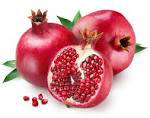
 There is a very famous saying in India: “ek anar saw bimar!” which translates into: “1 pomegranate for a100 diseases.” In indian culture, the pomegranate fruit has been prized as a balancing tridoshic healthy fruit since times immemorial. Bhav Prakash says:
“Pomegranate tastes astringent, is mild to drink and increases intellect and strength.”
The sweet, not sour, variety is particularly in high demand – the sour variety can cause minor pitta dosha aggravation, even though it can still be beneficial as the sutra below indicates:
This verse says: “some pomegranates taste a bit sour, hence they increase appetite and taste, causing some pitta dosha aggravation. However, even then, they are beneficial for rheumatic and cough affected persons.”
In general, the pomegranate fruit is known to have a very unique combination of various healing and balancing properties that rarely occur together, as the sutra also indicates:
“Pomegranate tastes sweet in the beginning, leaving a slight astringent taste at the end. It is tridoshic (balances all three humors of body-vata, pitta and kapha); quenches thirst; helps reduce “fire” in the abdomen; and eliminates fever. It also gives strength to the heart and helps cure ailments of the throat; it removes bad breath; it cools and hydrates; nurtures the reproductive tissue; and gives the body a general sense of lightness [because it enhances circulation].” These are just a few of the pomegranate’s many healing properties; however, it is probably most prized in the SVA lineage for its “grahi prabhava.” Remember that “prabhava” means the ultimate, most subtle, vibrational effect any food item has on the physiology, and “grahi” means absorption. A “dravya” or food item with a “grahi prabhava” means it will help you absorb and get the most out of any food you are consuming. In general, “grahi” or absorbing fruits or  herbs tend to carry warm or hot properties – because you need more “agni” or metabolic fire to absorb more. So, in general, a food that has a higher index of “grahi prabhava” will be more “agneya” or “fiery,” ingeneral, by definition. When a food item is more “agneya,” it means it can increase “pachak agni” (digestive fire), the “bhutagni” (5 metabolic/digestive fires of the liver), or even the “bhrajak agni” (metabolic principle of the skin). But unlike what we would expect, pomegranate is “grahi” yet cooling at the same time. In this sense, it is a great fruit to be consumed by “high pitta low agni” individuals – that is individuals who have high stomach acidity but low digestive enzymes and metabolism.
As a rule, the pomegranate fruit pacifies and balances “pachak pitta” (stomach metabolism), “ranjak pitta” (the heat in the blood), “alochak pitta” (the fire in the eyes), “bhrajak pitta” (the metabolic functions in the skin), and last but not least, “sadhak pitta” or the pitta that manages the emotional heart. All in all, it is a great balancing remedy for all 5 pittas, and high pitta individuals. If we delve a little further, we see that Ayurveda discusses the benefits of pomegranates beyond their physical, nutritional, and dietary content details. This is what goes on in your body, ayurvedically speaking, after you consume pomegranates.
Due to its non-heating “grahi prabhava” or after-effect, particularly in the colon, pomegranate prevents a person from making “ama” (toxins) in the “rasa dhatu” or the clear part of plasma – the first tissue that gets formed after you eat food. Ama in the rasa dhatu  clogs the lymphatic system. Many individuals’ problems lie right here, in that they make toxins of their food, no matter how healthy the food they are consuming, because they just don’t have enough “rasa dhatu agni.” And we know by now that “rasa dhatu” is the raw material for all ensuing “dhatu”-s or tissues in the body. So, in this sense, if “rasa dhatu” produces zero or no “ama” or toxic build-up, then we will not have toxins or “ama” or “amavisha” build-‐up in “rakta dhatu” (blood tissue) either. “Rakta” or the blood carries a lot of active “pranic” energy, so when it is free from toxins, then organs such as the lungs and kidneys also receive ama-free or amavisha-free healthy blood. In this sense, if an individual is experiencing some issues in their lungs for example, pomegranate is of great help as it supports the flow of clean healthy blood to the lungs by keeping “rasa dhatu” free from toxins.
But there’s more: when you consume pomegranate and it helps burn down the ama from your rasa dhatu, and helps produce better cleaner blood for rakta dhatu, then the heart, as well as the entire cardiovascular system, also receive fully pranic fresh blood and get nourished. Then, ama or toxin-free micro-circulatory channels (srota-s) enhance coordination between heart and mind. Pomegranate, overall, enhances oxygenation to the brain and the body, enhancing circulation of nutrients, energy, heat, and more. Scientific research also confirms what ayurvedic knowledge claims, as it acknowledges that pomegranates are good for heart health and the mind.
SVA practitioners know to use pomegranate in many forms and ways (chutney, juice, cooked in the meal) to help support “apana agni” or the digestive metabolic fire in the colon area, to enhance absorption of nutrients. Pomegranates come back into season at the end of summer beginning of Fall, when pitta may still be high in your physiology from the summer heat, causing some Vata disturbances that naturally occur due to the cooler temperatures. Pomegranate will help keep Vata in balance, by cooling off the excess heat in your body, and in any of your pitta sub-doshas. Make sure to consume some pomegranate in your daily diet seasonally, as Mother Nature makes this superfood available to us just at the right time!
Contraindication:
If you tend to have slower bowel movement, or tend to be constipated, you may want to limit your consumption of pomegranate, or replace it with amla berry – SVA Wild Amla, or Amalaki Rasayana, or Nectar drops, or Tamarind and Amla preserve, etc. As pomegranate enhances absorption, it may constipate an individual who already has that tendency.

thank you for the excellent knowledge , what amount of pomegranate juice could we consume daily for those of us who tolerate it well?
Dear Sir,
I am having Bowel sounds especially after lunch. The sound may be some time heard from outside. Now I am drinking Pomegranate juice just after every meal and the sound is greatly reduced. Thanks for your article. Is it any permanent solution for this problem?, since problem comes again if I am not drinking Pomegranate juice after meal.
Thanks and Regards,
S. Palanivel.
– S. Anderson:
– I recommend:
– 4 oz. of pomegranate juice
– 4 oz. of lukewarm water
– Sip this along with/during lunch.
Thank u for the useful info, I am with low Agni and high pitta I am already getting the benefits of pomegranate with practical results. Now I know the Ayurveda background.
I have read somewhere recently that the seeds of the pomegranate are not to be chewed. Would you be able to shed some light on if that is a valid instruction? Thanks!
Can i drink pomegranate juice in evening or its recommended to have in the morning on empty stomach.
I suffer from hyper acidity ….. I drink 2 glass of pomegranate juice a day is that ok to continue ?
i am suffering from Gastritis … i drink pomegranate juice 2 times a day is it safe to drink pomegranate juice or have this fruit even though its sweet and sour ?
Please consider scheduling a consultation with Dr. Marianne Teitelbaum: http://drmteitelbaum.com – SVA Customer Service Team
This article may be of interest to you: https://www.svayurveda.com/4662/ – SVA Customer Service Team